Archive for the ‘wardrobe planning’ category

Some sources suggesting basic capsules

March 2, 2013

Having at last made my final Index page 5 which lists posts on co-ordinates and capsules, here are some other capsules which could be the starting point for a basic wardrobe.

There must be thousands of attractive inspiring outfits on the web. Apart from all the style blogs, Polyvore is set up to devise them, and there are multiple Pinterest pages.

A capsule is more than an outfit – a small group of co-ordinated clothes which can be interchanged to make several outfits.
Perhaps (2 tops, 2 bottoms) to make 4 outfits.
Or (jacket, shirt, 2 tees, pants, jeans) which together make 12 outfits to cover many situations.

Here’s my post on basic capsule options : building your wardrobe in small groups. Start with one capsule and simply add another similar.

There’s so much advice available on capsules and wardrobes, I’m amazed how many people aren’t aware of the idea 😀

Judith Rasband’s college textbook Wardrobe Strategies for Women bases wardrobe building on capsules.

Once you set up the basic pieces, every time you add a co-ordinating item it can double the number of possible outfits. See my post on the power of the boring.

There’s a discussion on minimalist wardrobes at You Look Fab.

Project 333 allows a free choice of what to include in your wardrobe, but to a limit of 33 items including : clothing, accessories, jewellery, outerwear and shoes. As many wardrobe planners suggest a basic group of 5 – 12 garments, that’s quite a generous allowance really 😀

If you find it easier to take inspiration from specific capsules or to react against them, rather than devising your own starting point, here are some of the many possibilities.

Some are specific enough to show a particular style. Some are just numbers of garments. Though even numbers have style implications. Most for example include 0 or 1 dress – no use if you love dresses.

Some of these groups just count clothes, some count both clothes and accessories. If you’re allowed infinite numbers of accessories, you can make infinite numbers of outfits with very few clothes, see the Uniform Project.

– – –

Here’s an 8-item weekend travel capsule consisting of 4 garments, 4 accessories.

Or here’s a group of 6 garments – jacket, 3 tops, skirt, choice of 2 pants : The Kit (click on the photo for more detail about each style).

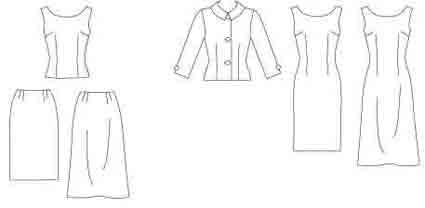
In style contrast, Perfectly Packed has a classic business wardrobe of 8 garments, which can be copied easily using two wardrobe patterns, see my post on classic style.

Tim Gunn’s 10 essential elements
His 10 items are clothes only, add accessories.
For example variants of this, see the middle of my post on your personal wardrobe plan.
And Imogen Lamport’s thoughts on this list and her own version.

Imogen has several suggested capsules for different lifestyles, mostly about a dozen items. Here’s her post on a capsule wardrobe of 12 items. And here’s her post on combining colours and combining prints, very ‘this season’ co-ordination.

Stylist Angie Cox also has a few posts on capsules at YouLookFab, and now has a section called Ensembles. (She uses the word ‘outfit’ for groups of clothes on a specific person.)

Elizabeth (ejvc) suggests a 12-item group, and prices it (about $225) for sewing. If you want natural fabrics, you need to use just one pattern magazine, and mainly black fabric, to get the cost that low. Much cheaper if you’re comfortable in polyester. I would probably use a wardrobe pattern book (see Index page 3), about twice the price of a pattern magazine.

This list from the Nate Berkus Show
has 12 basic items including accessories, plus 8 add-ons : 20 in all.

Wardrobe Oxygen list updated
23 items including underwear and accessories.
I still disagree with nearly very word of this, see my post, but many people working in a very classic environment love it.

Nancy Nix-Rice builds up from 12 basic garments to 23 garments in all, plus suggestions for minimum accessories. She claims to get nearly 100 different outfits from her 12 garments. See Index page 4 for my posts on her scheme, with links to her lessons, and suggested patterns.

Seasonal 6PACs : 24 garments in all, organised in 4 seasonal groups of 6. Here’s a list of relevant posts from ejvc, who started the idea. There’s always a sewalong for the current season at Stitcher’s Guild.

Oprah Winfrey’s dream closet checklist
32 items including shoes.
(Useful tips there too on clothes that flatter different body shapes.)

Many of Janice’s posts at The Vivienne Files are suggestions for capsules, showing the different outfit combinations you can make. And most of her other posts show how to take a single garment or outfit and make many different looks by using accessories.

And here’s a whole pinterest page of capsule suggestions.

For real-life inspiration, see :
Sewing With A Plan 2013
Sewing With A Plan 2012

– – –

What about some patterns ? Most of the capsules don’t suggest specific styles. So here are my current personal easy sewing ‘Key 3’ patterns. Sewing Workshop Hudson top and pants, Indygo Junction Origami wrap.

”swhudson”
”ijorigami”

Add intermediate sewing skills, and make the Sewing Workshop Tribeca shirt and Indygo Junction Silhouette vest (close the vest up to the neck). My current ‘Vital 5’. In quality fabrics for Relaxed Luxe style.

”tribeacasilhouette”

Very different in spirit from many wardrobe plans. My needs are most like the Sewing Workshop wardrobe, see my post on Linda Lee’s layering wardrobe.

– – –

I groaned recently about some wardrobe styling advice which suggested what were supposed to be different style capsules, but were actually all variants of blazer, knit top, jeans. As I don’t wear any of those. I’m glad I’ve done all the work on identifying my own style and wardrobe needs, so I can just move on from unhelpful advice. People who love dresses probably feel equally ignored by most wardrobe suggestions.

If your personal style is ‘modern classic’ and you feel happy in blazer, tee, jeans, then good luck to you. Prefer different types of top, bottom, layer, or dresses ? Best Wishes to all the people who have to find their own capsule scheme.

Is it because I don’t match any of the simple advice on fit, colouring, style, body shape, that my blog is helpful 😀

I think most wardrobe lists need to be adapted to your own personal style, colouring, body shape, lifestyle.
(All that black and classic shapes – aargh. . .)

Hence my post on your personal wardrobe plan.
See Index page 4 on wardrobe plans in general.
Also your personal style preferences.
And Index page 1 on personal style.
There are some links on the other ways to look your best, in my post on So many choices.

If you haven’t got a good starting point for your own wardrobe group, have a look at patterns that are supposed to take less than 2 hours sewing time – Index page 8.

See Index page 5 for comments on co-ordination, and posts which include specific capsules.

Starting with a small capsule and building on it isn’t the only way to get a basic wardrobe. There are many books and websites with wardrobe plans with other approaches – see wardrobe and capsule planning references thread at Stitchers Guild. Each writer has their own scheme.

If you still think planning a wardrobe is frivolous, here’s an excellent piece by The Dashing Eccentric.

As usual, have fun with it all 😀

– – –

P.S. Several people have commented that we haven’t got to develop capsules and wardrobes. Just have good outfits, if that’s what works well for you. No need to worry about co-ordination if you don’t want to. Just avoid ‘orphans’ – clothes which don’t go with anything else. You don’t even need to worry about them if you only wear dresses 😀

Or have several different small groups of clothes, which co-ordinate within one capsule but not with others. I should think there are very few people who have a wardrobe in which everything co-ordinates with everything else. Would that only be possible if you led a very limited life ? I haven’t got clothes wearable for both sailing and a black tie evening.

My clothes are in a limited range of colours and shapes so many, though not all, are interchangeable. Not so with accessories – some of my outfits are enhanced by scarves, some by necklaces.

– – –

Links and patterns available March 2013

= = =

Build your wardrobe in small groups

October 20, 2012

The Vivienne Files post on building a wardrobe by fours started me on yet more thoughts about basic wardrobe building.

Perhaps it’s part of your personal style that you don’t like to plan, prefer a free-flow approach to choosing your clothes, and just use general guidelines on colour and shape so you haven’t got a closet full of orphans.

If instead you want the simplest possible scheme for wardrobe building – add small groups, rather than a whole wardrobe all at once.

What are the garment types you wear all the time : dresses or jeans ? shirts or tees ? jackets or sweaters ? If you’re not sure, look at my personal wardrobe plan post.

What clothes grouping do these items make ? Would it suit you to build your wardrobe in co-ordinated capsules of 4/ 5/ 6 items, or individual outfits of 1/ 2/ 3 items ?

Here are the common possibilities.

– – –

CAPSULES

Small groups which include enough clothes for you to make several outfits.

Core 4

Often 2 tops, 2 bottoms. For example, Butterick 5333. Easy to make four different outfits.

”b5333-4outfiits”

If one top can layer over the other, that adds two more outfits.

”b5333-2-key3s”

Janice of The Vivienne Files builds a basic wardrobe of 12 items by adding 4 items at a time. Here’s her original post.
– Core Four – sleeveless and sleeved tops, skirt, pants, in interesting colour.
– Expansion Four – 2 more tops and bottoms, in neutral colour.
– Mileage Four – more tops, in fabrics which combine colours.

She calls her approach ‘Four by Four’, and adds 4 accessories to the 12 clothes.

I’ve written posts on patterns for her original scheme, and on adding layers.

Janice has several other posts suggesting four-by-four wardrobes, with good illustrations of outfit combinations. See her Archive for May 2012, and here. (In that post the Core 4 is 3 tops, 1 bottom – sweater knit, shirt, tee, pants).

P.S. Janice now has a post on building up to a Project 333 wardrobe in groups of 4 items, each group in one colour. To me her later mixed version is more interesting but also more difficult to achieve.

Janice’s 4×4 clothes are rather similar to Nancy Nix-Rice’s 12 item basic wardrobe. Nancy makes nearly 100 different outfits from her 12 clothes.

– Start with one of each item needed (Nancy’s Core 4 is jacket, top, skirt, pants), in a dark neutral.
– repeat in a light neutral, using the same or more relaxed styles.
– add another 4 with fabric interest to add variety : a top and layer in an accent colour, and a 2-piece dress in a mixed colour print.

Sadly Nancy’s list of newsletters is no longer on her site, but they are still available :
21. Core 4
22. Second top and layer
23. 2 more bottoms
24. accent colour twinset
25. 2-piece print dress.
She also has a post on a 16-item travel wardrobe.

I wrote a post on patterns for Nancy’s starter 12 here. See full list of my posts about her wardrobe on Index page 4.

Or there’s Eileen Fisher‘s ‘system’ of wardrobe basics. Her ‘system’ changes from season to season. (For the current version, see the Eileen Fisher Video on “What if it were this easy”.) She makes co-ordination especially easy by having nearly everything in black ! perhaps with one cream top and one grey one. In summer 2010 the ‘system’ consisted of 3 Core 4s : 3 layers, 3 tops, 3 skirts, 3 pants. Here’s my post on patterns for that.

Vital 5

Judith Rasband recommends a basic wardrobe ‘cluster’ of 5 items. Such as : jacket/ layer, 2 tops, skirt, pants. See her Wardrobe strategies for Women book, and 5 Easy Pieces DVD.

”s1945”
Simplicity 1945

These particular 5 items make 10 different outfits (including layering the wrap top over the cowl one.) Add some scarves or statement jewellery, dressy and casual shoes – and there’s your wardrobe for a week’s trip !

To build on this basic group, Judith Rasband adds one item at a time. So long as each new item co-ordinates with all the items you already have, it can double the number of different outfits possible (see my power of the boring post).

My personal Vital 5 is rather different, as in winter I need 5 garments to make one outfit. I don’t own any fitted jackets or dresses, and only wear skirts on formal occasions. But I can’t get my wardrobe needs down to less than 5 different types of item : shirt, pullover layer, shirt-jacket layer, vest, pants. Simplifying, that’s shirt, pants, and 3 added layer options. In winter I wear all 3 added layers at the same time !

I could repeat this group two or three times, to make a wardrobe of 10 – 15 items.

Season’s 6

ejvc’s 6 item 6PACs are another capsule-to-wardrobe building idea. Make a 6 item capsule each season, following the colour suggestions (3 neutrals, accent), and you have a marvellous 24 item co-ordinated wardrobe by the end of the year ! Here’s the original summary of the overall concept. See comments on the current 6PAC season at Stitchers Guild. This inspiration has been running successfully for several years.

OUTFITS

Do all those possibilities make you feel overwhelmed and confused ? If so – start with outfits rather than trying to achieve interchangeable items.

Perhaps it’s your personal style to wear a few favourite outfits, rather than wanting to look different each day. Here’s an encouraging piece from YouLookFab. And another post from her, on ways of building outfits.

Key 3

Simpler than a Core 4, if you only wear pants never skirts, or the other way round – a Key 3 : layer, top, bottom.

”soft-capsule”
Butterick 4989, McCall’s 5889

”s2635s-8”
Simplicity 2635

The original and long oop wardrobe planning book, “Working Wardrobe” by Janet Wallach, was written when women rarely wore pants to work. Her 12 items consist of 4 Key 3s :
– 4 layers (jackets and sweater knits),
– 4 blouses,
– 3 skirts plus either pants or dress.
A coat gives 13 items.
She uses 2-3 basic colours plus one item in an accent colour. Four pages of suggestions for colour pairs – not only used as solids but also as mixed weaves or prints.

Easiest possible wardrobe building :
Choose your Tried ‘N True patterns, for top, jacket/ layer, pants/ skirt.
Choose 3 fabrics : perhaps dark neutral, light neutral, accent print or solid.
Make your 3 patterns in each fabric.
Hey presto, 9 basic co-ordinates. . .

Nice and easy – except many of us don’t like to wear the same fabric for both tops and pants ! Perhaps make the 3 in the same colour.

One Key 3 group needn’t only make a single outfit – if they co-ordinate with other items. Make a Key 3 all from the same fabric/ colour. This gives you an ‘inner column’ of top and bottom the same.  To which you can add other layers. And an ‘outer column’ of layer and bottom the same. Add other tops. All 3 items the same gives infinite options for combining with other clothes 😀

I don’t know where this ‘column of colour’ idea started. I heard it first from Nancy Nix-Rice, Lesson 22. Imogen Lamport has several posts with good illustrations – links here. Also she and Jill Chivers have a video on styling up a basic outfit of tee and jeans.

Dress 1

Your wardrobe plan could be much simpler : 10 dresses and have done with it 😀 No co-ordination needed ! Though I voice my usual objection to “every woman should have. . .” as I’m a happy zero dresses person.

The Vivienne Files has many posts on styling a dress for different looks. They are usually sleeveless sheaths, but you can apply the same ideas to other dress shapes too.

If you prefer pants, jumpsuits are a current ‘one-item outfit’ option.

Simply 2

Or do you always and only wear two item outfits, such as:

– dress and layer, example from Butterick 5247 :

”b5247-core2”

– top and bottom, perhaps tee and jeans/ blouse and skirt/ shirt and shorts, or slouchy Butterick 5651 :
”b5651”

Make up 5 to 7 outfits without worrying about co-ordination. If any of the items combine into other outfits that’s just a bonus 😀

– – –

Did any of these ideas make you think – “ah, that’s right for me” or “no, not for me, I need. . .”

Do you feel it would all be too limiting ? Here’s a post from Inside-Out Style on getting variety from a capsule wardrobe.

If you decide to make a personal wardrobe plan, rather than ‘winging it’, the process can be daunting. There’s not only the basic group of clothes to pick out, but also your personal style and colours – see my post on so many choices. With all these individual variations, probably few people follow any of these schemes exactly. They can be a good guide for first thoughts. But getting flattering enjoyable outfits is the key goal.

Don’t try to do everything at once. Every little step can help. I learned a lot about what’s best for me by trying to fit myself to other people’s plans.

I’m most in tune with Judith Rasband’s ideas. Which is your preference 😀

– – –

Links available October 2012

= = =

Wardrobe of relaxed basics

June 2, 2012

It’s the Queen’s Diamond Jubilee long holiday weekend.

I haven’t got an ideal post for celebrating it – I don’t really write about copying the Queen’s style 😀 Not many patterns for a sheath dress with matching coat. (Saturday she wore her usual coat with pleated ruffle round neck and front edge, attractive and current.) This can be a more interesting look than a suit, especially for a petite. So perhaps start from New Look 6163. Leave off the band collar for a more classic effect.

”nl6163”

And she always shines in her ‘Spring’ Colours. Good Luck to her anyway.

I could just go on as usual, and post more comments on Judith Rasband’s summer capsule. Or write about my current obsession – getting basic blocks to fit – which I plan to spend the weekend doing. I’ve chosen instead to post the first of some pieces on relaxed clothes – suitable for a switch-off and laze weekend.

– – –

This post is inspired by The Vivienne Files. Usually I enjoy looking at the ideas there but would never copy them for myself. All those close fitting tees, leggings, short skirts and sheath dresses – not my style at all.

But she (Janice) recently suggested a some loose casuals which I could happily wear. All clothes from L. L. Bean.

In fact I got so inspired by this it has turned into 4 pieces – this on patterns for her basic wardrobe, another on accessories and layers, yet more on big jackets for wearing over loose casual tops, and some comments on simple wardrobe plans.

– – –

Janice talks about building a wardrobe in groups of 4 items, and starts with 2 tops, 2 bottoms. Sleeveless and sleeved tops, gathered waist skirt and capris.

”vcore4”
image from The Vivienne Files with permission

Everything in the same accent colour. An interesting idea if you like strong colour in summer. But not essential! Don’t let the colour put you off considering this approach to wardrobe building 😀 Personally I prefer variants around a colour rather than everything exactly the same, and I rarely wear accents.

A bit like Kate Mathews’ ideas for a 6-yard wardrobe, in her oop book ‘Sewing a Travel Wardrobe‘. She uses a jacket, dress, skirt and pants all made in the same fabric, as the core of a travel wardrobe.

Or follow the trendy colour blocking idea, and make each garment in a different strong colour – red, green, aqua, blue, orange, yellow, chartreuse, purple.

True basics, with minimum style elements – co-ordinate easily with almost any other relaxed loose fit styles. Easy to reproduce using Cutting Line Designs.

Cutting Line shell – Pure & Simple

”lcpuresimpleshell”

Cutting Line sleeved top – 2 x 4

”lc2x4”

Looking closely at the photo in the red group, this might be a boat neck raglan top, like a classic sweat shirt. See my post on patterns for sweatshirts and relaxed tees.

Cutting Line skirt – In the Trenches

”lctrenchesskt”

Cutting Line pants – One Seam – at cropped length

”lc-one-seam-pants”

– – –

Janice then adds 4 to the initial group, 2 more tops, 2 more bottoms. Tee, knit cardigan for layering, shorts and pants.

For colour this time she uses a simple medium-light or medium neutral.

”vexpand4”
image from The Vivienne Files with permission

For the top, use your favourite tee pattern.

If you’re looking for a starter tee pattern, find one with the right level of ease for you. Do you prefer loose fitting knits ? knits which are the same size as your body ? knits with negative ease, that stretch over and emphasise your shape ? Skin fit knits are ‘modern classic’ but may not be your style. Carefully check illustrations of the effect. Best to measure a knit pattern before cutting out, so you don’t get too-big/ too-small surprises.

I’m learning the importance of this from a tee pattern I’m currently trying. This pattern has negative ease over the hips (oh dear, not an area I need fabric stretched over), sleeves so tight I couldn’t bend my average size arms, and a neckline too small for my large head to get through. (Sewing Workshop Trio Tee – use very stretchy fabric.) As always, a huge pay-off for me from making a muslin. (And a huge pay-off from all my previous fitting struggles – I’m merrily slashing around and altering my muslin without concern 😀 )

Plus Janice’s second group includes a classic button up cardigan in a textured knit, perhaps chosen from Butterick 5760.

”b5760-2”

Pants with waistband, fly, slant pockets – shorts and full length.
Palmer-Pletsch have a pattern for chinos, McCall’s 6361.

”m6361”

– – –

Finally Janice adds 4 more tops – a variety of ‘casual classics’.

Using fabrics which bring together the colours. Here she adds white (use your lightest neutral).
And added interest with multicolour weaves :
– accent-light neutral stripes
– accent-medium neutral-light neutral plaid.

”vmileage4”
image from The Vivienne Files with permission

Make a big change to the style of the wardrobe by using prints instead of straight line weaves.
This season’s print possibilities : underwater aquas, paisley, Afro, pretty florals, or techno prints that could only come from a computer.
Or introduce a current fabrication : sheer, satin, metallic.
Prints for jackets and pants as well as tops this season.

For garment patterns, repeat your favourite shell and tee.

‘Polo’ shirt with set-in placket in a knit. A couple of patterns :
Jalie 2562

”jalie2562polo”

Silhouette Patterns 225 Sarah’s Top has B, C, D cup sizes.

”sil-22-sarahs-top”

Well, only if you like polo tops of course. For some reason I feel ‘no never’ about them – too many associations with high-school sports perhaps 😀 Though I do like a lowest layer with a collar. So I would replace the ‘polo’ top with a collared blouse in a woven.

Big shirt which can be worn alone or layered – many possible patterns, even a men’s shirt.
There’s the shirt in Butterick 5760 mentioned before. Or a new big shirt from them, Butterick 5773.

Or, staying with Cutting Line patterns, use The Blouse Perfected.

”lc-blouse-perfected”

Louise Cutting also has a ‘big shirt’ pattern coming out this summer.

I like the big shirts from Rag Merchant, which have softer corners and some added ‘crafter’ design interest. Here’s their Back Country Shirt.

”back-country-shirt”

– – –

Use quality fabrics : linen, sheers, satin, light textured knits or stretch lace, pretty or striking prints. Fabrics for work, relaxation, special occasions. Add your favourite embellishments. Wear these relaxed shapes without looking like you’re on a camping trip 😀

Janice is always good on accessories. But this post has got very long, so I’m putting them in a later post.

And relate your choices to your own tastes and needs. Even in summer here I usually need an added layer. It’s the ‘essential fifth’ for me – the initial core 4 plus layer. So I’ll suggest a range of jackets for a different look to these relaxed basics.

Or perhaps you only wear dresses and can ignore all this. (Here’s the start of a series from The Vivienne Files on how to accessorise a basic dress.)

Or perhaps like the Queen you prefer tweeds and a Barbour when not on show.

Are these clothes in your style – a quick make for an easy-wear collection ? or too casual and shapeless for you to be happy in 😀

– – –

Links and patterns available June 2012

= = =

The Classic Style

April 20, 2012

The ‘Classic’ style is well known and popular. Many basic wardrobe plans are based on classic styles.

Judith Rasband‘s simplest wardrobe cluster is a group of 5 items.

Her March 2012 newsletter makes the case for wardrobe basics very clearly, These simple clothes with very few added style elements are mainly what is called the ‘Classic’ style.

Buying into fashion lines that feature garments with simple design lines is the smart way to dress.  These clothes are called “basics” because you can build most of your wardrobe with them.  With simple design lines, basics don’t call a lot of attention to themselves.  Basics don’t have design lines that fight with other garment’s design lines.  Most basics don’t go out of style.  You can find basics that are affordable.  Some of my favorites are
basic blazer and bomber jackets,
basic V-neck tops,
basic sport [band collar] and camp shirts,
basic straight and flared skirts,
and basic straight-leg slacks. 
With a wardrobe built on basics, you can afford a more complex or decorative garment once in awhile because it will go with most of your basics, adding a surprise element to your usual looks.  Building your wardrobe on basics is the way to go! 

Rasband counts a style ‘basic’ if it’s so simple that it will co-ordinate easily with pretty well any other style. So, for example, a ‘basic’ top co-ordinates with almost any skirt or pants style.

One of each of her basics would give you a ‘cluster’ of 5 items, perhaps as many as 10 different outfits.

Basics which include a blazer jacket also make good business wear for many people. Their simplicity means they don’t draw attention to themselves but do look efficient.

Perfectly Packed suggests a basic business wardrobe of 8 classic items :
suit fabric : blazer jacket, straight skirt, pants.
dressier fabric : zip-front jacket, sheath dress.
lighter fabric : sleeveless top, a-line skirt (together make a 2-piece dress).
shirting fabric : shirt.

I reckon you can make 21 different outfits out of these, enough for every day of a working month. Add another blouse or shirt and that adds 9 more combinations.

Similar classic styles make the basis of many other published wardrobe plans. Such as Nancy Nix-Rice’s basic wardrobe, newsletter issues 21 – 28.

– – –

Reproducing the basic classic wardrobe

You only need a couple of wardrobe patterns and 4 fabrics.

Butterick 5760

”b5760-2”

darkest neutral suit fabric : jacket, skirt, pants.
lightest neutral shirting : shirt (shorten dress).
(the knit cardigan gets mentioned later)

Butterick 5147

”b5147”

mid neutral dress weight : top, a-line skirt.
mid neutral dressy fabric : jacket (made without collar and with zip front), sheath dress.

– – –

‘Modern classics’

There are versions of the classic styles which look more ‘modern’ because they are crisp, close fitting, a little edgy.

The Vivienne Files frequently suggests basic minimum wardrobe groups in ‘modern classics’ style.
For instance some of her recent posts are on wardrobe groups consisting of neutrals plus one accent colour :
– 5 core dark neutral garments (for her that’s usually 2 tops, 2 bottoms, dress),
– a couple of white or light neutral tops,
– an accent jacket,
– 6 other garments in accent colour.
That’s 7 neutral garments and 7 accents.

Example here. And some of her other posts : one, two, three.

This modern take on classics includes many knits. Her basics include tees, knit classic cardigans, and leggings as essentials.

Tees, both fitted and looser and longer. Many tee patterns of course, one is McCall’s 6491.

”m6491”

Knit cardigan closing to neck, see Butterick 5760, first pattern mentioned in this post.

Slim pants pattern by Palmer-Pletsch, McCall’s 6440 (seams down back, 4 hem styles).

”m6440”

Leggings : McCall’s 6360 is one of many leggings patterns, 4 styles 4 lengths.

”m6360”

The ‘modern classic’ style is essentially sleek and close fitting, crisp in wovens. If you’d like to explore beyond Big 4 patterns, look to :
Burda Style downloads
styleARC

Notice I don’t call these ‘young classics’, as anyone can wear them if you’re the right shape 😀

– – –

Doesn’t mean of course that you have to wear these styles, or be limited to colours of black, white, grey, and denim blue. . . [aargh, eek]

As frequently happens, I find myself thinking about classics because many people write about them, even though I never wear them myself.

Does the classic style make you feel your best ? or make you feel constricted and constrained and unable to be your true self ? It’s very interesting this. The Vivienne Files recently posted on her everyday basics here. I actually shuddered. She loves these, but if I had to wear them I would find it completely soul destroying. Even if they weren’t all black, they’re the wrong shapes and fabrics for me. Fascinating that people can be so different.

For those of us who never wear classics ? We have to do a bit of thinking outside the box to work out how wardrobe plans like this match up with our own needs.

I have a whole lot of reactions to all this, some of which I’ve cycled through many times before. As usual I feel so strongly about this I found myself writing several hundred words, so it’s become a separate post (here).

There’s much to enjoy here. I’m fascinated by clothes and style, and I enjoy looking at and thinking about the classics. But it’s definitely not a style for me to wear myself !

– – –

Patterns and links available April 2012

= = =