Archive for the ‘style and planning’ category

Eileen Fisher – 12 Summer Shapes : layers

June 23, 2024

This is the second part of a commentary on Eileen Fisher’s 12 Shapes, this part covering :
– patterns which could copy Eileen Fisher’s summer layers and outerwear,
– some outfit patterns in a similar style.

For people in hot climates, layering garments may be of less interest than the tops and bottoms in the first post. Though a couple of the layers below are light in weight, perhaps for a cool evening.

Layers

As usual, you can choose to vary the length of any layers – cropped above waist, cropped to high hip, crotch length, thigh length, knee length, calf length/ midi, ankle length/ duster.
See the photos for the lengths Eileen Fisher typically uses – different for each shape !
And make sleeveless or with short/ elbow/ wrist length sleeves.

If you want to layer over other garments, make sure your layer pattern allows for this. Every time you add another layer, most people want at least another 2″/5cm of ease for wearing comfort. For example, if your top has 2″/5cm of ease, a layer to wear over it needs at least 4″/10cm of ease.

And if you are layering over a top with sleeves, check the armhole. Many ‘jacket’ patterns are designed to be worn alone, or with just a cami/tank under, so they can be uncomfortably tight when worn over a top/ blouse/ shirt with sleeves.

Also necklines need to be compatible. Though that is not a problem with these Eileen Fisher styles. The only collars used in these 12 Shapes are a classic shirt collar worn under shawl or notched collar layers, which can classically be worn together without interfering with each other.

4 layer Shapes :

Button front sleeveless Vest

In summer this may be worn as a top. When you make one to be worn alone, you may want to make a smaller armhole than you use in a vest which will be layered over a top/ shirt.

Some of the suggested patterns for boxy tops and shirts in the first post have low armholes. Scoop out the vest armhole until it is deeper than the top armhole, and make the armhole facing to match.

vest

Many vest style options, which is your favourite ?
V neck, or a jewel neck which may have 2-piece collar or band alone.
Boxy shape or with fitting darts. If you have a fitted pattern but want a boxy shape, just don’t sew the vertical darts. Most of the patterns below don’t include fitting darts.
Choice of hemline shape – pointed, curved, straight.

McCall’s 8442 has several classic front opening, hem shape, and trim options, free video.

Butterick 6745 adds several more style options, one is for winter.

Butterick 6901 by Lisette is a classic fitted vest.

A vest with a 2-piece collar or a simple band collar could be adapted from a shirt pattern (see first post).

Vogue 1970 by Marcy Tilton has a flared shape and 2 types of band collar, plus a sleeve option.

Light loose summer layers

The two light layers from Eileen Fisher are said to be inspired by ‘kimono’ style, but they’re without a neckline band. They are made from one layer of fabric, and very unstructured.

This is a general post about ‘kimono’ style patterns, but they all have bands.

The two Eileen Fisher styles are a ‘cardigan’ style, and a ‘high collar’ version with a collar round the back of the neck.
Both best made from fabric with two ‘good’ sides.

Cardigan

cardigan

You might copy this ‘cardigan’ using a pattern in the above ‘kimonos’ post, simply by replacing the neckline band with a narrow hem or bias binding finish.

New Look 6770 has the neckline edge finished with a narrow facing, which could be replaced with bias binding or bias facing.

Burda 5883 has 2 lengths and is rated ‘very easy’, not obvious how the neckline is finished.

McCall’s 7331 is a knit wardrobe pattern from Nancy Zieman – lengthen this cardigan design, again not obvious how the neck edge is finished.

This Tropical Research coat pattern is the right shape, and could be made unlined to be like the Eileen Fisher version, i.e. make a single layer, possibly with french seams, and bind the neckline edges.
This pattern has many other options.

High collar at back neck

This light layer appears to be made using shawl collar technique, which is not for early beginners. It looks as if it does have a narrow facing finishing the neckline edge.

hi collar

McCall’s 6996 is a single layer jacket in knit fabric. Make longer.
Can be made either with neckline band (easier), or with shawl collar as in the Eileen Fisher version.

For a light shawl collar, just make the front facing at collar width throughout its length. Cut off the extended part of the facing pattern which lies under the front (left image). This means the ‘wrong side’ of the front fabric will often be seen.
narrow shawl collar facingcut along red line centre back neck seam

The next 2 patterns are designed for heavier items. So for summer – make the neckline with narrower facings, or as a single layer with no facing and instead a narrow hem or binding finish along the neckline edge. If making a single layer, sew the centre back neck seam (green line on right image) as a flat-felled seam, so there are no free seam allowances.

Vogue 9338 has a shawl collar, 3 sleeves and 2 length options, make longer.

Vogue 9334 is another interesting option, includes slim pants. That dart at the side of the neck should make it easier to sew a ’shawl collar’.

Notched collar blazer

Most of the Eileen Fisher blazers for summer are unlined, loose and unstructured, patch pockets, 2-piece sleeves.

blazer

Different blazer designs have different levels of collar notch, and height of the highest closure/ top button/ bottom of neckline opening.
The Triumph of Individual Style is a beautiful book, with many ideas about clothing proportions. It suggests 2 ideal ‘balance points’ for neckline depth, which are related to your facial measurements – see about half way through this post.
It is possible that on a blazer your ideal collar notch height should come at your high balance point, and the top closure/ bottom of neckline opening should come at your low balance point, for the best relation to your personal proportions. Try it (place some kitchen towel cut-outs on your front) and see if this idea works for you 😀
While having the notch down at bust level will draw attention your bust. . .

There’s a list of the top 14 blazer patterns at Pattern Review.

More blazer pattern options, and links to support videos, in this post.

Summer Outerwear

Eileen Fisher has a light outerwear jacket with zipper+popper front opening, big pockets, back box pleat, funnel collar containing hood.

coat 1
coat 2
coat 3

There are more detailed style elements in one garment here than in most of the other Eileen Fisher pieces.

I have yet to find a pattern for that hood zipped into the collar, but these patterns make something similar.
Omit the waist casing to make them more like the Eileen Fisher version.
Could be made longer for more protection.

Simplicity 9052 by Mimi G – zipper and separate hood.

Simplicity 8843 – choice of front openings and sleeves, collar or hood.

Tropical Research parka – collar or hood, optional lining, free video.

Do you use a brolly when it rains and want coverage of your legs ? A trench coat is not included in Eileen Fisher’s current outerwear, but this pattern has most classic trench style elements and I think it would work with her style.
Know Me pattern ME2070 by Beauté J’Adore, with free video sew-along.

– – –

Capsule and outfit patterns

Having more than one garment in a pattern makes your co-ordination choices easier.
I think these combination patterns are similar to Eileen Fisher’s style.
Most of the layers look as if they have generous armholes.
Some of these patterns include individual items which are referred to above or in the first post.

This post has some more wardrobe pattern suggestions, not all trying to mimic Eileen Fisher style.

Core 4 – top, skirt, pants, layer

New Look 6217 – cut-on sleeve top, skirt, pants, ‘kimono’ style jacket.

Vogue 9286 – 5 Easy Pieces – tank top, tunic, skirt, slim pants, jacket.
Note the jacket and tunic use many of the same pattern pieces, so one can’t be worn over the other. But they have very generous ease, so you might make the tunic a size smaller – and perhaps without box pleat or sleeve cuffs (taper sleeves).
(Vogue ‘Very Easy’ and ‘Easy’ patterns are definitely not for early beginners, they’re often lower intermediate in difficulty.)

3-item outfit : top, pants, and layer

Simplicity 8924 – two layering tops, slim pants, ‘kimono’ jacket.

Simplicity 9114 by Mimi G – camisole, pants, duster – leave off the lower flounce for a thigh length layer.

Simplicity 9271 – tank top, wide leg pants, ‘kimono’ jacket.

Vogue 9191 – 5 Easy Pieces – tank top, shorts, wide leg pants, 2 styles of poncho layer.

2-item outfit : top or layer, plus pants

Butterick 6901 by Lisette – classic vest, classic pants with slant pockets and side zipper.

Know Me pattern ME2052 by Beauté J’Adore – shirt and pants, free sew-along video.

New Look 6461 – 3 tops, wide leg pants.

Simplicity 9149 – box top with choice of hem shapes, wide leg pants.

Simplicity 9926 – cape-like top with 2 front lengths, fly front pants.

Vogue 1642 – funnel neck raglan sleeve top in 2 lengths, wide leg pants.

Vogue 9011 – Very Easy Vogue – open front jacket, pants.

Vogue 9258 – Very Easy Vogue – two sleeveless tops, with slimmer and wider pants.

Vogue 9334 – Very Easy Vogue – ‘robe’ jacket, slim pants.

– – –

Pick the patterns at your level of confidence.
Here’s the link to the first post on tops, pants and skirts.
Even if you haven’t got much experience with sewing clothes, you may be able to make a basic outfit in this casual chic style without much difficulty, perhaps a whole capsule 😀 👍

= = = = =

Eileen Fisher – 12 Summer Shapes : tops + bottoms

June 23, 2024

It’s nearly 15 years since I first wrote about copying Eileen Fisher’s casual chic style.
In this length of time many patterns go out of print, so it’s time for another try.

This time I’m basing my suggestions on Eileen Fisher’s ’12 Shapes’.
This grouping is for light summer clothes.

These basic silhouettes can be made with various relative proportions of widths and lengths.
If your prefer to wear over-sized styles, it’s best to use patterns deliberately designed to be oversized, rather than making a larger size of an average fit pattern, as the shoulder and armscye are more likely to be correct.
Or, if you like closely fitted styles : different skin-tight patterns are designed for fabric with different amounts of stretch, and should tell you how much stretch you need to use.

While if you prefer a different length to the one the pattern is made for, that is a change it is often easy to make yourself, see this tutorial from Tilly and the Buttons.

Basically Eileen Fisher suggests :
4 tops : tank, tee, box top, shirt (she also has a cami).
4 pants : slim pants, wide leg pants, lantern pants, fly zip trousers.
4 layers : vest, cardigan, high collar cardigan, blazer.
You could choose to make one of each for a basic 12 item capsule 😀
Or, if some of these styles are wrong for you, just make the items that you do like. For example, I never wear wide leg pants (make me look like a heffalump) or a notch collar blazer (too angular near my face).

Skirts are not among Eileen Fisher’s basic 12 Shapes, but she does also offer 4 main skirt silhouettes : pencil, a-line, lantern skirt, culottes.
Plus, for summer, a parka-style bad-weather jacket.

This post got longer and longer, so I have divided it in two :
– this first part covers tops and bottoms,
– the second part suggests ways to copy the layer styles. After that, there are links to some wardrobe and outfit patterns which I think are in a similar chic relaxed casual style. Though, unlike the Eileen Fisher items, these are not all interchangeable!

If you are concerned about choosing different styles which work well together, the co-ordination of shapes is done here for you. Most of the tops will go with most of the bottoms. All the layers could be made in a way which will go over all of the tops and bottoms, see the second post for some notes.

When you’re making a group for yourself that will mix-and-match, it is best to minimise and co-ordinate your colour choices. Perhaps choose two from your best colours plus one light (unless you best not wear lights).

Eileen Fisher also adds variety by making the same shape in different fabric textures.

To copy the impact of Eileen Fisher’s clothes, you really do need to make them from quality fabrics using quality techniques ! These days Eileen Fisher uses only natural fibres and has environmental concerns.

Accessories
Nearly all Eileen Fisher’s summer shoes are wide-strap sandals. Mostly slides, as can be seen from the photos below. Personally I don’t wear slides, I find them insecure when using stairs.
Her bags are very easy to copy, and make from scraps. Perhaps I need to look out some patterns but I find these totes and rectangular bags obvious.
Add a straw hat.

The 12 Shapes

Most of the Eileen Fisher Shapes are stylish versions of casual classics, so there are many patterns for them. You may well have your own favourites.

I have just picked a few typical patterns.
I haven’t tried many of these patterns myself, so give no guarantee the instructions are good, though they are from reputable companies.

The garment images are all from the Eileen Fisher website.

– – –

Tops

No dresses in the 12 Shapes group, but all tops can be made dress length.

All the tops can also be sleeveless or with various sleeve lengths.
Also various body lengths :
top at high hip, crotch length,
mini dress/ tunic at thigh length,
dress at knee length, midi/ calf length, ankle length, floor length.

4 basic Shapes, and I have added a cami.

Tank

Choose your preferred width, length, neckline shape, strap width.
tank

I don’t wear tanks myself – I don’t find the climate I live in warm enough, but there are plenty of patterns.
Here are a few.

McCall’s 7386 – ‘Learn to Sew’ pattern, includes dresses and skirts of several lengths.

The Grainline Studio Willow Tank is a basic classic.

These have a flared shape :
Vogue 9258 – two sleeveless tops, with slimmer and wider pants.

Tropical Research – pattern for tank dress, but tank top cutting length and sleeve options included.

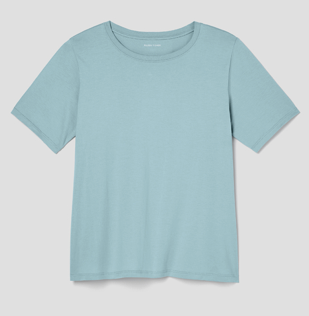
Tee

Again not something I wear myself, but there are many patterns. If you wear tees, you probably have a favourite.
tee

McCall’s 7322, ‘Learn to Sew’ pattern, neckline and sleeve variations, woven or knit fabric.

This one from LoveNotions is also aimed at beginners – for knits, and has 3 necklines, 4 sleeves.

Tropical Research minimalist tee, various body and sleeve length options.

Box top

These may have cut-on or separate sleeves.
Most of these patterns finish the neckline with a bias strip facing. If you can’t yet do that to your satisfaction, draft a pattern for a true facing instead, see this facings post.

box top

Box top with cut on sleeves

These suggestions are all oriented to learning to sew :

All Well Workshop box top, instructions for adding sleeves and skirt.

Cal Patch at Creative Bug – video includes drafting your own pattern.

Sew DIY Lou box top, 2 necklines, 3 hems.

Tropical Research – tee shirt tunic, with free video.

Box top with separate sleeves

Add 4 sleeve styles to the Sew DIY Lou box top above.

Tropical Research – boxy top with separate sleeves of several lengths, also a skirt option – with free video.

Or take your box top up a notch with Vogue 1912 designed by Rachel Comey (lower the neckline for summer).

Classic band collar shirt

Eileen Fisher versions are mainly 2-piece collar shirts, or may be made only with collar band.

shirt
Of course there are many shirt patterns, see some in this post. Includes links to many videos.

Or try one of these :
Know Me pattern ME2052 by Beauté J’Adore – shirt with pants, free sew-along video.

Tropical Research – shirt with several collar, yoke and pocket options – free video.

Camisole

Not included in the 12 Shapes, but Eileen Fisher has a simple gathered cami.
Here’s the dress version :

cami

Have not found a pattern exactly the same, but :
Wardrobe By Me Carma Camisole makes the neckline binding and straps in the same way. To copy the Eileen Fisher one, you need to add gathers across the front. Just cut the front with the pattern fold edge lying away from the fabric fold : 1″ gap will add 2″ to the fabric piece. Gather into the band.

Or this pattern has a gathered neckline, not similar to the Eileen Fisher one but very easy to make.
McCall’s 7405 is a ‘Learn to Sew’ pattern.

– – –

Pants

Nearly all the Eileen Fisher pants have an elastic waist or a waistband made from stretchy knit.
Here’s a general post on elastic waist pants.

All the pant shapes could be various lengths – micro shorts, bermuda shorts, capri, ankle length, floor length.
Eileen Fisher does have wide leg bermuda length shorts.
Her capris are low calf length.
Most Eileen Fisher pants are ankle length for summer.
Longest length to go with a given shoe heel height ? make the pant length so it just touches the front of your foot.

Pants may have in-seam, slant, or cargo pockets.

These are the 4 Eileen Fisher silhouettes.

Slim pant

slim pant

Can be made from woven fabric or ponte knit.

These slim pant patterns are for woven fabric :
Sew Over It Carrie – pay extra for video.

Butterick 6028 by Katherine Tilton.

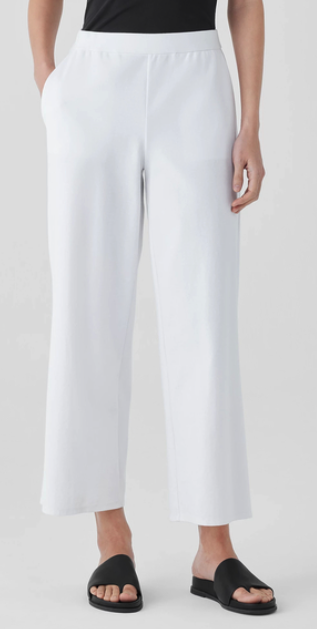
Wide leg pant

wide leg pant

Not actually very wide by current standards, wider than the ‘slim leg’ pants. Many straight leg pant patterns will work here. (If you want some suggestions, see the wardrobe patterns in the second post.)

Here are some wider possibilities.

Simplicity 9149 includes an interesting box top.

Simplicity 9608, an ‘easy-to-sew’ pattern – make it even easier by replacing the button placket side panels with a simple side seam.

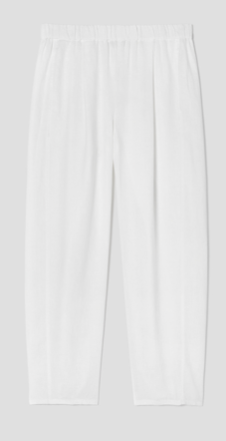
Lantern pant

lantern pant

Also called ‘barrel leg’ pants.
Loose over the hips, thighs and down the legs, tapering in at the ankle.

Here’s a pattern round-up for these, from Threads magazine.

If this shape works well for you, here is a pattern for a jeans version from Forest & Thread, video available.

Trouser pant

The above styles are all elastic-waist, but ‘trousers’ have the classic features : waistband, pleats, slant pockets, fly front zipper closure.

trouser

Another style for which there are many patterns.

Butterick 6973 is from Palmer-Pletsch, so has extra fitting and sewing guidance.

Sew Over It have a video masterclass which includes patterns for both slim and wider leg styles.

– – –

Skirts

Eileen Fisher doesn’t include a skirt in her 12 Shapes, but she does have them among her offerings.
Her skirts are nearly all midi length, with a few pencil minis. But of course you can make them any length : mini, mid knee or just below knee length, calf length/midi, ankle length, floor length.
From the photos, you can see Eileen Fisher has both high calf and low calf midi styles. I prefer the low calf length.
Which skirt length is most flattering on your legs ?

Again 4 basic silhouettes.

Pencil – i.e. slim straight

pencil skirt

McCall’s 8068 is a ‘Learn to Sew’ pattern with back zipper (so perhaps not for early beginners), choice of silhouette and length.

There are easy elastic waist possibilities in this elastic-waist skirts post.

A-line skirt with side seam pockets, also in a wrap version.

a-line

Very like the Elizabeth Suzann Bel skirt pattern.

Lantern skirt

lantern skirt

Tapered in at the hem.

Vogue 1731 by Marcy Tilton is more tapered than the Eileen Fisher one (pattern includes pants but they are not lantern silhouette).

The Sewing Workshop has some patterns with this shape (Edgewater, Metro, Tosca).

Wide leg culottes – Eileen Fisher calls them skirt pants, they used to be called divided skirts.

culottes

Simplicity 8134 View E is an ‘easy to sew’ pattern. Shorts and other pant styles included.

– – –

The second post on this topic covers :
– Eileen Fisher’s summer layers and outerwear.
– some possible outfit patterns in related style.

Enjoy !

= = = = =

Click on the red header to see the index at top right.

Choosing core pattern blocks

May 22, 2022

How to choose a small basic set of patterns to use as the starting point for your hacking adventures ?

I’m surprised that I have at last got my own group of core patterns. I recognise that I have got to this point because I now feel relaxed about it. It must have been a concern for years, as I’ve written many posts about it, which I’ve pulled together here. I have written so much on this, it’s obviously not a topic for which there is an instant, or single, solution.

There are three main sections of this post :
– my own core patterns, as an example.
– I wrote many past posts about the possible choice of a small group of patterns to make a capsule, which I have brought together here.
– as most of those posts are a decade old the pattern links no longer work, so I have added links to some current indie pattern companies which offer stylish casual patterns.

– – –

My own core patterns

As in most aspects of sewing, there are so many pattern choices it can rapidly get overwhelming. So it’s well worth being secure about your own style, the clothes that you love to wear. Notice what it is that you always reach for, or that you regret being in the laundry.

The best patterns to use as a base for pattern hacking are very simple, they have few or no style elements. Those elements are added by the pattern hacking.

The following posts are about my own core patterns, the basic shapes I need for ‘stylish casuals’ :
cut-on sleeve top,
drop shoulder casual sleeved top (also basis for shirts),
on-shoulder casual sleeved top,
basic slim leg pants fit (scroll down).
I also have a well-fitting pattern for a raglan sleeve top, though that’s not a key shape for me, I need more shoulder definition.

The pullover tops can all easily be developed to other garment types :
– open the front : here’s my series of posts on doing that.
– enlarge to a layering jacket/ vest/ coat : I refer to Don McCunn p.154.

All the tops can very easily be lengthened into simple dresses (basically just extend the side seams, some notes on this process from Paper Theory).

I also have core patterns for, but rarely use as I’m not a dress and skirt wearer :
– fitted bodice,
– pencil skirt,
– a-line skirt (without darts).
For my body shape, I would do best with an a-line dress shape, neatly fitted at the shoulders and armholes with generous ease at the hips.
If I was a dress wearer with a more average body shape I would also have a core :
– sheath dress (fitted dress without a waist seam),
but my small busted wide hipped body would just look silly in such a style.

Once your core patterns are developed to fit well, then you can look at the pattern companies for style element ideas 😀 to add to the basics by pattern hacking (see the first post in this pair).

– – –

Past posts on small groups of patterns
I’ve written many posts which suggest a group of patterns for a core wardrobe. They were originally written as comments on wardrobe planning, so don’t include much guidance on hacking them to make different styles, such as :
Pattern books for wardrobe building
A core wardrobe from Sew Over It patterns

A wardrobe pattern might be simple solution to the issue of finding a basic set of patterns that co-ordinate, but they’re no longer available, just not economic I suppose. Some indie pattern designers have ‘pattern bundles’. I was fond of the long out-of-print 6-item Central Park pattern from Park Bench patterns, very easy to copy, either literally or in spirit.

”central-park”

Most of my posts about small groups of co-ordinating patterns refer to the work of 5 people who advise using a small capsule of key pieces as a basis for wardrobe choices : Eileen Fisher, Nancy Nix-Rice, Judith Rasband, The Vivienne Files, and Linda Lee of Sewing Workshop patterns.

Most of these posts on patterns for capsules were written around a decade ago, so many of the specific pattern suggestions are out of print. Though many of the ideas still apply. Although ‘fashion’ changes in detail every season, the basic styles which most of us wear are fairly constant.

These posts refer mainly Big 4 patterns, as they were easy to find out about at the time. Sadly those sites have changed, so most of the links in the posts do not work.
So these posts now mainly provide food for thought rather than usable links.

Eileen Fisher
here’s the 2022 version of her basics.

basic capsule.
revise the basics.
personalisation.
spring suggestions.
first part of Eileen Fisher’s holiday wear capsule, tops.
holiday wear dresses

Nancy Nix-Rice
Her set of posts referred to in my posts are no longer available. Her book has brief sections on all wardrobing topics and could be a good replacement, or she has a Craftsy class if you prefer video. She more recently emphasises that the styles in her core wardrobe diagrams are just indications, not required, such as : you need some sort of front-opening layer to wear in more serious situations, but it need not be a blazer !

NNR capsules
Some of Nancy’s capsule suggestions : 3 jackets, 4 tops, 2 skirts, 3 pants

first 8 items, there are 12 items in her core wardrobe, starting with a ‘Core 4’. The first 8 items are in dark and light core neutrals.
final 4 items, adding colour and print.
additions, the best items to add when you want more than 12. ‘Best’ defined as those items which instantly add outfits for many more situations, such as leisure if you’ve focussed your 12 on professional/ serious, or vice versa.
more comments.
accessories, no patterns.

Judith Rasband
author of college text Wardrobe Strategies for Women [terrible cover, rich content],
and the fitting bible.
While Nancy Nix-Rice uses similar shapes for the same type of garment, to make co-ordination easy, Judith Rasband deliberately makes several of the same type of garment as different as possible, to make different styles of outfit.
She has retired and her site is discontinued.

general capsule, she uses a ‘Core 5’ with 2 skirts.
summer capsule, this is 6 items with 3 tops.
variations for summer.

Vivienne Files
Janice has many bases for organising your wardrobe choices, see the Articles tab here.

wardrobe of relaxed basics [this post was written at the time of the Queen’s Diamond jubilee, in June we will be celebrating her Platinum jubilee – 70 years as Queen – amazing, good for her].
variations on relaxed wardrobe.
starting with smaller groups.

Sewing Workshop patterns
layering wardrobe.
Currently Linda Lee sews a new capsule each year, in the Sew Confident series.

other posts :
Holiday wardrobe plans, only 2 patterns suggested : classic tailored and casual wardrobe patterns.

suggestions for 3-item groups, each item claimed to be makable in less than 3 hours.

An early piece on my own minimal basics.

Fall season 2012.

More sources suggesting small groups of garments, not many pattern suggestions.

Wardrobe patterns 2012, there were more wardrobe patterns then.

– – –

Indie pattern companies

The basic options for a casual wardrobe keep repeating. Nearly every company has patterns for a tee, tank, sweatshirt/ hoodie, cardigan, casual pants.
And the number of indie pattern companies has greatly expanded since the above posts were written (new ones daily). So there are many other sources of good casual patterns. It’s just a matter of finding ones that are right for you.

Here is a small selection of current companies mainly oriented to stylish casuals rather than activewear or dresses – my choice, other people could come up with a completely different list :

The Assembly Line.

BMann by Bridget – lagenlook.

Closet Core – famous for their jeans.

Friday Pattern Company.

Grainline Studio.

Helmersson – zero waste.

In the Folds – ‘Curated by In the Folds’ is a series of detailed written tutorials on intermediate level techniques for sewing, fitting, hacking.

Megan Nielsen.

Muna & Broad – will draft larger if you need it.

Paper Theory.

Rebecca Page.

Sew House Seven.

Sew Liberated.

Twig and Tale.

Wardrobe By Me.

mainly knits :

Christine Jonson.

Pamela’s Patterns.

There are many many more indie companies. The list of companies at Pattern Review goes into the 100s. As there are also many small companies which don’t appear in the Pattern Review list, there may be as many as 150,000 patterns, more if we’re interested in vintage patterns.

No wonder we get overwhelmed !! So it’s important to have a strategy for limiting the options.
What are the basic 3-4 garment types that you absolutely have to have in your closet ?

Are there one or two pattern companies you feel especially in tune with ? For me, if I was restricted to using only patterns from one company I might choose the relaxed styles at Paper Theory or Sew House Seven, or the crisper styles at The Assembly Line if I was still working, with Birgitta Helmersson for when I’m feeling especially planet-conscious. While when I’m going more ‘cottage core’/ sprite I choose Twig and Tale.
But I’m a pattern nerd, expecting me to reduce my patterns is unrealistic 😀
Okay, if you don’t keep up with all the other pattern lines you might miss something good, but that way madness lies ! I’m on many e-mail lists, but I keep away from all the aggressive marketing on Instagram.

Which would be your favourite pattern for each of your essential garment types ?

– – –

There are two aims to finding these small groups of co-ordinating patterns :
– simplifying your wardrobe planning and co-ordination,
– providing the starting points for your pattern hacking, as summarised in the first post of this pair.

Best Wishes and Good Luck for finding and fitting your own top ranking patterns, which you can use as a starting point for hacking to add your own favourite style elements. These can be your TNTs – Tried aNd True patterns – those shapes which are key in building your personal wardrobe.

♥️ 👍 ♥️ 👍 ♥️

= = = = =

One Pattern Many Looks – pattern hacking

May 22, 2022

Having recently established my own group of core essentials patterns which I can use as the base for pattern hacking, I’ve been pulling together my previous posts related to this topic into a group of 2 posts :
– pattern hacking – this post,
– choosing a small group of core patterns to use as the starting point for hacking – separate post.

Once you have a basic pattern you’re happy with, there’s an almost infinite number of changes you can make to it. With the special bonus that, if the starting pattern fits you well, the patterns you make from it are likely to fit you well too. Here are some of the many books and patterns on the subject. Follow through with any of them for a huge range of ideas.

As my body is very non-average – developing some basic patterns that fit well, and then hacking them to make new styles, works much better for me than using a different pattern for every project. So this is a topic I keep returning to. The suggestions below are the options that come first to mind, so most are in my casual top-plus-pants style.

Most of the books include patterns, but I think it’s best to use their ideas to alter your own pattern blocks. Otherwise you just keep repeating the same problem: every time you start with a new book or pattern, you have to get the patterns to fit you before you can start making your own styles.

You can of course choose your own group of basic block patterns to use in your hacking. In this blog I have often chosen a group of patterns as the base for a capsule. I have linked to those posts in a second post, though they contain little hacking guidance. Perhaps like me you just need :
– blouse/ layering top (jacket)/pants.
Or your key choices might be :
– sheath dress/dress with waist seam/’french’ jacket, or
– tee/ cardigan/ jeans,
or any other grouping, depending on your personal style.

Once you have your base patterns, the sources linked from this post are ones that do much of the thinking for you about how to change them, they include many ideas and much guidance on both pattern making and construction.

– – –

One-pattern-many-looks books, patterns included :

This isn’t all of them, some others are mentioned in my other posts.

full size paper patterns :
Sonya Philip, Act of Sewing, patterns for cut-on sleeve and fitted sleeve tops, a-line skirt, pants. Half the book is on simple pattern alterations.
100acts

Kwik Sew Easy Sewing, patterns for tee, camp shirt, pants, straight and flared skirts. Many alternative styles for each, with pattern changes indicated.
kwiksew

pdf patterns :
Amy Barickman Magic Pattern Book, patterns for tank top, peasant style top/dress, skirt, cardigan, coat, accessories, with patterns for 6 variations of each plus many more ideas.

draft patterns from diagrams :
Rusty Bensussen, 4 patterns – top (also used for dresses, jackets, coats), pants, a-line and circle skirts.
rusty4patts

Bordow and Rosenberg Hassle Free Make Your Own Clothes, mainly skirt, top, pants.

I don’t wear dresses and skirts, but this is one of several books about modular dress patterns – combine any bodice with any skirt : Tanya Whelan.

and there are several similar books about skirts, such as :
A-line skirts.
4 skirt silhouettes.
This is even easier – Sew What Skirts.

In the same spirit as the last skirts book, but about making simple items from fleece – Sew What Fleece.

– – –

If you prefer videos, these are some options.

A couple of DVDs by Angela Wolf at Threads :
One Pattern Many Ways One, and Two.

Many classes at Craftsy.
Many classes from Suzy Furrer on changing style elements. I do not recommend her classes on basic sloper drafting as she claims to help you draft personalised patterns, but actually uses many ‘industry standard’ measures, so the patterns are barely better fitting than any other.
I find when I have followed one of these pattern drafting methods (not just Suzy Furrer’s, any of the ‘personalised’ sloper drafting methods) I then have to do a huge amount of fitting work to get the draft to work for me, so I might as well do that on a starter pattern and skip all the drafting effort. I don’t have any problems with the geometry and maths of drafting, what does leave me spitting pins is that the supposedly well-fitting pattern I end up with after a lot of work actually has no relation to me whatever. And I’ve tried many such methods. See my fitting posts. And as you can see, whenever this topic comes up, I’m still so angry I can’t resist a rant !
But Suzy Furrer does also have many classes on how to change style elements, and you can use those ideas on your own base patterns that do fit you well.

(Much easier ways of getting core patterns that fit without drafting your own block :
cut-on sleeve top,
sleeved top,
basic pants fit.)

There are also Craftsy classes on changes you can make starting from a basic blouse and pants patterns (patterns not included).

– – –

Pattern ranges

Fit for Art has several basic patterns with detailed instructions on how to get them to fit well. Then many add-on patterns with the specific pattern pieces for making other styles.

There is a Simplicity hacking patterns range which includes the pattern pieces you need – not as many options in this range as there used to be.

– – –

The following sources refer to master patterns which must be bought separately. You can use many of their ideas on your own pattern block, so it is not essential to start from their master pattern :

from Judy Kessinger of FitNice, who has master patterns for top and pants :
tops, dresses, pants, jackets.
tops only.

from Glenda Sparling of Sure-Fit Designs : variations of her dress, shirt, pants patterns.

Or, if you want to be more in ‘official pattern making style’, the book by Adele Margolis starts from a fitting sloper and makes it all much easier than the big college textbook tomes.

– – –

Pattern hacking can be very easy to do. Don’t be put off trying it by looking at one of the huge college pattern making textbooks.
Many ideas in this pattern hacking post, which has :
– many suggestions for simple starting points.
– links to more patterns which include hacking instructions.

And yet more ideas in these hacking posts. More books and patterns to add to those listed above :
My sewing style is one pattern many looks.
easiest pattern changes.
more simple starting points for pattern changes.
more books.

– – –

Choose and develop the fit of your own core patterns (see some ideas on the patterns to choose in the second post in this group), and look here and at the hacking posts for ideas on what to do with them !

Once you find pattern hacking is something you enjoy doing, the range of options can be overwhelming. Explore to find which part of all this fascinates you, what lifts your spirits and warms your heart 😀

= = = = =