Archive for the ‘fit + patterns’ category

Make everything from one pattern ?

November 12, 2016

Make your whole wardrobe using just one pattern ?
Interested in the challenge of making everything from one pattern ?
And I don’t mean a wardrobe pattern !

For the Pattern Review One Pattern Many Looks contest e.g. 2016 you have to choose one view of a pattern. They only allow you to make changes in fabrics and trims.
They specifically exclude doing any pattern work, apart from fitting.

Personally I find it more fun to do some simple pattern work. I know many people don’t want to change patterns, but the alterations suggested in this post are simple.

Some of these pattern changes make different garment types, such as jumpsuit to dress, skirt, coat. Others involve more subtle changes to style elements : collars, pockets, front openings – good if detailed differences delight you 😀

Basically you’re doing the simplest aspects of pattern making, as taught in the big college pattern making tomes, but you’re starting from what is already a pattern in your style, instead of from a fitted body sloper.

– – –

A starter pattern

Several years ago I wrote a post on using one top pattern for a dress, top, jacket, vest, coat.
The pattern I used is now out of print.

This time I’m starting from Simplicity 8060 (2021 – that is also discontinued), a Mimi G jumpsuit pattern.
”s8060”

2021 : use Sew Over It’s Farrah jumpsuit pdf/A0 pattern : (body bust 31″-46″) with dropped shoulders, 4 flap pockets, and no yoke.
SOI Farrah

Or McCall’s 7330 (body bust 30″-49″), a less casual style, already includes sleeve and leg length, collar, pocket and belt variations.
mcc jumpsuit

The Merchant & Mills Thelma is for body bust 31″-56″.
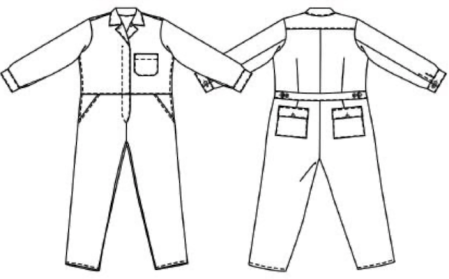
Thelma

If those aren’t your style, there are many other jumpsuit patterns. You could do these simple pattern alterations starting from any pattern with sleeves and waist seam. I collected some on this pinterest board. 2021 : jumpsuits are current, so there are many more.

Or of course you could instead work the other way round, and use your favourite top and pants patterns to make a jumpsuit. Make the length of the top pattern at your personal bodice length (nape of neck to waist) plus 1-2” / 3-5cm, to allow for movement. If you’d like a tutorial, here’s a video from Wonder How To.

If you find you enjoy this process, you’ll probably find it’s less work to start, not from the original multi-size pattern, but from a tracing of your size. Perhaps with some adaptations for you, such as different sizes for top and bottom, or adjustments to bodice and crotch length. Also tracings of one or two sizes larger, to use for layers such as jackets and coats. An investment in time that saves time later.

If you become a true addict of this process, you’ll want to transfer the basic pattern pieces to card so you can trace round them every time they’re used.

Most of these pattern altering ideas don’t just apply to one pattern. They’re general pattern altering skills which can be applied to many other patterns as well. I’ve begun a pinterest board of some patterns that are easy to change.

– – –

Some simple ideas for what you can make from a jumpsuit pattern

(Apart from a jumpsuit !)

Style elements

– move / omit / change shape of patch and slant pockets.
More complex pocket changes : guides to making different pockets in this post.
– change the shape of the collar : round the corners, or use only the band.
More complex collar changes : patterns for many collars from momosAtelier – some are detached, the ones with partial front in the same fabric are attached to the garment.

Garment type

Use pattern pieces for jumpsuit top and bottom separately.

Use a larger size of the top for a bomber / blouson jacket.
Use the casing and drawstring for the waist.

Make a dress with a waist seam, by adding a gathered rectangle of fabric below the waist instead of the pants. Any length from mini to maxi. How about using some special occasion fabric ?
Several examples of commercial patterns which do that on this pinterest board.

Use the pants pattern pieces to make gathered waist pants.
Use the casing and drawstring for the waist.
(Converting a jumpsuit pattern with a continuous opening from neck to crotch into pants : continue using the buttoned front opening at CF of pants – cut off above waist, or ignore the placket opening on the pants CF seam and extend the casing around the complete waist.)

With very little pattern work

These changes can be made direct with the pattern tissue if you want to.
Or for more speed there are even easier methods.

Lengthen or Shorten

Change body, sleeve and leg lengths – see instructions for lengthening and shortening the pattern tissue, given on many pattern sheets.
If you’d like more detailed advice, there are photos of lengthening and shortening in this post from Tilly and the Buttons.
If you’re tracing the pattern, you can just slide it along by the amount needed, instead of needing to cut and paste.

Lengthen the top to make :
shirt / tunic / shift shirt dress without waist seam.
Use a size larger for a shirt-jacket, longer for a duster.

If the top pattern is the same width all the way down from underarm to hem, you can just mark the added length onto the fabric when cutting, with no need to add on tissue. (Well, I need to check that’s big enough for my hips !)

Shorten the length of the jumpsuit pants to make a romper.
Shorten the pants used without the top, to cropped pants, capris, bermudas, shorts.

For speed shortening, just fold back the unwanted part of the tissue when cutting. Though only if the side seam meets the hem at a right angle (see ways of dealing with other angles below).

Omit pieces

Omit collar / cuffs / sleeves.
Make sleeveless tops, vests and sleeveless coats.
Add bias binding to the remaining edge.
Or make a facing pattern, see about 3/4 of the way down this post.

With a little more pattern work

For these changes, it’s best to trace the pattern and work with the tracing.

Style elements

Colour blocking and patchwork
Add decorative seams so you can use different fabrics in the same pattern piece. Draw the new seam line across the pattern piece. Cut along this line, or trace the two parts. Add seam allowances to both sides of the new seam.

Change neckline.
Here’s a post on changing necklines.

Close front of top to make a pullover top
Here’s a post on closing the front of a pattern.
Extend that to a shift dress.

Add a variety of half plackets to the top (henley, polo, zip – see this post for links to instructions for sewing these).

Add a full length front opening placket : to a pattern that has not got one, see links in the previous post on starting from one pattern. Change to an edge-to-edge opening, zippered, cut on button band, separate button band, cut-on facing, separate facing.

Change the leg shape of the pants – make them wider or slimmer, flared or bell bottom. Make the same changes to inner and outer seams of both front and back, to retain the balance of how the pant legs fall. If you don’t do this, they will hang oddly.

Garment type

To make a skirt from the pants pattern – lengthen downwards from the vertical part of the crotch seam.
Use the casing and drawstring for the waist.
(Going from pants to skirt is much easier than the other way round.)

I’ve extended the stitching lines in this example, as I tend to make my own patterns without seam allowances. You can of course extend the cutting lines.
Remember to add hem allowance.

”skirt

That diagram is just the first step, marking seams and hem position.
The next step is to make the hem a smooth line, and for that the hem and seam need to meet at a right angle. So if your pattern piece has sloping sides, you need to curve the hem shape. Find a line at right angles to the sloping side that meets the hem about 1/3 the way along, then smooth the wide angled join into a curve.
”true
Finally, check that the front and back side seams are the same length. Move the whole hem up or down if not.

For slight angles between seam and hem, as on sleeves and legs, there’s a much simpler ‘hack’ – just straighten out the tapered seam in the hem area.
”straighten-hem”
(the upper horizontal line and centre vertical lines in this photo are pdf pattern join marks)

Hmm – what about a coat ? Use 2 or more sizes larger of a lengthened top pattern.
For more challenge, add a lining 😀 Easier than you might think : either copy the main pattern pieces exactly and make a reversible item, or make lining pattern pieces which fit onto the facings and hems.
2021 : The Threads magazine book on how to make and sew lining patterns is no longer in print, but you can still find copies, such as from Alibris or Abe Books. The clothes styles may be dated, but not the technique content.

Going Further

When you know more about pattern making there could be many other options ! For starters – what styles could you make if you widened some of the pattern pieces so you could add gathers, pleats, tucks.

It may be a long time before you want to go further than all the possibilities in this post. But when you do there are several people who specialise in making this process easy.

Here are some you could try. Use your starter pattern instead of their master pattern.

Judy Kessinger has a couple of books on doing this.
Also many free videos, such as :
Dolman sleeves.
Raglan sleeves.
Princess seam style.
More tops.
More pants.

The Sure-Fit Academy has many videos on changing starter patterns to other styles, not free.

More books :
The Act of Sewing by Sonya Philip has half the book on making simple pattern alterations. The book includes 4 very basic patterns, but you can apply the ideas to your own patterns.

Design-It-Yourself Clothes by Cal Patch tells you how to draft starter patterns to your own measurements. Then instructions for various styles. Again you could use your existing starter pattern.
Cal Patch also has a year long on-line class which focusses on pattern hacking. If you’re lucky and in the right place you can even go to a face-to-face class with her.

Sew Guide has links to many posts on simplified patterns for changing style elements.

For big changes : I suggest making a test garment (muslin, toile) to check the details are as you want them. Professional designers go through many iterations to finalise their designs.

– – –

This post focusses on all the things you can do to make different items from one pattern.
Well, all the things which involve only simple pattern work.

I haven’t mentioned all the possibilities for changing the look of a garment which don’t need any pattern work, such as changing fabric colour, print, type, or adding decorative stitches, appliqués, trims, ruffles, or adding wadding and quilting to some sections, or cutting striped or plaid pieces on the bias.
There are now several posts on these possibilities : see posts on repetition, embellishment, and textile skills.

This post used to end with a section listing some other sources which show how easy it can be to alter a pattern.
That section has expanded so much, I’ve now made it a separate post on Simple pattern alterations.

If you love playing with patterns, all this can be a fun and fascinating thing to do 😀

– – –

First published November 2016, some additions and links checked October 2021, links checked July 2024.
2024 : There are now several posts on making pattern variations at Aim for Quality.
Simplest pattern hacking.
From pullover top to open front.

= = = = =
Changing a pattern neckline

October 22, 2016

You like a pattern except for the neckline ? or you want to try a different shape ?
Changing a neckline is quite easy pattern work.

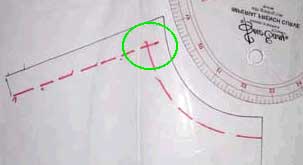
First draw in the stitching lines on the existing pattern. It’s easy to do this with a transparent French Curve with 5/8 inch marked round the curved edge. These stitching lines show the position of the shoulder seam and the finished neckline edge.

”nkptcircle”

The crucial point to identify is where the neck edge meets the shoulder seam, sometimes called the neck point.

So long as you draw your new front stitching line-finished neckline through this point, you won’t have to alter the back neckline (or vice versa).

”v-neck”

If you want a wider or narrower neckline, draw in the new finished neckline position. Then measure how far the new neckline is from the old neck point, along the shoulder seam. Use this measure to find where to start the new back neckline.

”lowneckarrow”

To add the new cutting line :
– make some marks 5/8 inch from the stitching line.
The ends of both a tape measure and a seam gauge are 5/8 inch.

”cutlinemark”

– Then join the marks into a smooth curve – easy to do with a French Curve.

”cutline2”

Changing the neckline of a wrap top/ dress is a bit more complex. Here’s a tutorial.

Neckline finish

You could simply finish the new neckline with a bias binding or a bias facing.

If you want the added structure of a proper facing, that involves a bit of easy pattern making.

See instructions for making a facing pattern about 3/4 of the way through this post.

Here’s a video from Louise Cutting on how to add a back neck facing to a pattern that hasn’t got one (facings do make collars very easy to sew on).

– – –

There’s a Craftsy class from Suzy Furrer on drafting necklines.

Again, many possibilities to think about and try out. But once you’ve decided what to do, the pattern work needed can be very simple.

– – –

Links available October 2016

= = = = =

To get to main blog, click on red header.

Choosing necklines

October 22, 2016

Do you know what is the best neckline for you ? There’s much to consider. There’s the shape of neckline that enhances your upper body. There’s the shape of neckline that flatters your face. And the widths and depths of neckline that go best with your proportions. All that before you even think about pattern making techniques for changing a neckline.

My old post on choosing and changing necklines is much visited but now rather out of date. So I’ve updated it in 2 sections.
1. choosing necklines.
2. changing a pattern neckline.

– – –

Imogen Lamport’s advice about choosing flattering necklines covers both face shape and body shape (flatter your features). There are also many on-line recommendations on one or the other.

The neckline shape that flatters your body

If you search ‘choose neckline’ you’ll find a lot of guidance, especially about the best necklines for your body shape, your combination of neck, shoulders and bust.

Amy Herzog has good advice about necklines. She gives much detail about hand knitting, but the general ideas apply to all garments. She used to have on-line tutorials, now it’s in a book, Knit to Flatter, and a Craftsy class, also Knit to Flatter.

– – –

What about flattering your face

To think about this, you need to be aware of the shape of your facial features – your jaw, lips, nose, eyes, eyebrows – are the edge lines straight or curved ?

The Triumph of Individual Style is a beautiful and interesting book with many reproduction art works of women. The aim is to show that, whatever your shape, someone has found it worth celebrating. There’s an interesting section on facial features, pp. 16 – 21. (The proportions of the clothes in this book are very outdated, so just look at the general principles for a wealth of helpful ideas.)

Once you’ve decided whether your features are mainly straight or curved, there’s conflicting advice about what to do with this information. Some people say the best neckline echoes the shape of your features. Others say the best neckline counteracts your features, so use curved shapes if you have an angular face, angular ones if you’re curved. Perhaps the choice between these attitudes depends on personal style, rather than there being one answer which is right for everybody.

The shapes of your face might influence for example whether you look better in a V-neckline with straight edges or with a slightly curved shape.

So do some experimenting. Cut neckline shapes from kitchen towel and try them out.

Imogen Lamport (Inside-Out Style blog) says the best neckline shape is related to your jaw shape. Your jaw shape is likely to be related to your body type (curvy or angular) but is nearer your face.

‘The Triumph of Individual Style’ says you can wear any shape of neckline, so long as it balances your face with your body. Though they recommend echoing your jawline.

Personally I agree with going for shapes that echo the curves of my features. Necklines with sharp angles seem out-of-kilter with my face. But then I prefer softer curved looks anyway. And also, I’m old enough to have ‘jowls’. I find my best neckline is the shape that echoes what my jawline shape used to be 😀 I have to be careful with a draped neckline. They look good in a fabric with enough body to fall in a curve. But if the fabric is so soft that the bottom of the drape falls into a sharper V, that isn’t good on me at all.

– – –

Width of neckline

Gale Grigg Hazen has an ingenious suggestion about measuring necklines, in her book Fantastic Fit for Every Body. Use a transparent (quilters) ruler to measure how wide your neck is, and how far your straps are from your centre line.

”gghneck” (Grigg Hazen p.170)

Compare these measures with the pattern : is the pattern neckline wide enough for your neck ? too wide to cover your straps ?

‘The Triumph of Individual Style’ says your neckline or collar opening should be wider than the widest part of your face. For most of us that means we aren’t at our best in a jewel neckline which is close fitting round the neck.

– – –

Depth and balance

‘The Triumph of Individual Style’ has some fascinating suggestions about flattering neckline depths, pp. 49 – 55. They suggest two ‘balance points’, for high necklines and low.

All their measurements need to be made vertical and straight, with a ruler. Not over the bumps, as you would using a tape measure.

High balance point

Measure vertically from the widest part of your face to the tip of your chin. Your widest point could be at your forehead, your check bones, or somewhere on your jaw.

I’m 3-1/2 inches vertical from cheek bone to tip of chin.

”upperpt”

Measure that distance down from the neck end of your shoulder.

Across from there is the most flattering level for your upper neckline.
On me this comes at the level of my collar bones. I’ve long known that a neckline closely fitting my neck doesn’t look good on me.
This point can also be a good place for collar emphasis, such as the notch of a notch collar.

Low balance point

Measure vertically from your hairline to the tip of your chin.
Or, if you always wear a hair style that substantially covers your forehead, measure down from your hair.

I have a long face, and on me this is 8 inches.

”lowerpt”

Wear something that you don’t mind sticking a pin into or marking.

Measure the length of your face down from the tip of your chin, On me that comes near my bust point.
Mark that level, which is said to be the most flattering level for lower necklines.

You need to convert this to a measure that can be compared with a pattern. So measure from the neck end of your shoulder down to the pin or marker, this time using a tape measure on your body. Because of collar bones and bust, that is likely to be longer than the vertical measure down from your chin.

I’ve got prominent collar bones, and on me this measurement is 11 inches.

If this point comes low on you, you need to think what this means for you personally. With my long head, the low neckline point comes so low it would need a lot of double sided tape to be at all decent, and would be much more revealing than suits my style. But that doesn’t mean I can’t emphasise necklines to this level. It explains why I like wearing long necklaces, and deep V necks on layering tops and jackets, which are all coming down to that level.

So if you need modesty you could have a more obvious neckline going down to this point, filled to a higher level by something less obvious. And I’m trying out emphasising this level using embellishment, a corsage, or a necklace pendant.

Now I know about these balance points, I keep spotting celebrity examples. Wear your neckline below the low balance point if you want all the attention to be on your cleavage !
I think the necklines of most patterns are developed on models with long necks.

Cut test necklines from kitchen towel, or drape scarves, and see what you think. Image consultant suppliers sell sets of basic neckline shapes made from calico. You can try a much wider variety if you make your own !

– – –

Collars

Of course, getting the best neckline shape is essential, but only the first step. Then there are collars, bias drapes, bows, ruffles, whatever. But presumably these additions follow the same principle – that they are best when they coordinate with the lines, shapes, and proportions of our bodies.

For example, big collars need to be in proportion to our overall build. (I’ve just been attracted by a large collar jacket pattern, but fortunately thought of checking my personal croquis. A deep collar wider than my shoulders, on a short jacket, would make me look like a heffalump. . .)

‘The Triumph of Individual Style’ has illustrations showing how to adapt classic collar shapes to high and low neckline balance points.
And Darlene Miller’s book ‘Your shape, your clothes and you’, has illustrations suggesting curved collars go with curved bodies and straight with straight.

There’s a class on drafting simple collars at eSewingWorkshop.

And a Craftsy class by Suzy Furrer on drafting collars, which covers many more collar types.

Lots of possibilities to think about and try.

– – –

Links available October 2016

= = = = =

To get to main blog, click on red header.

Sewing Patterns for Men’s Clothes

April 12, 2015

Inspired by the Great British Sewing Bee 2015, I’ve been looking for men’s patterns. And I’ve been adding to this list when I find a new source.
You might think there’s nothing for men learning to sew for themselves, between making a cushion cover and tailoring a suit, but in fact there are many options.

2024 : This post was originally written in 2015. Nowadays I would recommend :
Vogue for tailoring, and Know Me for a big range of stylish clothes. They are both at this url, mixed in with many normcore items (though the presentation is very repetitive, so it looks as if there are more patterns than there are). Most of the Know Me patterns have sew-along videos.
Islander Sewing Systems – classic shirts.
Islander Sewing Systems – modern fit shirts.
While Grasser is a new-to-me company with generally stylish patterns.

[I haven’t checked the rest of this post for whether the links are still valid !]

Sections :
– Learning to sew menswear
Learn to sew patterns
– General patterns
Casual wear – including ‘made to measure’ patterns, magazines
Costumes
Activewear and Outdoor gear
Shirts, suits, vests, coats – including video courses on technique
– Make your own patterns
Basic blocks
Custom fit

Learning to sew menswear

Even the simplest modern sewing machine is a complex machine tool. (Here are links to information about the mechanisms.) And it’s surprising how many different techniques are involved in making even the simplest sewing project. Some people love challenges, some people prefer to learn one new technique at a time.

The first step is to learn the basics of using a sewing machine, see side menu at Aim for Quality for many free guides.

Then learn the simplest basics of cutting fabric and constructing something from it.
Do you prefer to learn from video or written instructions ?
There are a couple of free video classes on bag making at Craftsy/Bluprint.

There are some special easy patterns for men’s clothes, see next section.
There are also some special courses :

There’s a subscription service for learning to sew mens’s clothes from complete beginner. Taught by Mimi G, Sew It Academy, about $12 a month – videos with few written instructions.

If you prefer written instructions, here’s a “learn to sew” project book for complete beginners. The Merchant & Mills Sewing Book has a sequence of unisex bags and home dec (clothes patterns in this book are small and difficult to use, M&M single patterns are good).

The Sewing Guru is a trained tailor who has videos for making shirts and suits (and pyjamas), using speed and classical tailoring techniques. Projects vary in difficulty, and there’s no formal sewing school with a suggested sequence for learning sewing skills.

Burda Academy has an online video course for learning to sew menswear, which includes patterns for jacket, pants, and Barbour. This is also not for beginners.

There are many video sew-alongs for Big 4 patterns, including some by men.

Many links about tie making in this post from Thread Theory.

‘Learn to Sew’ clothes patterns for men

These could be ‘early beginner’ projects, a first garment after learning basic cutting out and construction from simpler projects :
Robe : Simplicity 1946.
Elastic-waist pants, no fly opening : Simplicity 2290.
Elastic-waist cargo shorts with ‘mock fly’ (doesn’t open) : McCall’s 6933.

The next I suggest might be ‘extra help for the first time you do this’ patterns – not for a complete beginner at garment sewing, but perhaps for a beginner at sewing these styles :
This shirt pattern is labelled ‘Learn to Sew’ by McCall’s, but definitely not easy, McCall’s 6972. For some reason they chose the most difficult way of attaching a one-piece collar.
And this ‘Learn to Sew’ pattern is for pants with zip fly, McCall’s 7987.
These jumpsuit costumes have zipper closure : McCall’s 7675.

– – –

General Patterns

When you’ve learned the basics of how to sew, where can you go ?
I haven’t linked to individual patterns here, as there are 100s of them ! These are just links to pattern sources.
Sections here for :
Casual wear
Costumes
Activewear and Outdoor gear
Shirts
Suits, vests, coats.
These are all paper patterns unless noted.

Plus a final section on making your own patterns.

There are about a dozen patterns for men in this list of patterns supposed to be sewable in less than 3 hours.

If you’re specifically looking for patterns for larger men, here’s a post from the Curvy Sewing Collective which lists some patterns for men which go up to larger sizes. (See also the ‘make your own patterns’ section below.)

– – –

Casual wear
Some of these sites are not sorted for men/women.
Some are in several languages.

Burda tissue patterns / Simplicity
Burda Style download patterns
Butterick
Colette Patterns – Walden for men
Elbe Textiles
Green Style Creations
Hot Patterns
I Am Patterns
Jalie
Jennifer Lauren Handmade
Knipmode
Liesl & Co.
Mark Francis
McCall’s
Merchant & Mills
Patterns for Pirates
Patrons les BG
ProperFit Cothing – caps
Rebecca Page
Schnittquelle
Seamwork (download)
Sew Sew Def (download)
Silhouette patterns
Stof & Stil
The Tailoress
Thread Theory
Toby K
Wardrobe By Me
5 out of 4 patterns

’Made to Measure’ pdf download patterns

Most of these only use a few basic measures, such as height, chest, waist, hips.

Bootstrap Fashion has patterns for several shirts and jackets.

Freesewing.org (formerly Make My Pattern) has patterns for most garment types.

Lekala patterns include more than 120 patterns for men.

For more detailed personalising of design and fit, see the ‘Make your own patterns’ section below.

Pattern magazines

There is an on-line sewing magazine specifically for menswear, Bartack.
This has been set up by Jamie Kemp, former contestant on the Great British Sewing Bee. Click on the Welcome to read about the content. It’s free to look at the content, subscription for the downloads.
There’s an extensive pattern finder section.

There’s the annual special family issues of Ottobre magazine, 7/2017, 07/2018, which have several traceable patterns for men.

Many of the download patterns at Burda Style previously appeared in Burda Style pattern magazine.

La Maison Victor is a Belgian pattern magazine said to have a pattern for men in each issue.

Occasionally there are stylish patterns for men in Italian pattern magazine La Mia Boutique

– – –

Costumes

Many of these sites aren’t pre-sorted for men/ women.

Burda Style download patterns
Butterick
Folkwear
McCall’s
Simplicity

There are several specialist pattern companies for historic styles.
Such as :
Laughing Moon
Nehelenia
Patterns of Time
Reconstructing History
The Recollections of J.P.Ryan

Choose the era you are interested in at
The Great Pattern Review
That doesn’t link you direct to the pattern.
Here’s their list of links to sources.

The Great Pattern Review site also has a ‘futuristic-fantasy’ section.
For cosplay costumes for specific characters, you can usually find ideas on specialist sites for the character.
There are some ‘online only’ cosplay costume patterns from McCall’s : Cosplay by McCall’s.

– – –

Active wear

Burda Style download patterns
Controlled Exposure
Daisy Kingdom
Fehr Trade
Green Pepper
Jalie
Round Earth Publishing – martial arts
Shelby Kaava
Storm Mountain Designs
Suitability – patterns for riders and horses

Outdoor gear

Here’s a guide to tips on sewing outdoor gear which aren’t in most conventional sewing books.
Many heavy duty sewing projects here, from Sail-rite sewing machines.

Some patterns :
Pennine Outdoor (mainly tents and sleeping bags)
Quest Outfitters (tents, bivy bags, backpacks)
Rainshed (mainly special purpose bags)

Many free patterns for bike bags available on-line.

– – –

Moving on to shirts and suits (if you want to)

Video courses on technique

David Page Coffin, noted for his books and DVDs on shirts and pants, has video classes at Craftsy/Bluprint, David Page Coffin.

Burda Academy have an on-line video course on making menswear, which includes download patterns for notched collar and barbour jackets, pants, no shirt.

The Sewing Guru is a tailor who has many video courses on making shirts and suits.

Kenneth King has video tailoring class at Taunton Workshops, Smart Tailoring.

There are many video courses on making women’s shirts, which use the same techniques. Such as this class from Sew Over It, which includes both men’s and women’s shirts with pdf patterns.

Patterns for Shirts

More than one shirt pattern at each of these sites :
Burda paper, Simplicity
Burda Style download
Islander Sewing Systems – classic shirts
Islander Sewing Systems – modern fit shirts
Vogue
(a single shirt pattern also in some of the Casual wear listings)

Patterns for Suits, Vests, Coats

Burda paper, Simplicity
Burda Style download
Vogue

– – –

Make your own clothes patterns

The University of Fashion has on-line video lessons on drafting patterns for men. These are standard industry slopers.

There are ready-made full size basic pattern blocks for men (average body shape) from :
Design Cut and Wear (some up to 46″ chest)
Shoben Media (up to about 110cm / 43” chest).
See below for larger sizes.

Custom fit patterns

Don’t expect a perfect fit from these tools unless you’re lucky. They only cover about a quarter of all fitting issues. But they may give a better fit than patterns for ‘average’ body shape.

‘Connect the dots’ tracing from a master pattern, by Sure-Fit Designs :
Shirts and casual jackets (easy to make any height-collar-chest combination up to about 157cm/62” chest).
Pants for men instructions used with pants pattern (up to 62″ hips).

Pattern making software :
Wild Ginger PatternMaster Tailor Made (claims no upper size limits)

Formal Pattern Drafting books :
Patternmaking for Menswear : classic to contemporary by Kim & Kim
Metric pattern cutting for menswear by Winifred Aldrich
(There are several other general pattern making books for men, but these get the best reviews.)

– – –

Other options :

Vintage patterns
There are many vintage pattern sites. Good places to start are searches on ebay and Etsy.

The Japanese produce marvellous pattern books, with full size traceable pattern sheets. So long as you don’t mind they’re in Japanese ! with many good line drawings of construction. A fun challenge, but not for beginners. Sizes are small. Body sizes are given with the book information, in cm. Multi-size patterns, so they may be quite easy to grade up.
These are the books for men’s clothes at my favourite source, which shows many sample pages.
Simply Pretty

Free patterns – with very variable quality of pattern drafting and instructions.
Sadly there’s no obvious good source focussed on men’s patterns.

– – –

It’s worth checking a pattern at Pattern Review, to see if anyone has helpful advice. (I find it quickest to search by pattern number.)
Pattern Review

Men’s clothing may not show the almost infinite variations in style elements that there are in women’s clothes. The differences are more in subtle details.
You do have to search thoroughly if you want something stylish, but there is a lifetime of possibilities to explore !

– – –

First written April 2015, links checked March 2019.
I add a link whenever I come across a new source, but I don’t keep checking whether the links are all still valid.

= = = = = = = = = =