What do these words refer to ? This question came up in a discussion group I belong to. And for me it turned into a review of where our personal basic patterns come from. Thought I would put my comments here in case they encourage others in the same situation.
I don’t much use the terms block and sloper. I have worked my way through the drafting instructions in so many pattern making classes, books and software using ‘personal measurements’, which have never ended up with a basic pattern which even remotely resembled me. I did eventually have the sense to stop trying yet another of those methods in the hope it would at last be one that worked for me.
I found (see later) that it was something about the general principles of these methods which meant that they weren’t for me (especially the fit features which were included), not a limitation of the specific way the blocks were drafted. A naive beginner might assume there is a standard way of drafting pattern blocks, but actually each person who writes a textbook has a different method.
As we all have different body shapes, as well as different clothing styles and learning styles, we need to find our own way through the plethora of methods for attaining basic reference patterns which work for us. Meaning the patterns fit well, and provide a starting point for making the sort of garments we wear.
Perhaps there are different groups of us. Most pattern drafting and fitting methods work well for people who like fitted clothes, and have only one or two body features different from average. While I’m in a group who mainly wear casual clothes, and who have many differences from average.
Although I could now make fitted styles for myself if I wanted to, I find I don’t. Comfort and ease of movement are essentials for me. And though I have a good silhouette (with indented waist) from the front, from the side both bust and rear are flat and the only obvious features are my round shoulders and protruding stomach !
I talk in detail about the ‘issues’ I have with fit. But my solutions are just an example. It’s obvious from the comments below, and from sewing friends, that each of us who has big difficulties with fit has to find their own solution, which may be the opposite of mine 😀 While I have no use for them, other people have found it helpful to use software, tissue fitting, drafting (one specific method), a fitting scheme which ignores shoulders . . . Of course if you have a generous bust or rear, your fitting needs will not be the same as mine. So each of us has to do much exploring.
Combined in my case with the problem that my preferred learning style is to follow detailed instructions exactly when I first start learning, and give credit to the teacher as an expert. So I stayed for much longer than I should have with trying to follow pattern making and fit courses and books which didn’t work for me. Each expert is so enthusiastic about selling their method, and making big claims that it works for everyone. For a long time I assumed there was something wrong with me, not with the methods on offer.
–
Why don’t all these methods work for me ?
I had to do much work to understand why those methods didn’t work for me (much of it recorded in posts here). Most of the points in this section are about fit. There are many variations in fitting technique, also in what is fitted and in what order. And pattern drafting usually starts with making fitted bodice and skirt blocks. While I rarely wear closely fitted clothes, so those are not tools I need.
Nearly all pattern drafting methods divide your overall bust, waist and hip measures into 4 sections, and use this quarter measure for drafting the half-pattern block. I stopped following this idea after I measured my front and back separately for each of those 3 areas, and found that assumption is not true for me. I then converted those measures to BMV pattern sizes, and found I need 4 different pattern sizes in all (see this post).
There are several posts here on fit, in which I discuss the limits of fitting methods. Most pattern making and fitting sources include about 20 fit issues, which is about 1/4 of the 80+ issues that Liechty & Co describe. My fitting issues are mostly among the other 3/4. . . which the courses never mention, grrr. . .
I eventually gave away my copies of a famous series of fitting books, as they never answered any of my fitting questions. As an example of other sources, there’s a pattern company whose sewing courses I greatly enjoy, who have a course on fitting a bodice. There’s no mention at all about making a comfortable neckline or armhole-sleevehead, which are two of my biggest issues. (Liechty & Co is the only place I’ve found my armhole fit problems mentioned.)
I do think it’s irresponsible for people to claim that their fitting method works for everyone, when they include such a small proportion of what can be important. Though the claims can be very tempting. I would love to be able to use one of those pattern rulers, they claim to give a personalised fit and make the drafting process look so easy. But if you watch the video you’ll see that every curve is standardised, and nearly every dimension of the top is taken as related to the bust measure.
And as for that pattern company which claims their patterns fit everyone ! They did stop claiming that for a while after I wrote to complain, but I see they’ve started again. Here’s a post on why that is impossible. Though I’m surprised people need that explaining to them, you just need to look around to see how many different body shapes there are !
My main fitting issues (they get described as ‘issues’ only because they’re different from ‘average’!) are :
above the waist : neckline, shoulders, armhole, and relative length proportions,
below the waist : protruding high hips, deep crotch.
Instead of thinking of these as difficulties, even abnormalities, think of getting fit right for you as a special type of self-care 😀
It is amazing how well-fitted clothes can make you look as if you have a perfect body !
And many fitting methods deal with fitting issues in isolation, while if you improve the fit of one aspect of a garment, it usually worsens the fit of another. . . I did eventually learn to fit by ‘reading the wrinkles’ of a starter garment, which shows all the interactions. And you don’t need to know the cause to deal with the result. Using a complete fabric test garment. Combined with ‘slash the test garment and allow to spread’ when an area is too tight.
(Never ’tissue fitting’ a half-garment paper pattern, which is impossible without knowledgeable help.)
As I have sloping shoulders I need to start with fitting them so a garment hangs properly, while several fitting methods fit shoulders last.
Also most style advice for body shapes is stuck in the 50s, and aims at getting you to look more as if you have a balanced hourglass shape, rather than celebrating your good features. I’m a ‘pear’ shape, and would prefer to focus the viewer’s eye on my slim shoulders, not try to make my shoulders look as wide as my hips !
Another aspect of personal style : I usually enjoy using a computer, so assumed I would like pattern making software. But when I did at last find pattern making software which allowed me to alter shapes to my fit (Garment Designer), I found that for pattern making I am much happier working directly with paper and pencil, rather than entering numbers and moving points on a screen.
–
So how did I get my basic reference patterns, and what are they for ?
I do sometimes refer to my basic patterns as ‘blocks’, but they weren’t derived in the official way – by starting with some basic measurements and blank paper, and drafting. Though I have taken that rare thing, a class which drafts a starter block using only your personal measurements (from Brooks Ann Camper), instead of much of the time using ‘standard’ industry measures. Such as Suzy Furrer does at Craftsy (surely if commercial patterns don’t fit well, those standard measures are what we need to get away from). I stopped having any interest in Suzy Furrer’s block drafting classes when she told you to use an ‘industry standard’ measure which I already knew was wrong for me. Her classes on changing a basic block to make other styles can be more useful, as those methods apply to nearly any basic pattern, not just hers. Even with Brooks Ann’s course, after I had finished altering my muslin to fit, there was only one aspect of the result which was the same as the pattern I had drafted to start from. So the outcome of the fitting work is useful, the drafted ‘personal block’ wasn’t.
Although I have an indented waist I haven’t got much of a bust and don’t use fitted patterns much. So I don’t actually need what most pattern drafting classes start from. They start from drafting a fitted block and expand it to make casual patterns. It turned out to be much less work for me to start by fitting casual commercial patterns similar to what I was looking for. I’m a casual dresser who mostly wears loose to very loose fitting clothes, but even they look much better if they fit well.
Some of my basic reference patterns were derived from fitting a commercial pattern, and I label them by the source name.
This is the same as what people do when they develop TNTs – Tried ‘N True patterns. Those are not usually referred to as ‘blocks’, but they are in practice.
These are my successful patterns based on a specific starting point.
In each case, the main fitting issue was getting the shoulder slope/length-armhole-sleeve cap relation right. At that time there was little guidance available on that. Just recently Sew Sew Guild has offered a course.
fitted bodice and sleeves – fitted bodice from Brooks Ann Camper class, armhole and sleeve finalised in Judy Kessinger class.
raglan sleeve top – Sewing Workshop Trio (see post here).
drop shoulder loose fitting casual top – Cindy Taylor Oates Sew-Easy shirt (see post here).
very loose fitting ‘coat’ size – Burda (started as a men’s pyjamas pattern 😀 ).
My other base patterns developed through basic fitting work direct on my body, not from either drafting or from fitting someone else’s pattern.
cut-on sleeve top – started from a self-made sketch. I want a flared silhouette and all the 100s of commercial patterns are straight. (First test garment made in Pattern Ease.)
starting point

after fitting – shoulders and front neck depth copied from CTO so didn’t need work, this is the back, little change to the front.

pants – the result of much work by me, e.g. side seam shape from direct draping on my body, crotch curve from using a bendy ruler – no commercial pattern looks anything like it (I have a protruding front and flat rear on a deep torso which slopes down from front to back).
Liechty & Co have more than 40 pages on the crotch curve, while some people who claim to advise on fit don’t even mention it. People who advise on pant fitting may have many photos/sketches of what can go wrong. I found using a bendy ruler very effective – instant good fit – amazing. And without having to try to understand what is wrong – I usually can’t identify myself among all the photos and diagrams.
Though there are many fit advisors who, if your crotch length is not average, just tell you to increase the crotch height, mentioning nothing about crotch extensions or curve shape. (Crotch extensions are the ‘horizontal’ sections that go under the body, see this post.) Most pattern drafting sources don’t mention crotch shape. Another issue is that some pattern grading methods use the same crotch extensions for all sizes – have they really not noticed the varying depth of larger bodies ! When I come across a pant pattern like that, I don’t waste any more time on it.
My lower body has much the same total circumference all the way down, from high hip to thigh. But actually my shape changes greatly between waist and knees. A few inches below my waist, there’s my protrusion at high hips. Moving down a few inches, this shifts forward to maximum protrusion of my stomach. Shifts down and back to maximum protrusion of my buttocks. Shifts down and sideways to maximum width of my thighs. It’s better just to use a constant measure straight shape down from high hips, not try to follow how these lumps move around. I do avoid wearing anything tight fitting !
waist to hip darts – used for both skirt and pants, developed by self-fitting on my body, with some help from Brooks Ann Camper. Back on left :
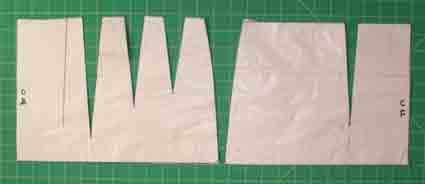
One pattern making book even forbids using the result I found I needed (3 back darts, to deal with my indented waist above high hip pads – she said you should never use more than 2 darts).
–
So this is yet another rant from me about pattern making and fitting classes which, despite their grand claims, only work well for people who are close to average.
Sadly those of us who are far from ‘average’ in our body shape need to do much work and exploration to find what we need to get a good fit. It may take years before you feel satisfied, but every little improvement is a help and an achievement. You have my sympathy ♥️
I have long been angry about personal pattern drafting classes which generate ‘blocks’/ ‘slopers’. But I am pleased that, after decades of struggle and upset from believing the claims of pattern making and fitting sources, I do know both which basic patterns I need and how to get them 😀
I still don’t know whether I should call these basic patterns ‘blocks’ or ‘slopers’. But I don’t much care – it’s having them that matters 😀
(2023 : I have recently read a book from the 1920s which says a ‘block’ is a basic pattern with stitching lines at the edges, no added seam allowances. Like the patterns used in Burda Style magazine, and in ‘couture’ sewing. This is the base pattern it’s easiest to start from when changing the style of a pattern. I don’t know if this meaning is still true – the terms ‘block’ and ‘sloper’ seem these days to be used quite loosely.)



 Sewingplums