Do you feel special in your clothes ? Do they help you to feel you ? to feel confident ?
There are many sources of personal styling advice :
– national styling companies with local representatives who do face-to-face consultations,
– in-store shopping advisors,
– on-line advisors, some of whom do personal consultations locally or on-line using Skype, Zoom or photos,
– interesting individuals who have come to their own conclusions (find by word of mouth),
– books – there are shelf yards of books on choosing your best clothes according to your colouring, body shape, and personal style. Here’s my post on my favourite styling books (written in 2013 so now somewhat out of date).
The first post in this group was about what style categories can do for you, and how to use them.
This is about some on-line sources of advice about ‘best clothes for you’. Only a small selection, or this post really would be huge.
Even so, this is a very long post (nearly 7000 words !) with several main topics :
Stylists who advise about personal style, the clothes you are happiest wearing.
Stylists who advise about how you can best flatter your colouring and body shape.
Stylists who advise about planning a ‘capsule wardrobe’, a small group of co-ordinating clothes.
If the main style categories are not ‘you’ : this post ends with an extended section of things to try if you can’t find yourself in other people’s categories !
Of course most styling sites are set up to help people who don’t sew. But there are a few who give pattern advice, and I’ve noted them.
This ends with comments on what to do if you feel the stylists don’t cover your needs. There are no absolute rules about styling, so you won’t find all stylists suggest what works well for you. We all have different personalities – if you’re a person who likes soft over-sized clothes, you’re not likely to get on well with a stylist who loves tailoring ! Try the stylists who look as if they allow for your preferences, and if they don’t then move on. And not to worry if none of them do, there are many other ways of exploring your own style. See the next post for some ideas.
– – –
Personal style
Doctor T Designs – Kibbe styles – see Sew your Kibbe under the Wardrobe Planning tab. There’s a wealth of Kibbe-related guidance on the web. This site is good for sewists because it has extensive suggestions of sewing patterns for each style : within each overall style – for casual, work, and special occasions.
No need to know your Kibbe style, just look through the patterns suggested for likely styles, and see if there’s a group you feel are ‘you’. Sadly patterns can become unavailable quite quickly, but you can get many ideas about what to look for from these images.
I like over-sized slouchy clothes, which here are categorised as ‘Flamboyant Natural’. I’m not the physical type that is supposed to like these styles, nor have I got a flamboyant personality. A good example of the styles being more important than the category name.
Inside Out Style from Imogen Lamport, for colour, body shape and personal style. She has a huge range of excellent free advice.
My favourite saying of hers :
“You want to love your clothes, and have them love you back.”
Her Style Manifesto might be a good starting point for your own explorations.
In the Evolve Your Style course there are daily challenges, a quick way of finding the limits to what you can happily wear – I refused the challenge on the days when she told me to wear bright red lipstick or high heels !
She has collected together a group of her posts on developing personal style.
I enjoyed Imogen’s ‘7 Steps to Style‘ course, not free but rich with useful information on colouring and body shape. And I found the module on personality more helpful (once I allowed myself to be honest when answering the questions 😀 ) than the ’16 Style Types’ course, for which see below.
Stunning Style from April Grow has good posts on five ‘classic style twists’ : cute, edgy, minimal, soft, sporty. I enjoyed her ‘Perfectly Put Together’ course, which analyses the detail of garments and focusses on what it is you really like about your favourite clothes. Her examples are edgy classics but she is always generously encouraging about wearing what you love, whatever it may be.
April also has extended courses on each of the style twists, accessible through doing the Style Twist quiz.
Her posts on her five Style Twists include many inspirational images. Don’t be put off by April’s own style, Edgy Winter. I found many relevant comments for me in the Soft Chic course, and I am the direct opposite to her in both style and colouring. It is very visual, there are many photos which I love 😀 (unlike 16 Style Types, see later).
Sadly Truth is Beauty is not as good as it used to be, she no longer provides free access to her inspirational Pinterest boards on her 63(!) style categories. You have to buy her Style Calculator. But look at this page for the style category names. Type a name you think you may be in the search box upper right and many blog posts will come up below the products.
I’ve never thought of myself as living in a fairy tale, but if you do then what fun 😀 Though Fantastical Beauty (see top right on that page) is another site that appears to have dropped the useful services – there’s no longer a free guide to finding which of her types you may be.
If you register for the Love to Sew podcast they send you a brief ‘Create your dream wardrobe’ pdf. Unlike most style courses which are for buyers rather than makers, it ends with a section on planning your sewing.
I found it very helpful for pulling out what is important for me. I don’t know if that was made easier because I have already worked through many lengthy courses so had done much thinking on this, and was not disconcerted when their lists of example words didn’t include anything relevant to me. It seems that, in the same way that I don’t fit into any of the quick and easy fit categories, I don’t fit into most stylists’ style categories either.
None of those courses focus only on the young and slim, but if you fear they might there’s a course from 40plusStyle.
As stylists do not all see the world in the same way, it’s helpful to search until you find one that suits you. For example, these 4 stylists expand their style categories in different directions :
Imogen Lamport and Truth is Beauty both use 7 personal style categories. They both include the basic 4 that are used by many systems : Classic, Natural, Dramatic, Romantic.
Then Imogen Lamport adds Elegant Chic and also Creative, Rebellious – rather aggressively quirky in style, which are more ways of being Dramatic. (Creative here means a unique combination of pieces, usually the wearers are not makers.)
(In my opinion, Kibbe’s styles are also inclined to Dramatic. In his book he really doesn’t know what to do with soft classics, they just get ‘mother of the bride’.)
Truth is Beauty adds Ethereal, Gamine, Ingenue to the basic 4 styles – quirky on a quieter smaller scale, these are more ways of being Romantic/ Feminine.
April Grow at Stunning Style specialises in 5 varieties of Classic – cute, edgy, minimal, soft, sporty.
Classy yet Trendy’s 6 categories include several options for Natural/ Relaxed/ Casual style : stay at home mom (soft relaxed), athleisure (sporty), teacher (‘elevated’ casual – no blue jeans), french minimalist (both dressy and casual, neutral colours only), essential (both dressy and casual), also workwear (classic).
Which of these, or perhaps someone else entirely, suggests styles that you feel are ‘right’ for you ?
If your style is far from mainstream, you may have to do much searching before you find an advisor you feel at home with. Many stylists don’t even mention some of the possibilities, so don’t help you to realise they exist. As examples : I love heirloom stitching and smock styles. Truth is Beauty used to be the only site which mentions them. Now that April Grow at Stunning Style is showing styles which are not Edgy (in her Style Twist courses) she does include them.
And there is a fun Facebook group for lagenlook, which style advisors certainly never mention 😀
Or perhaps the teaching style doesn’t suit you. Many people love Merriam Style. But I need an overview to start from, and I didn’t last five minutes with her videos ! One of the courses below in my ‘not for me’ section is mainly in words, while for style I do better with images.
You Look Fab has daily posts on style topics – fun to follow, but not the best place to start as a guide for your personal style search.
We are all different, and I suspect the best/ most helpful course to take very much depends on the individual.
I personally have got the most out of :
Truth is Beauty – I was lucky to find her when she gave free access to many inspiring images, the first style advisor I found who includes my style. She has 63 style categories, many more than most people.
Seamwork magazine Design Your Wardrobe class (only open to members) – includes a thought provoking section on finding your own style – and no categories !
Stunning Style Society – April Grow’s style is nothing like mine, but I did find her constant emphasis on wearing only what you love (in her Perfectly Put Together course) had a big impact on the quality of my wardrobe. She has excellent collections of images for each of her ’classic style twists’.
– – –
Examples of personal style advice ‘fails’ for me
I’ve so far mentioned some on-line stylists I have learned from. But there are ones I find less useful. This isn’t all of them ! – and it is important to recognise when none of a stylist’s suggestions are right for you.
For me, Dressing Your Truth is very limited, I can rarely fit people I know into it. But people who aren’t used to the idea of having a personal style, or who want to be told what to wear, often find it a helpful starting point. It divides us into 4 Types according to how we mainly use our energy, basically : fun lovers, sensitives, achievers, perfectionists. Everyone of the same Type is supposed to wear the same style and the same season of colours : Spring, Summer, Autumn, Winter, and have the same facial features. (There have been 100s of research studies looking for a relation between physical characteristics and personality, and none have ever found anything.) The wealth of human nature means there are more than 4 types of people, and people who do fit the 4 DYT Types do not all look good in the same colours. I’m definitely ‘sensitive’ and wear soft shapes (Type 2), but I look best in clear warm quiet colours, terrible in muted cool ones. 30somethingurbangirl also pairs style type and colour season, but in a different way – these things are not set in stone ! However there are many free videos on the DYT site, which may help with getting a quick idea of where your tastes lie, and what to look out for when assessing clothes. I’m not a ‘believer’ in DYT (I prefer the Stunning Style approach of ensuring every detail of what you wear is your own choice of what you love), but I confess I enjoy watching the make-over shows.
Imogen Lamport’s and Jill Chilvers’ Your Type of Style : 16 Style Types course is on dressing your MBTI personality Type. Okay, 16 Types are better than 4, but still don’t capture the whole of human nature !
I first tried the shorter ‘Discover your style type‘ course. I had never, in years of reading books about it and trying tests, found which MBTI Type I am. From the indicators given in this course I am, as usual, ‘6 of one and half a dozen of the other’ on 3 of the 4 MBTI dimensions (the same result in the test on the official MBTI site). This course matches some of my attitudes to clothes and shopping, but there’s very little about specific styles to wear.
Despite that, I naively and optimistically signed on for the longer course. There is more in the longer course, but it relates most of your style options to your MBTI Type. So if you can’t manage to constrain yourself to a single MBTI Type (it’s mainly a tool for middle management), or you don’t recognise yourself in Imogen’s 7 style categories (they lean towards the Dramatic, see above), then you’re unlikely to get much value from this course !
Some people fit into this system well, and find this approach opens up important insights for them, but many people dropped out when I took this course. And from the course attitude – you ‘must’ be one of the 16 Types – I suspect many of them left feeling there was something wrong with them, which is sad.
There are 100s of personality tests, which all test different aspects of us multi-dimensional human beings. Some personality descriptions may suit us and some not. For example an Amazon reviewer says of a book on the Enneagram : “Just made me feel bad about myself with a diagnosis that totally didn’t fit”. I.m the opposite – I can see where I fit in the Enneagram, and feel that way about the MBTI !
The MBTI is just one personality theory among many, and none of them can be completely accurate, only helpful. Each theory captures some fragments of our complex natures. The MBTI is obviously helpful for these authors, and for some of the rest of us, but not all.
Though it must be said that some people take the opposite approach. Instead of retiring defeated when they can’t find their single Type, they repeat this styling course again and again, each year ‘trying on’ a different Type and learning more about themselves (repeats are free).
There is a post about ‘The Magic of your Style Type‘ which does imply that the reader is at fault if we don’t agree with and value every word of our Style Type Report.
Sorry NO. My MBTI type is not random, I am definitely IN. So I accessed the Style Reports for all 4 IN Types. I am slightly more likely to be INF than INT. p.1 of the Reports for INFT and INFJ Types says “You are looking for a style solution that assumes you are a talented, intelligent and curious woman”.
Then lower on those pages there is this image

Are the authors of the course saying that when I get in touch with my true inner core nature I will find myself wanting to wear shoes like those ? I find that idea deeply offensive. A person I know who runs a stable was appalled by this photo. Perhaps there are people who dream of wearing such shoes, I do not even want to meet the designer.
Here instead is my favourite personal ‘items I love’ mood board. Could my style be further from those shoes 😀

This image does align more with how they describe people of my type later in the Style Report, as : Conscientious, Empathetic, Visionary, Private, Value-driven, Perfectionistic, Planful, Reserved, Idealistic, Sensitive.
It isn’t clear to me what clothes such person would like to wear, but it definitely is not vicious shoes !
While INFPs are the people who campaign about causes, I would guess they are equally shocked by those shoes.
The contrast between that shoes photo and my personal style favourites certainly does not inspire in me any confidence that reading the rest of these Style Reports will give me useful insights and support. Nor does it encourage me to believe, as the authors claim, that the writers know my inner self and needs better than I do.
Are these shoes really the best image they could find to represent INFs ? That does not convince me the authors put much effort into finding the images for this course. The INTs get a photo of someone in a law library. Well, I would find it less offensive to be represented as boring than as cruel and barbed.
Altogether the ’16 Style Types’ course is short on images and is mainly written instructions, so if you like a good choice of images to get ideas from, this is not for you. I picked up a few pointers about my style early on, but just skimmed later sections. Despite my very wordy blog posts in my techniques blog Aim for Quality, I need images for styling (many images in most of my Sewingplums posts).
Some possible sources of good image collections :
Truth is Beauty no longer provides free access to her inspirational Pinterest boards on her 63 style categories. But look at her page for the style category names. Type a category you think you may be in the search box upper right and many blog posts will come up below the products.
The Stunning Style Chic Twist posts and courses are excellent, full of photos and good advice.
Or look at the patterns suggested for different Kibbe types by Doctor T.
Another issue is that the 16 Style Types only has Imogen’s 7 style categories to align people with. And they don’t include all the possibilities. For example she, like Nancy Nix-Rice who I generally admire, is someone who would never suggest you might like to wear lagenlook.
If you feel it would be helpful to be analytic and verbal about how clothing style elements relate to your personality, and you get a clear answer on MBTI tests, then you may find the 16 Style Types course worthwhile. But what if you learn your style by noticing what makes your heart leap, rather than from logical analysis ? If you are a visual and heart person, who needs images for inspiration and chooses what you like to wear based directly on how you feel when wearing it, then you may feel this course is an expensive mistake. Instead, if you have taken any of Imogen’s paid-for courses, you’ll have free access to her ‘Visualise your style’ course, which does focus on images of what you love. Follow William Morris or KonMari – keep only items that are useful or ‘spark joy’.
On a positive note, as pretty well everything about this course is wrong for me, I learned a great deal about myself and my needs 😀
I got good value from Imogen’s ‘7 Steps to Style‘ course, which has detailed guidance on best colours and body shapes, but not here.
Personally, I have found the ‘Authentic Happiness’ survey of character strengths a much more helpful indicator of my nature than the MBTI – though it’s not all obvious how the results might relate to my clothing style 😀 The same with the Enneagram.
As an alternative to 16 Style Types, April Grow’s Perfectly put together course puts the emphasis on wearing what you love. April’s own example outfits are Edgy styles in Winter colours, but the main inspiration applies to every style.
Ultimately I’ve found it much cheaper and more effective for me to use Pinterest to collect images of clothes I would like to wear. But of course that will be no help for people who would prefer to be given some general principles for styling. 16 Style Types claims to do that but, as my comments on those shoes show, I don’t trust their opinions. Perhaps you would like to pick out some key words to describe your style, and use them for reference when you are deciding what to buy/ make ?
Here’s another style advice example which is not right for me, but will be well suited to some other people (such as one of my niece-in-laws ♥️). My Private Stylist has a questionnaire which she claims guides you to 1 of 50 categories. But the first 2 questions are about shoes and all the choices have high heels, which I never wear. Then the next 2 questions are about dresses – I haven’t worn a dress in decades, and all the choices have a fitted waist, which I didn’t wear when I did wear dresses. So I don’t think going through the rest of the questions would be likely to lead me on a path of self-discovery. Of course many people love the clothes illustrated, but that is not where I belong.
We just need to accept this will happen with some stylists – it feels as if they limit our possibilities to ones which make us feel uncomfortable, rather than opening up a rich vista. If so, choose to move on.
– – –
In the same way that we may find we’re a mixture of stylist’s personal style categories (or we don’t fit into any of them 😀 ), we may also find we don’t fit neatly into any simple body shape or colouring categories (I certainly don’t, see later). But it can still be helpful to see what we can learn from these systems about what may be the best choices for us.
The first half of this post discussed some of the on-line style advisors, for and against.
This part has sections on advice about :
– body shape,
– colouring,
– wardrobe planning, particularly about capsules, but also suggestions to consider if the capsule idea does not appeal.
Then the final section is about what do to do if you don’t recognise yourself in any of the stylists’ categories. After all, the categories are not great and universal truths. Human physical and personality characteristics are widely spread on many dimensions. See the final section below for some suggestions about the many options you can try instead of trying to fit yourself into categories.
I have been falling into this ‘you must be in one of these categories’ trap for decades, and am only just beginning to recognise that I need personalised assessments, not to try to force myself into some category or other. The trouble is that personalised assessments can be so detailed they are thoroughly confusing/ overwhelming for beginners. People with less style experience do need style categories, to try to make sense of the huge arena of options. But ultimately they may find that a category is more limiting than making their own decisions.
– – –
What is best for your body shape
As far as I know Imogen Lamport’s Body Shape Bible is the most detailed information you can find on-line about how to flatter your body shape : your silhouette, your length proportions, and your other special features such as large bust or rear.
Make what use of it you can. As usual I’m mixed, clearly bottom heavy so a ‘pear’ or ‘A’ in Imogen’s system, but not ‘triangle’ as I have a clearly defined waist, an 8 in Imogen’s system. So I’m mixed pear/hourglass. In Imogen’s system there are many of us who are ‘A over 8’.
(For books, I think this one is excellent : oop Flatter your figure by Jan Larkey. She doesn’t suggest body shape categories, just deals with different body features. And recognises the problem that what is recommended for one part of you may be best avoided because of another part 😀 )
And you may love garment styles which don’t flatter your body shape – well, not to worry, go for what you love (hourglass figures who love lagenlook ?). Here is Imogen’s post on why your personality is more important than your body shape in determining which clothes you look and feel best in.
Indeed there is now also a very different approach to dressing your body which, instead of comparing bust waist hip widths (with suggestions about illusions which make you look a more ‘ideal’ shape, which is a very 50s idea), looks at length proportions and yin-yang features.
Here’s a video from Audrey Coyne who tries out 4 different ways of doing this.
The analysts all come up with such different recommendations it’s obviously rather an individual-subjective process, but there are some interesting ideas to try out.
The four analysts are :
6.30 min. Elyssa.
13 min. Frani.
23 min. Nona.
26 min. Rachel.
Frani and Nona both use the Kibbe body typing system and (fortunately) both choose the same type !
Audrey Coyne also has a YouTube channel and a blog.
Much to watch from all of these people if you enjoy style videos.
More recent advisors also focus on celebrating and drawing attention to your good features, rather than trying to disguise your less ideal ones. Personally as a ‘pear’ shape I prefer to draw attention my slim shoulders, rather than to make them look as wide as my hips !
– – –
What is best for your personal colouring
Probably the best colour advice comes from a personal face-to-face consultation using fabric colour drapes. Though even these are best done by someone recommended, as they may use a system which gives minimal training.
There are many on-line colour analysis services. Most of them do not mention grey hair, and if they do they often insist if you have grey hair you must have cool skin – so not for me.
These on-line services fall in three groups.
People who give general advice about colour categories.
Many people find this page from Cardigan Empire is a helpful starting point. For me, she’s just another person who doesn’t mention grey hair 😀
There are many ‘expanded season’ colour services online, with simple DIY analysis. I particularly like True Colour.
People who give personal advice based on photos you send them.
As screens, cameras, software and printers can alter colours, personal colour advice is not something that’s easy to do well on-line or from photos. In my opinion, advisors who do not insist your photos are taken in natural light without wearing make-up are even more unlikely to be correct.
People who send physical colour comparison cards.
I think courses which mail you physical comparison colour cards are better than courses using only virtual colours. You hold these cards up against your face, and you or they decide which look flattering and like you. As both you and the reference colours are in the same lighting, camera, processing software etc. the comparison is likely to be more valid.
I have tried a service which sent colour cards which were none of them anything like me (now not available). I haven’t tried all these methods, but have found 2 examples which for me gave useful advice :
– the DIY Color Style Kit (mainly colour wheel colours), finds your colour type on the 3 dimensions warm-cool, bright-soft, light-medium-deep, using mailed reference cards, and assigns you to a category. Follow with her next level course, Discover your color style, which doesn’t use categories and works better for my mixed colouring. Includes detailed advice for grey hair and/or dark skin.
– the colour section of Imogen Lamport’s ‘7 Steps to style’ course – Inside Out Style, see top tabs – also mails colour cards. More subtle colours – sadly almost impossible to find in clothes or fabrics.
Here I am with Imogen’s ‘cool’ and ‘warm’ colour cards.
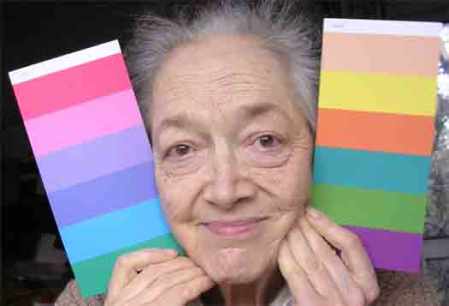
I have cool grey hair at the front, warm grey hair at the back, cool lips, warm skin and eyes (since that photo was taken my eyebrows have greyed). Cover the warm card and I look strained, cover the cool card and I look healthy – fascinating. Obviously I don’t fit easily into any simple colour category. I do look at colour suggestions to see if there are any useful options I might try. And have decided I am right that only a very small range of colours make me look good.
Both those systems which send comparison cards use their own colour groupings, rather than a ‘season’ analysis.
They use warm-cool, bright-soft, light-medium-dark colour dimensions.
Nancy Nix-Rice adds level of contrast and size of pattern to those, and for many of us they are important.
–
Some colours are greatly affected by lighting. I have a khaki hoodie and boots which both look brown in some lights, green in others. And a greige poncho which looks grey in direct sunlight, beige otherwise. This might be important for you, for example if you test colours at home in natural light, but spend your working day in fluorescent light.
So the first colour issue is what colours make your skin look healthy and your eyes shine. I look like a living-dead-witch in black, not a good look for a special occasion. But the second important colour question is which colours you feel happy wearing. Here’s a post by Imogen Lamport on your colour personality.
Like my points in the first post, about style categories – the aim of colour categories is to support us in finding colours that we look and feel good in, not to force ourselves to fit into some colour category scheme ! I’ve spent time in my life trying to be a Summer, a Spring, an Autumn – the only season I’ve clearly never been is a Winter. Now with my cool/warm grey hair, warm tan skin, cool pink lips, warm brown eyes and eyebrows – I’m part warm part cool, part bright part soft, part light part medium. There are no simple rules for what colours are best for me, but I do try colour advice to see what is helpful. And actually with my ‘colour personality’ I mainly wear neutrals anyway. But not all neutrals – I look dreadful in black and in denim blue, and it’s surprising how many fabric stores sell only cool colours. . .
– – –
Wardrobe planning
A ‘capsule’ wardrobe is small group of co-ordinating clothes that can be mixed and matched to make different outfits. If you only have a small number of clothes, you want to be sure they fit the needs of your lifestyle. And that they’re all items you love to reach for in the morning – they suit your personality and make you look and feel good. Hence the whole area of ‘wardrobe planning’.
Most of the discussions about wardrobe planning are about capsules, perhaps with the notion that someone who is trying to start afresh with getting their clothing sorted out will be starting small. But of course a capsule of co-ordinates which can be mixed and matched is not everyone’s concept of an ideal wardrobe. So there are links at the end of this section to some discussions of other approaches to wardrobe planning.
There are 100s of people on-line telling you how to plan a capsule wardrobe. Stunning Style from April Grow is one. These are some of the others :
The Vivienne Files is a site bursting with methods for planning a capsule wardrobe, but most of the clothes shown are ‘normcore’ in style. There’s a big focus on colour co-ordination, but little on finding your most flattering colours. Excellent if planning or revamping your wardrobe are what you want to optimise, but little help with alternative styles.
Classy yet Trendy also suggests specific capsules, in some nearly-normcore styles : teacher, essential, workwear, athleisure, stay at home mom, French minimalist. The first 3 differ mainly in how formal the clothes are : all casual, some casual/some dressy, all dressy. ‘Athleisure’ is a little more sporty, ‘stay at home’ clothes have a little more softness, and the ‘French’ clothes are a little ‘edgy’.
Those sites have links to specific RTW items in the capsule (they earn their living from people following their recommendation links).
Usually they recommend standard styles and there are many patterns which could be used to copy them. But the sites support shoppers not sewists.
The next capsule sites are for sewists and include pattern advice :
Nancy Nix-Rice has :
– ‘Looking Good’ book and DVD.
– a Craftsy video class.
– blog posts suggesting sewing patterns, many from Pamela’s Patterns.
– a membership site with a 3-month on-line class and community discussion, Looking Good Together.
Meg McElwee of Sew Liberated patterns has a Mindful Wardrobe course which combines : personal style/ colouring/ fit, devising a capsule wardrobe, the deeper issues of clothing and sewing as self care.
The Wardrobe Architect posts from Colette patterns are an interesting series of exercises on all aspects of choosing your clothes.
Seamwork on-line magazine with patterns has a Design your Wardrobe 3-week video class. Also from Colette patterns, you have to be a Seamwork member for access.
In The Folds pattern company takes a different approach. Instead of making an entire wardrobe from scratch, they suggest you assess your current wardrobe and sew to fill the gaps.
These next 2 classes have capsule and pattern suggestions, but don’t cover the wider issues of personal style, body shape, colouring :
Sandy Miller shows variations of Cutting Line patterns, at Threads magazine. Cutting Line have a pdf of their pattern line drawings, so you can play with outfit combinations, perhaps try them on a personal croquis.
Sewing Workshop pattern’s Sew Confident series builds up a capsule wardrobe over the course of each year. The courses include much technique advice and sew-alongs, but assume you look good in their styles, and in black !
Most pattern books from indie pattern publishers don’t include wardrobe planning advice (lifestyle, personal style, colouring, body shape). This one does: Dressed from Deer & Doe patterns has 9 downloadable pdf patterns claimed to be makable in an afternoon. I don’t know about that, but they are all simple, with a wide variety of style elements which, with a little knowledge of pattern hacking (not included), you could combine in many different ways.
–
Not attracted by capsules ?
Many stylists tell you how to build a capsule, but that may not be the best way of organising your wardrobe for you. Imogen Lamport has an interesting piece on whether you prefer capsule, formula, or uniform for your clothing. Nancy Nix-Rice also has a post about using a fashion formula. Even more simply, you may be an ‘outfit’ wearer, if you don’t want to have to mix-and-match clothes, and you always wear each item with the same other items. Or you may be someone who doesn’t want any limits to your style choices (though such people are unlikely to be reading this !). I’m a Uniform person – but you may love just going with the mood of the day 😀
More on capsules in this specific post.
And more about alternative approaches to capsules as a way of ‘wardrobing’ in this post.
– – –
If the main style/ body/ colour categories are not ‘you’
You don’t actually need to know your style category. Categories are tools, they may aid communication, and help style advisors to point you in the direction of clothes you may like. Many of the style advisors don’t mention it, but are actually oriented to suggesting clothes suited to professionals at work, or for stay-at-home mums, or for people who are able to dress casually at work.
Categories can lead you to groups of clothes you may like to wear. But they’re not ‘big truths’ which all advisors agree on ! There are many other options for finding your own style, suggestions in the next post. The most important thing is to notice and remember which clothes you feel and look your best in 😀
If you do not feel recognised or validated by any of the stylists’ categories, that does not mean you have no style. It just means none of the style advisors who use categories think yours is a style that many will be interested in.
There are several style advisors who don’t try to fit you into a category but take a more personalised approach. Examples are :
Seamwork magazine Design Your Wardrobe class (only open to members).
Sew Liberated patterns Mindful Wardrobe course goes into general issues of ‘self-care’ in both choosing and making your clothes.
Instead of trying to fit yourself into a category, you might start with this list of style questions. If you have any preferences at all, you have a personal style 👍.
If you do want to go further with getting advice from others, look at the suggestions from several stylists. For example, one person’s advice for ‘natural’ may not be the same as another stylist’s advice for ‘casual’. Stylists certainly don’t all agree. As an example, some stylists say that Casual and Chic are complete opposites, while others have a ‘Casual Chic’ category.
Style is a matter of judgement and opinion, not accurate measurement. This can be difficult for people like me, I prefer clear simple rules when I’m learning something for the first time (though I’m flexible later). That really is not possible with ‘style’. So look for stylists you feel you have something in common with, follow them as far as they can take you, but be prepared to move on.
April Grow at Stunning Style says there are only 2 rules : wear what you love, and don’t spend beyond your budget. The details of what works for us we have to explore. Trying style courses may help with this by showing us some of the options, but ultimately we have to make our own decisions.
You may come across style words which you respond to, but which the general stylists do not give information about because the words only apply to a small percentage of people.
Search style words in google, pinterest, youtube.
Try : lagenlook, mori girl, folkloric, vintage, retro, prairie, pioneer, western, hip hop, grunge, punk, goth.
New style words emerge in each season and each sub-culture.
I’ve recently come across a new style word ‘cottagecore’ which could be a good word for me, though it apparently has political connections which I am not in sympathy with.
What is the style of your favourite movie or fantasy character ?
Would you like to look like Iris Apfel or the ladies with Advanced Style ? wear Ivey Abitz style ?
Are any of the Folkwear patterns to your taste ?
Some people like to follow celebrity/ influencer style. But celebrities/ style ‘influencers’ have genes which mean they look good photographed from any angle, near average bodies so RTW fits well, and apparently unlimited budgets (or they get lent clothes by designers). My gifts lie elsewhere so I don’t feel I have much in common with them ! If you do like this idea, have a look at the celebrity outfits suggested by StyleARC patterns (though do not believe the StyleARC claim that their clothes fit everyone, that is just not possible, see this post).
Or start from images rather than words. Cherish and collect the images which do ‘speak’ to you.
Choose a pinterest image and see what pinterest suggests have something in common with it.
Also check for your own wardrobe needs. I wear mainly pullover layers and vests, and they’re rarely mentioned in wardrobe plans or by stylists.
– – –
Finally
Getting closer to wearing your own style is a way of making you feel better about yourself, not worse ! These are some of the pitfalls I’ve experienced with personal style courses :
Notice how you respond to a stylist. I’m a quiet person, and some stylists have such powerful personalities I feel knocked sideways from myself. Or they emphasise all my inadequacies as a way of convincing me I need their course. Despite their big claims, some of them make me feel lesser – those I’m learning to avoid !
Oddly, many of the sites which claim to cover all styles don’t include anything like what I love. But they may insist strongly that they do include everything, even that there’s something wrong with you if you can’t find where you fit in. That attitude can make me feel so invalidated/ alienated/ knocked off-centre, I need to carry some self-care supplies while exploring them. Is there something to look at/ hold/ listen to, a person, an activity, which automatically makes you feel yourself, so you can get grounded back at your centre again ?
And what does that item say about your style ? What items do you have in your life which you chose without knowing your choice ‘mattered’ ? My avatar was chosen long before I knew there was such a thing as ‘personal style’ 😀
 (Embroidery Library C8464)
The header for this blog (a piece I made long ago by following what I liked the look of) was made long before I knew my choices might say something about my inner self ! This blog was started in the days when the fashion advisors in the top fashion magazines all said the same things were fashionable each season. I grew up in that sort of era, but those days are gone. I gave up writing ‘fashion’ posts here when the fashion advice for the coming season from Vogue, Elle etc. did not have any common features. When Vogue and Elle say different styles are fashionable then, if you follow them, only other readers of Vogue or Elle will know that you are ‘in fashion’. Which is a rather small proportion of the population. The same for Pantone colours. The last wear-these-items-to-be-in-fashion post from me was written in Spring 2013.
Also there are several sites which claim to be all about ‘self expression’ in your clothing choices, which actually have quite strict rules on how you go about expressing yourself – what type of person you ‘ought’ to be expressing. As if there’s only one way of dressing to express yourself. I think you ought to feel free to be an extreme classic, or very unfashionable. Wear totally mismatched wrongly proportioned clothes. Wear only black with sharp angles. What makes you feel truly you 😀
And beware courses which offer a styling ‘rescue fantasy’, suggesting that all the decisions have been made for you, and all your styling problems will quickly be at an end. This may be a good place for styling and capsule planning beginners to start from, but ultimately to get your style right for you, you do need to respond to your own feelings about the suggestions made. See the next posts for some ideas on making your style more personal to you.
Go along with any stylist who helps you feel you know what style direction to go in, but only follow them as far as they do. Once you start to feel you don’t fit in, or that you’re having to force yourself to follow their suggestions, then thank them for what you have learned from them, and move on to look for other insights elsewhere. And one day you’ll find yourself making your own style decisions 😀 which can be exciting, even exhilarating 👍 ♥️
May you enjoy yourself and have Good Fortune on this quest 😀
– – –
There are 4 in this group of posts about personal style. The others are :
1. using style categories.
3. exploring styles.
4. trying on clothes.
– – – – –
Originally written August 2019, links checked March 2024
= = = = =




 Sewingplums