Archive for the ‘style and planning’ category

Some sources suggesting basic capsules

March 2, 2013

Having at last made my final Index page 5 which lists posts on co-ordinates and capsules, here are some other capsules which could be the starting point for a basic wardrobe.

There must be thousands of attractive inspiring outfits on the web. Apart from all the style blogs, Polyvore is set up to devise them, and there are multiple Pinterest pages.

A capsule is more than an outfit – a small group of co-ordinated clothes which can be interchanged to make several outfits.
Perhaps (2 tops, 2 bottoms) to make 4 outfits.
Or (jacket, shirt, 2 tees, pants, jeans) which together make 12 outfits to cover many situations.

Here’s my post on basic capsule options : building your wardrobe in small groups. Start with one capsule and simply add another similar.

There’s so much advice available on capsules and wardrobes, I’m amazed how many people aren’t aware of the idea 😀

Judith Rasband’s college textbook Wardrobe Strategies for Women bases wardrobe building on capsules.

Once you set up the basic pieces, every time you add a co-ordinating item it can double the number of possible outfits. See my post on the power of the boring.

There’s a discussion on minimalist wardrobes at You Look Fab.

Project 333 allows a free choice of what to include in your wardrobe, but to a limit of 33 items including : clothing, accessories, jewellery, outerwear and shoes. As many wardrobe planners suggest a basic group of 5 – 12 garments, that’s quite a generous allowance really 😀

If you find it easier to take inspiration from specific capsules or to react against them, rather than devising your own starting point, here are some of the many possibilities.

Some are specific enough to show a particular style. Some are just numbers of garments. Though even numbers have style implications. Most for example include 0 or 1 dress – no use if you love dresses.

Some of these groups just count clothes, some count both clothes and accessories. If you’re allowed infinite numbers of accessories, you can make infinite numbers of outfits with very few clothes, see the Uniform Project.

– – –

Here’s an 8-item weekend travel capsule consisting of 4 garments, 4 accessories.

Or here’s a group of 6 garments – jacket, 3 tops, skirt, choice of 2 pants : The Kit (click on the photo for more detail about each style).

In style contrast, Perfectly Packed has a classic business wardrobe of 8 garments, which can be copied easily using two wardrobe patterns, see my post on classic style.

Tim Gunn’s 10 essential elements
His 10 items are clothes only, add accessories.
For example variants of this, see the middle of my post on your personal wardrobe plan.
And Imogen Lamport’s thoughts on this list and her own version.

Imogen has several suggested capsules for different lifestyles, mostly about a dozen items. Here’s her post on a capsule wardrobe of 12 items. And here’s her post on combining colours and combining prints, very ‘this season’ co-ordination.

Stylist Angie Cox also has a few posts on capsules at YouLookFab, and now has a section called Ensembles. (She uses the word ‘outfit’ for groups of clothes on a specific person.)

Elizabeth (ejvc) suggests a 12-item group, and prices it (about $225) for sewing. If you want natural fabrics, you need to use just one pattern magazine, and mainly black fabric, to get the cost that low. Much cheaper if you’re comfortable in polyester. I would probably use a wardrobe pattern book (see Index page 3), about twice the price of a pattern magazine.

This list from the Nate Berkus Show
has 12 basic items including accessories, plus 8 add-ons : 20 in all.

Wardrobe Oxygen list updated
23 items including underwear and accessories.
I still disagree with nearly very word of this, see my post, but many people working in a very classic environment love it.

Nancy Nix-Rice builds up from 12 basic garments to 23 garments in all, plus suggestions for minimum accessories. She claims to get nearly 100 different outfits from her 12 garments. See Index page 4 for my posts on her scheme, with links to her lessons, and suggested patterns.

Seasonal 6PACs : 24 garments in all, organised in 4 seasonal groups of 6. Here’s a list of relevant posts from ejvc, who started the idea. There’s always a sewalong for the current season at Stitcher’s Guild.

Oprah Winfrey’s dream closet checklist
32 items including shoes.
(Useful tips there too on clothes that flatter different body shapes.)

Many of Janice’s posts at The Vivienne Files are suggestions for capsules, showing the different outfit combinations you can make. And most of her other posts show how to take a single garment or outfit and make many different looks by using accessories.

And here’s a whole pinterest page of capsule suggestions.

For real-life inspiration, see :
Sewing With A Plan 2013
Sewing With A Plan 2012

– – –

What about some patterns ? Most of the capsules don’t suggest specific styles. So here are my current personal easy sewing ‘Key 3’ patterns. Sewing Workshop Hudson top and pants, Indygo Junction Origami wrap.

”swhudson”
”ijorigami”

Add intermediate sewing skills, and make the Sewing Workshop Tribeca shirt and Indygo Junction Silhouette vest (close the vest up to the neck). My current ‘Vital 5’. In quality fabrics for Relaxed Luxe style.

”tribeacasilhouette”

Very different in spirit from many wardrobe plans. My needs are most like the Sewing Workshop wardrobe, see my post on Linda Lee’s layering wardrobe.

– – –

I groaned recently about some wardrobe styling advice which suggested what were supposed to be different style capsules, but were actually all variants of blazer, knit top, jeans. As I don’t wear any of those. I’m glad I’ve done all the work on identifying my own style and wardrobe needs, so I can just move on from unhelpful advice. People who love dresses probably feel equally ignored by most wardrobe suggestions.

If your personal style is ‘modern classic’ and you feel happy in blazer, tee, jeans, then good luck to you. Prefer different types of top, bottom, layer, or dresses ? Best Wishes to all the people who have to find their own capsule scheme.

Is it because I don’t match any of the simple advice on fit, colouring, style, body shape, that my blog is helpful 😀

I think most wardrobe lists need to be adapted to your own personal style, colouring, body shape, lifestyle.
(All that black and classic shapes – aargh. . .)

Hence my post on your personal wardrobe plan.
See Index page 4 on wardrobe plans in general.
Also your personal style preferences.
And Index page 1 on personal style.
There are some links on the other ways to look your best, in my post on So many choices.

If you haven’t got a good starting point for your own wardrobe group, have a look at patterns that are supposed to take less than 2 hours sewing time – Index page 8.

See Index page 5 for comments on co-ordination, and posts which include specific capsules.

Starting with a small capsule and building on it isn’t the only way to get a basic wardrobe. There are many books and websites with wardrobe plans with other approaches – see wardrobe and capsule planning references thread at Stitchers Guild. Each writer has their own scheme.

If you still think planning a wardrobe is frivolous, here’s an excellent piece by The Dashing Eccentric.

As usual, have fun with it all 😀

– – –

P.S. Several people have commented that we haven’t got to develop capsules and wardrobes. Just have good outfits, if that’s what works well for you. No need to worry about co-ordination if you don’t want to. Just avoid ‘orphans’ – clothes which don’t go with anything else. You don’t even need to worry about them if you only wear dresses 😀

Or have several different small groups of clothes, which co-ordinate within one capsule but not with others. I should think there are very few people who have a wardrobe in which everything co-ordinates with everything else. Would that only be possible if you led a very limited life ? I haven’t got clothes wearable for both sailing and a black tie evening.

My clothes are in a limited range of colours and shapes so many, though not all, are interchangeable. Not so with accessories – some of my outfits are enhanced by scarves, some by necklaces.

– – –

Links and patterns available March 2013

= = =

Aids to fashion drawing

February 9, 2013

Awed by designers’ fashion drawings ?
Amazed by sewers who sketch their planned wardrobes ?
I thought it was impossible for me. So was delighted to discover this Christmas that there are children’s toys which help with this process.

Clothes shapes

Use stencils that you draw round. Fashion Angels Design Portfolio is one.

”fashion

There are many books/ sets of stencils/ shapes to trace/ stickers, in several styles. Indulge your inner rock chick, dream up impossible red carpet dresses 😀

The shape you want isn’t included ? Make your own stencil.
Print the line drawing from commercial pattern information, onto “printable acetate” sheet.
Cut out the shape to make your own stencil. Not easy but it is possible.

Mock-ups in paper or fabric

There are children’s kits which are the modern equivalent of paper dolls – use templates to cut out pieces of paper in the shape you want, add glitter and trims.
Such as Paper Fashions by Klutz.

Some of these kits contain fabric rather than paper.
Or small 3-D mannequins which are easy to attach fabric to.
Such as Designed by you fashions.

These are obviously popular toys as there are multiple versions. Search ‘fashion’ in the toy section at Amazon.

Good if your focus is fashion design rather than pattern making or sewing.
Personally I prefer to make ‘real’ small clothes.

It would be fun to have a half-scale dress form, such as one from Dress Rite.
Or a quarter-scale 16 inch ‘fashion doll’ with adult body shape (not as distorted as Barbie), such as Tyler-Wentworth.
Generally I can only find sources in the US, and shipping charges are huge.

I’m making basic fitting shells for my 18″ child-shaped doll. So I can play with pattern making 😀 Also – like us – she’s not quite the same shape as commercial patterns for 18″ dolls.

Tips on drawing

Many tips on easy drawing approaches here from Threads magazine.

Fashion Design Workshop is a teen’s guide book on techniques for making your drawings look more like clothes. Lots of examples to copy.

”studio

There’s a bit about fashion drawing in the middle of this video from Simplicity.
From a designer so she makes it look easy.

The basic figure drawing which you add your fashion drawing to is called a ‘croquis’.

The ‘croquis kit’ in Simplicity’s Project Runway patterns includes a fashion figure, and separate drawings of each the style elements in the pattern. They suggest you trace the style elements onto separate vellum sheets, then move them over the fashion figure to choose which combination you like.

Here’s part of Simplicity 1718.

”runway-croquis”

Of course there are many books for people who want to produce professional fashion drawings. I’m just talking about having fun/ doing something that’s personally helpful !

Figure drawing

No good at drawing the human figure ? Many ways of avoiding this.
These aren’t children’s toys, they’re proper fashion designers’ aids.

Shoben Media have croquis templates to trace around.

”shoben

Pose 1 – woman, straight standing
Pose 2 – woman, straight walking
Pose 3 – woman, ‘high hip’ pose
Pose 4 – man, ‘high hip’ pose

Designers use the angled poses to display their work, as they make clothes look better. But to make design details clear, or to sketch from a pattern line drawing, you need the straight standing pose.

There are many sketch pads pre-printed with croquis. The Fashion Sketchpad is an example.

Hmm – compare the Shoben model croquis with a croquis more like me (from a discontinued site showing Trinny & Susannah’s 12 Body Shapes).

”shoben

Obviously sketching clothes onto a model croquis is fun for fashion designers, but not much use in deciding if a style flatters my body shape !

Designers’ croquis have long thin body proportions (ratio of 8 or 9 heads to body), the proportions which make clothes look good. But only a very small number of people have this body shape in real life.
There are free croquis from Threads magazine which have more ‘average’ proportions. They include croquis for petite and plus figures.

If you want to develop an accurate croquis of yourself, the book Fantastic Fit for Every Body by Gale Grigg Hazen has detailed instructions on making one from photos. (P.S. see the comments for several easy ways of making a personal croquis.)

You could print a croquis on tracing paper, so you can trace pattern line drawings onto a body shape.
For this, start with a straight-pose croquis like the ones above.
Check your tracing vellum will work with a printer !
Some fiddling with sizes may be necessary to get figure and clothes to the same scale. Learn to use the scaling function in your printer software. . .

– – –

This is just a small sample of what’s available.

Some people think they can’t play with these books and kits because they’re for children. How sad. My drawing skills are definitely at childish level, and they’re just right for me.

So get out your coloured pencils and have fun 😀

– – –

Patterns and links available February 2013

= = =

What helps you learn ?

February 2, 2013

This time some thoughts on personal learning style. (Earlier posts on our differences in Sewing style and Fitting style).

Sewing involves many skills. Each is complex and can be done many different ways.
So it helps to know what helps us learn 😀

What is the best format for you to learn from ?

There are different ways of dealing with the world, which we have different amounts of talent for.
Which of the ‘multiple intelligences’ come most easily to you ?
– writing,
– reading,
– hands-on work,
– artwork,
– self-evaluation,
– group discussion,
– maths calculations,
– music.

What does this tell you about the best way for you to learn ?

Many years ago a gifted teacher made us learn Latin verbs by singing them to a folk tune. I can still sing them 60 years later. Not sure how I could apply that method to sewing 😀

I like to see, read, write summaries, and do exercises. I’m most relaxed about learning sewing when I have both video demos and written materials. A video so I’m secure about exactly what I’m supposed to be doing. Detailed written step-by-step instructions so I haven’t got to remember every detail. And I definitely prefer physical books to e-books and on-line courses you can’t download and print !

I gave up on a quilt course with teachers who insisted you do a painting of what you were going to make before ever starting to sew. Not for me. But perhaps you find making design sketches of clothes helps you understand what you’re making and the processes needed.

My facility with practical maths probably relates to my enjoyment of pattern making.

If you’re mainly a hands-on learner, you probably don’t often look at this wordy blog 😀 But see the right hand menu for links to sewing DVDs, on-line video demos, and on-line written tutorials with photos.

Details or concepts

I also find an aspect of personality in the Myers-Briggs Type Indicator (MBTI) is very important in my learning – S/N. Are you happy with specific items (S), or do you prefer concepts and only understand details fully when you see how they fit into an overall scheme (N). I’m the second type of person (there are fewer of us), and teaching materials prepared by the first type of person can be difficult to cope with. If there’s no structure provided, I need to work out my own before I’m comfortable.

Specific example : here’s a list of sewing machine parts, from a teachers’ guide that has been available for some time, so presumably many teachers and students are happy with it.
Needle.
Presser foot.
Feed teeth.
Bobbin.
Balance wheel.
Thread take-up.
Upper tension control.
Stitch length selector.
Stitch width selector.
Spool pin.
Bobbin winder.
Reverse button/ lever.

Er. A list like that dances before my eyes.
I spent a while thinking out how to get it to make sense for me, and came up with :

Upper thread :
– Spool pin.
– Upper tension control.
– Thread take-up.
– Needle.
Lower thread :
– Bobbin.
– Bobbin winder.
Fabric control :
– Presser foot.
– Feed teeth.
Stitch formation :
– Stitch length selector.
– Stitch width selector.
– Reverse button/ lever.
– Balance wheel.

Ah, now I get it, of course, that’s obvious. . .

There are so many different techniques and tools used in making a garment, I can find it overwhelming. I need a brief overview of the process, which I can relate the details to.
Some Japanese pattern books summarise the sequence of sewing steps in a numbered diagram. I like to have a written list as well.

”jap

– – –

Other dimensions of the MBTI

Another dimension in the MBTI personality scheme is whether you like (J) or avoid (P) plans. This may affect whether you like to follow a formal learning scheme. I like to have a learning plan framework to give structure to the process, but in real life I rarely follow it!

Introversion (I) and extraversion (E) are probably linked to how much you learn from self evaluation or group discussion.

The final MBTI dimension is whether you react primarily by thinking (T) or by feeling (F). Not sure how that would relate to your preferred learning style. Perhaps Ts like to read all about it first, while Fs prefer to learn by doing.

Challenges or baby steps

How much difficulty do you enjoy coping with ? I like to be guided through a carefully planned sequence of learning steps with detailed instructions. Starting from the very easiest and increasing the difficulty in very small amounts. But many people like the challenge of jumping in, having a go at making something complex right from the start, and working out how to make it as they go along.

My preferences depend on where I am in the learning sequence. I prefer very detailed guidance when I’m first learning something. But once I know how to do it then I can be very creative with thinking what to do with the process, without any further instruction.

I need the outcome of each sewing step firmly fixed in my mind, to feel confident that I can do it again. If I just sew through without pausing to acknowledge that each step is completed, I sort of lose contact with what I’m doing. It’s helpful for me to stop and take stock after each step – recognise the universal skills, what other things I can do with each process I’ve learned, and where I’ve got to in the overall construction process.

Some other pointers

I need to make multiple samples until I feel secure with a method, rather than always pushing on to something new. If I’m really nervous about a process, I set myself to make a ridiculous number of samples – 10, 20, 50 😀 So I prefer to learn by myself with my own pacing. But many people are at their best if they can get to a class and learn with others. And all the repetition which calms me would infuriate others.

I also prefer to learn a new technique within a project specifically chosen for that technique, rather than being given a list of techniques and a list of projects, and having to combine them together myself. But some people passionately dislike having techniques explained within projects rather than separately. Some books and DVDs do it one way, some the other, and it’s good to find ones with the right style for you.

Sometimes learning involves a boring stage. Rewards are good to get you through them. What type of rewards do you enjoy 😀

– – –

Some of us enjoy a lifetime of learning new skills. And some of us are happy creating with a few simple techniques.
Each to their own.

Which of all these intelligences and personality dimensions are your natural gifts ?

(Do read the comments below, as people make many interesting points about their own learning style.)

Best Wishes for finding the type of sewing, fitting, learning that will give you the greatest pleasure and support and relaxation.
And plan to spend your sewing time that way 😀

– – –

Links available February 2013

= = =

How do you like to do your fitting ?

January 26, 2013

More on personal sewing style – how do you like to fit ?

I reviewed fitting aids in a post on aids to well fitting blocks.
Most of those are methods of getting a pattern that’s a better fit than average.

This post is about ways of getting an existing pattern to fit better.

There are two groups of techniques involved :
– methods of fitting (here),
– if you make a fabric trial garment, then there are several methods for transferring changes from muslin to make a revised pattern.

There are many parts of the fitting process. Long ago I innocently assumed fitting was all well understood and everyone used the same method 😀 Now I don’t follow any one expert entirely, but combine tips from several.

– – –

Different basic approaches

Liechty et al Fitting and Pattern alteration show 3 different ways of fitting :
– altering the pattern, on the basis of differences between your measurements and the pattern measurements,
– tissue fitting,
– altering a trial garment (‘reading the wrinkles’).

Many people like to make as many changes as possible to the pattern before (or without) making a test garment. For that you need to analyse your fitting issues, and find the differences between your measurements and the pattern measurements. I thought I’d like to work that way, as I’m good at analysis and practical sums. But I’ve found I prefer ‘reading the wrinkles’ on a test garment. Look for sags and strains, and try changes to see what works. Without any need to analyse what’s wrong and by how much.

Fitting gets better with experience – you know what to look for and what to do about it.

There are some fit alterations where you need to add a wedge to the flat fabric shape, such as doing an FBA or allowing for a large behind. See my posts :
Fabric wedges below the waist.
Note on the FBA.

It isn’t necessary to do this wedge adding to the pattern before making a test garment. If you don’t minding slashing and spreading your fabric, it’s quite easy to add a wedge to a muslin. See the intro photos for Lynda Maynard’s fitting class at Craftsy if you’re not familiar with this technique. Drawings and written instructions in Liechty et al Fitting and Pattern alteration.

It is possible to do this on yourself. You just need patience to keep taking the muslin on and off while you test different size darts or widths of added strip. I add temporary front openings if need be, to make it easier.

It is easier if you have a fitting buddy. I haven’t, but I have got patience. Use a full-length mirror in good light. Light from the side shows wrinkles well. Other people find taking photos is a big help, but that’s not something I’ve tried.

Tissue fitting – loved by many but not for me. I like to keep the starting point pattern intact – I’m the sort of person who puts the pattern back in the envelope using the original fold lines – eek 😀 Fitting buddy essential for tissue fitting, preferably someone who knows about fitting alterations. You only have half the garment, and how do you pin the centre back in place on yourself ! If you do want to try this, lots of guidance in Palmer-Pletsch books and DVDs. Though remember that tissue paper and fabric don’t behave in the same way.
I used to have all their books, much loved by many but they never answered my questions so I’ve passed them on.

Another advantage of testing the fit on your body (tissue or fabric) is that you can adjust lengths, shapes and positions of style elements, etc. until they flatter your face and body shape.

– – –

Some specific fitting guides

There’s a huge range of general methods and specific details used by different experts. Obviously fitting is one of my life quests, as I’ve tried a lot of them 😀

Since writing my post on fitting aids I’ve taken some courses on ‘reading the wrinkles’.

Sarah Veblen has a book Guide to perfect fitting, and pdf lessons with support videos at Pattern Review and videos at Taunton Workshops.
Detailed information, and personal help in the PR courses. Better content on fitting armholes and making a sleeve to match than I’ve seen in other courses.

Lynda Maynard – video lessons at Craftsy
Many examples of slash and spread on the muslin. (If you’re on the look out for ideas for fitting larger high hips above smaller thighs, Dolly is an example.)

I’ve also tried a class on changing the pattern before making a trial garment, Sandra Betzina on pant fitting at Craftsy. Reminded me that’s not a method I’m comfortable with.

P.S. 2018 – I’ve now taken some of Brooks Ann Campers’ fitting classes with video teaching, and they suit me very well. Having tried nearly every ‘works for everyone’ fitting method without success, I have at last got bodice and skirt patterns which fit, and without having to analyse my unusually long list of the fitting issues listed by Liechty et al. You start by drafting a pattern that is a first approximation to your shape, but most of the work is done by draping the fit of a muslin. Her classes don’t suit everyone, some don’t enjoy her cheery style and there is a lot of problem solving to do (with her help), but for me – hurrah !

– – –

Pattern with or without seam allowances

Pattern with or without seam allowances ? People feel strongly for or against.

You can make many fit adjustments if you cut wide seam allowances. If you’re not happy doing this by eye, you need to add them to the pattern before using it to cut fabric.

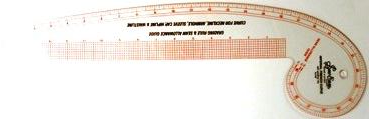
I find it easier to use a basic pattern without seam allowances. So I can draw round it to mark the stitching lines, and cut outside them. I have a transparent french curve with 5/8″ marked round the curve – makes marking stitching lines easy (here in UK).

”french-curve”

– – –

Reducing the effort of making a muslin

Some people avoid muslins like the plague. I have so many fit issues that making muslins has big rewards. I have reduced the hassle.

I use swedish tracing paper for a first test for a woven fabric, so I can trace a pattern and mark out a trial garment in one step. Best to use fabric close to the garment fabric for a final test. (P.S. 2018 – it needs to be ‘proper’ swedish tracing paper. Sadly what is now available in the UK under that name is just tracing paper, not like interfacing, and can’t be used for making trial garments. A sad loss.)

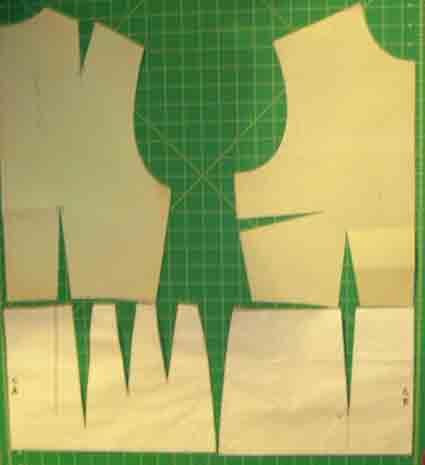
I have my basic blocks in card, with no seam allowances and the darts cut out, so I can draw round them easily.

”block-photo”
(Yes, top and bottom don’t match – I haven’t finished revising the top to fit my new waistline. Neckline and shoulders are still useful.)

Mark stitching lines, and horizontal and vertical reference lines, on the test garment fabric. Some experts use tracing wheel and carbon paper to transfer the lines from the starting pattern, then baste over the tracing with contrast thread. They warn against permanent marker pens. Sorry, those are what I use ! Another advantage of swedish tracing paper – you can just trace all those lines.

I confess I do the first fittings with the seam allowances sticking outwards, and without pressing the muslin.

– – –

Sequence of fitting

As well as the basic technique for making alterations (starting from the pattern or from a test garment), there’s also the sequence in which fitting issues are dealt with. Different experts start with different areas of the body. Try starting with your biggest area of difficulty. I find once I’ve got the shoulders / high back/ neck/ armholes right, most other issues disappear. But some fitting methods deal with the shoulders last !

I have sloping shoulders, a high round back, forward neck, unusual armholes. Many people like to start with an FBA. Or re-locating the bust point. One fitting system starts by getting the waist at the right height. For fitting pants, I first get the crotch extensions right. Other people may deal with large buttocks first, or waist/ abdomen larger than average. When you’ve solved the biggest issue, many other things may fall into place.

And how important is it to be able to move comfortably ? I test sitting down in pants, walking in skirts, reaching forward in tops. . .

– – –

How many muslins ?

I make adjustments to a test garment until it’s right, then make a pattern from the final version. Rather than going through a cycle of make pattern – test in fabric – revise pattern – make another muslin, etc. I do baste the changes into the muslin, instead of just pinning them. To stabilise the muslin before making more changes to it.

Some people like making many muslins so they keep everything neat and tidy. The most I’ve heard of is 7 muslins ! Sorry, I get screaming bored if I do this. I only started enjoying fitting when I realised it isn’t necessary to make a completely new muslin after each fitting adjustment. One of my personal limitations 😀

Though in an ideal world you do make a muslin from what you think is the final pattern, to fine tune the fit.

– – –

From muslin to pattern

If you make a test garment, transferring the fitting changes from the muslin to make a revised pattern is an essential part of the process. There are several methods for this. Here are a couple of them.

Many people, for example Lynda Maynard in her fitting class at Craftsy/Bluprint, mark the original stitching lines on the muslin, measure the distance away of the new stitching lines, and transfer those measures to the original pattern.

Personally, I find it easiest to make a new pattern : mark along the stitching lines of the finished muslin, then take the muslin apart, flatten it, and trace the stitching lines through to pattern paper.

– – –

I’m secure now about the methods I like for fitting, and for revising patterns. Though it’s taken several years and multiple false starts to get here. Many methods are not for me. (Tissue fitting – I tried it once, but never again 😀 Many other details of methods – I look at and cringe “no way”.) But I’ve learned something interesting or useful from most of them. And many methods I don’t enjoy are much loved by others.

There definitely isn’t “one size fits all” for fitting methods!

If you have a body shape fairly close to average, most methods may give you a good result.
If like me you’re well distant from average, you may have to experiment to find the fitting method you prefer.
If fitting involves a lot of work for you, best to think of it as a process of learning, exploring, improving – slow but sure rewards.

Find processes you enjoy, so you’ll willingly do this again 😀

– – –

First published 2013, links checked October 2021

= = =