Archive for the ‘style and planning’ category

Where do you like your outfit variety ?

November 10, 2012

Do you like each of your garments to have a different style ? Or perhaps you wear mainly similar styles, but in different colours or textures ?

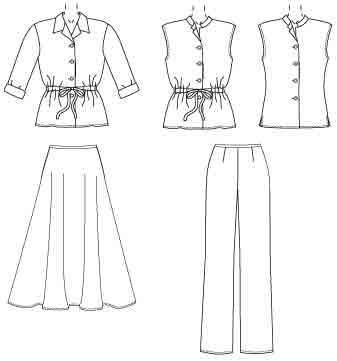
Janice of The Vivienne Files suggested a simple wardrobe as unnoticed background to interesting accessories. Here’s her post, and my post on patterns for it. This wardrobe has :
A very small range of colours : mainly white to black, and denim blue.
A very small range of surfaces : all smooth solids.
A very small range of fabrications : cashmere knits, broadcloth, denim.
A very small range of shapes : close fit knits, crew neck tees, shirts, slim pants.
And only one overall clothes style : very casual.

Minimum variety in the style elements of these clothes – though the general idea of this ‘creative’ style is not minimalism at all, as there is a lot of emphasis on noticeable and individual accessories.

Of course you haven’t got to use minimum style elements in your clothes for a small wardrobe. Here’s some of the usual ways of adding variety.

Colour and surface

Janice chose white, grey, black/ tan/ chambray and denim blues for colour.
All in smooth fine textures and solid colours.

In general, use your own best dark and light neutrals to copy this idea.
Or of course use only dark or only light, if that works best for you.
Black and chambray-denim blue aren’t flattering colours for me. My basic neutrals are white, grey, tan.

No accent colours in this wardrobe, as the clothes are background ! All the accent is in the accessories. You may be the opposite, dislike neutral clothes and have a closet full of colour ๐Ÿ˜€

And what about fabrication ? Imogen Lamport at Inside-Out Style has an interesting piece on changing the level for refinement of your clothes from casual to formal by changing the quality of the fabrics.

And what about tonal variations around a main colour, or variations in print, texture, embellishment and trims ?
Even in my minimum wardrobe, I would be unhappy without cream/ oyster/ caramel. . . nubbly textures. . . low contrast prints. . . a little embroidery or lace. . . a small ruffle. . . subtle deviations from classic style elements. . .

I may wear mainly simple styles in light neutral colours, but I keep thinking of ways of adding inherent interest to these simple clothes. I’m a happy scarves and bags person, with a few brooches/ pins and bangles – but my accessory choices are not attention-grabbing.
My style comes between ‘all the interest in accessories’ and ‘all the interest in the clothes’.

What type of minimalism ?

Perhaps you like the idea of a small unobtrusive wardrobe with few style elements – but not this particular version.
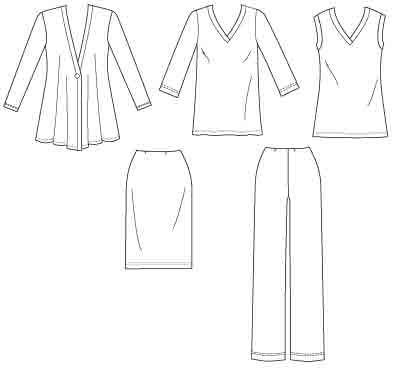
Would you like more elegant basics ? The simplest designer lines, made in quiet high quality fabrics and no denim. (This is a version of the idea that I would be happier with ๐Ÿ˜€ )

Perhaps use some of the patterns with minimum style elements from
Cutting Line Designs,
Loes Hinse,
styleARC.

Variety of shape and style elements

Janice’s ‘common wardrobe’ has 3 very similar tees, 3 very similar shirts, 3 very similar pants. Slight differences in colour and fabric. Plus 3 knits with the same fit, colour and texture. That makes these clothes easy to interchange and co-ordinate into ‘background’ outfits.

As I’m not such an accessories person, I go along more with Judith Rasband’s idea (Wardrobe strategies for women – excellent, ignore the awful cover photo). If you only have a small number of blouses etc., then you want them to be as different as possible in colour, fabric and style (while still co-ordinating with your other wardrobe capsule items). So you can get very different looking outfits from your small number of clothes.

But that’s a different strategy for wardrobe building and getting interesting outfits than the accessories based approach.

And – if you like variety/ interest in your clothes rather than your accessories – which clothes ? Many wardrobe plans have equal numbers of tops, bottoms, and layers, but that isn’t right for me. My bottoms (pants) are ‘background’ and I have few of them. In winter I wear lots of layers. My tops can hardly be seen, so are simple basics. But I love variety in my pullover tunics, vests and loose jackets.

Looking at the key patterns I picked out before thinking about this topic, most of the variety is in the neck area, to draw attention to my face. And high necks are essential for warmth. I would be disappointed if I was only allowed one pattern for each of my layers ๐Ÿ˜€

Here is what’s currently on my desk top for inspiration and pondering :

โ€basicsโ€
McCall’s 6606 shirt, Sewing Workshop Hudson top
Vogue 2779 pants, Wiksten Tova top
Wiksten Tank top (worn as over-layer), Craftsy Sewing with Knits Hoodie

โ€layersโ€
Vogue 8838 vest, Sewing Workshop Deja Vu wrap, Indygo Junction Origami wrap
Loes Hinse Boat neck top, Butterick 5789 View D jacket
Loes Hinse Cowl neck top, Burda 506E parka

(I focussed on easy patterns when I chose these.)

And which style elements do you vary ? The interest in my clothes is not just in the layers. It’s particularly in the neckline/ collar, which draws attention to my face. You may like style elements to draw attention to your bust, waist, rear view, hands, legs. . .

How much variety do you like ? and what type ?

The simplest possible clothes as a background for accessories – good for a travel wardrobe, as scarves and jewellery don’t take room to pack. But perhaps minimalism in clothes is not a good everyday style for you.

Which clothes do you like to have a wide variety of ?
Or can you be happy with just a few different styles ?
And what sort of variety do you like ?
– shape,
– closeness of fit,
– style,
– colour,
– texture (inherent in fabric, or in the way fabric is used such a ruching, tucks),
– weave,
– print,
– embellishment,
– fibre,
– style elements such as collars, cuffs, added seam lines.

What are your personal favourites to add to this list ?
What would you be unhappy without, even in the smallest capsule wardrobe ๐Ÿ˜€

Of course you haven’t got to be so analytic. Just notice what you like to wear. I think like this because it helps me understand why most wardrobe plans don’t work for me.

As ever, the aim is to enjoy your clothes and your sewing ๐Ÿ˜€

Links available November 2012, revised April 2021.

= = =

Trendy Autumn Capsule 2012

November 3, 2012

What if I wanted some trendy clothes this autumn ?
I fell in love with the Cosy Fall Wish List suggested by The Blush Chronicles.

โ€blush
from The Blush Chronicles

Fairly easy to reproduce.
Of course use your own best colours.

I’ve added notes on :
– simple pattern combining when you can’t find exactly what you want,
– add-ons to take this from capsule to wardrobe,
– some other sources of wearable trendy inspiration for this winter.

– – –

Sweater top

Butterick 5679, View B.

โ€b5679โ€

Slim pants

Pair with the ubiquitous slim pants, such as Palmer-Pletsch McCall’s 6440.

โ€m6440โ€

Collarless biker jacket

Burda 03/2012-116.

โ€burda03-2012โ€

Though I wouldn’t wear this in leather. Not for moral reasons, I’m just not happy in heavy stiffness.

Skirt

With my rear, I don’t look good in a short fitted jacket and pants, so would add a long straight skirt. Use the best length for you. Wearable with both jacket and sweater.

Perhaps the one in Vogue 8841.

โ€v8841โ€

Bag

Butterick 5367, View A.

โ€b5367โ€

– – –

Cape coat – combining patterns

No pattern exactly the same as the inspiration. A bit of pattern work needed here.

There is a recently oop cape-sleeved coat pattern, Vogue 8678.

โ€v8678โ€

But there isn’t much of the year when I would be happy in a coat without full length sleeves !

So add some capelet pieces to a shoulder princess coat, as in the inspiration.
Perhaps start from Burda 7855.

โ€burda-7855โ€

Try a mock-up of the capelet pattern pieces to get the length and width you want, starting with a half circle. Or adapt from a cape style with shaped shoulder seam, such as Vogue 6776 (better for getting the cape hem on-grain).

The cape-coat inspiration is double breasted. One of the many advantages of a shoulder princess pattern is – it’s easy to adapt the centre front panel to different styles.

And the inspiration has a trench style collar.
So swap the notched collar and front opening of the Burda coat for something like McCall’s 5525, View D.

โ€m5525โ€

To combine the patterns – overlay the front pattern pieces and match up the shoulder seams and centre fronts.
Then trace the style elements you want.
Do the same with the back pattern pieces to check if the back neck shapes are different.
Straighten out the front edge and add more buttons, if you want your coat to close up to the neck.

Or simply use this trench style in dark fabric with military buttons for another of this season’s coat looks.

– – –

From capsule to wardrobe

First stage of additions. The coat and pants photos in the inspiration include :
– long sleeved knit top,
– print top (possibly a short sleeved blouse),
– vest.
Second stage of additions :
– long sleeved blouse/ shirt,
– second pair of pants – straight leg or boot-cut.
And a self-fabric strip for one of the blouses/ shirts so you have a bow-neck look.
All in basic shapes. Vary the surfaces and textures.

That makes :
3 layers (jacket, sweater, vest),
3 tops (long sleeved tee, long and short sleeved blouses).
3 bottoms (2 pants, 1 skirt).
1 coat.
10 garments in all. The 9 indoor clothes give about 40 outfits if they all co-ordinate.

Including accessories :

Haven’t mentioned the shoes ๐Ÿ˜€ That’s the one piece of the starter capsule that I already have, as flat ankle boots are a favourite of mine. Many people round here are wearing knee high boots with their slim pants. Add a dressier pair of shoes to increase the range of opportunities for wearing these clothes. You haven’t got to wear the current sky-high stiletto heels to look dressy. Try pretty ankle boots with medium heels. Or decorated ballet flats.

Add some indoor and outdoor scarves, a narrow waist belt, warm hat and gloves, favourite jewellery.
Well, that looks like an effective collection ๐Ÿ˜€

– – –

For easy-wear current looks in ‘modern classic’ style, see YouLookFab’s Pinterest board – copy many of these outfits using this wardrobe, and her comments on what she’s wearing this season.
And here’s a list of current items from StyleMakeover.

For a wide range of current styles, see Nancy Nix-Rice on wearable current trends and suggested outfits (no they’re not the pure classic styles which she uses to illustrate her wardrobe planning posts).
Next stage of additions : add blazer, cascade jacket, big top to your wardrobe, and you can mimic many of these outfits too.
Next additions : drape, cowl, turtleneck tops – and so on ๐Ÿ˜€

Enjoy the new season !

– – –

Links and patterns available November 2012

= = =

Change in proportions

October 27, 2012

One of my key garments is a shirt-jacket. I had fun recently looking at older shirt-jacket wardrobe patterns on Etsy. There were dozens of very similar patterns published in the 70s to 90s.

Here’s one from the 70s. McCall’s 3280, 1972.
(Goodness, that summer I bought this house, so lived on crusts for several years. And I finished my thesis. It wasn’t a time I was thinking much about new clothes !)

โ€m3280โ€

This look was popular for decades. A recent pattern like this was only discontinued a short time ago, Butterick 4811.

โ€b4811โ€

In the late 80s to 90s, there was also another popular look for unlined casual jackets – oversized and collarless. Here’s McCall’s 7501, 1995. Huge oversize supported by huge shoulder pads, worn with a small skirt or full pants.

โ€m7501โ€

So, what is it about these styles that makes them look not quite up to date ?

Well, some designers have been showing oversized jackets in recent seasons, but usually without the huge support structures, and worn with slim pants or leggings. You Look Fab has a post about these here. Jackets like this haven’t reached this suburb (except for the students who buy men’s overcoats from the charity shops).

These days there’s so much freedom in fashion, you can find at least one designer who uses any given look. I’ve tried to focus on what’s frequently seen.

Here’s what I might replace those looks with.

New wardrobe pattern for wovens, Butterick 5821.

โ€b5811โ€

For a less casual jacket look, use the wardrobe jacket, but thigh length and without the hem casing. Add a waist casing for this season’s waist emphasis if that suits your body shape. Lots of seams for adding hip width if you’re pear shaped.

Or Nancy Zieman’s knits wardrobe McCall’s 6247.

โ€m6247โ€

I want a shirt-jacket wardrobe so would add McCall’s 6606, especially lower right.

โ€m6606โ€

– – –

What are the differences compared with earlier styles ?
Ignore the curved versus straight style elements, a matter of personal style.
I think the key is proportions and silhouette.

Shirts and tops

Shirts are now often not mid hip length but low hip or thigh length.
Several common proportions :

The trendy shirt look is slim with slight waist shaping, such as Butterick 5678.

โ€b5678โ€

A narrow belt at waist is ‘this season’.

Or oversized but without the huge shoulder pads, such as Katherine Tilton Vogue 8748.

โ€v8748โ€

Or for overlayers, try the indoor poncho look in a woven fabric, see McCall’s 6603.
Actually, in the trendy mail order catalogues I’ve received this season, there have been knit sweaters this shape and ponchos, but not shirts. (The ‘arty’ catalogue always has an oversized shirt.)

Both slim shirts and big trendy tops are worn with slim pants/ skirt or leggings.

The current casual shirt look is looser fitting, as in McCall’s 6606 shown with the wardrobes above. Straight not shaped to the body, but not very loose fit. Even the new Palmer-Pletsch unisex shirt (McCall’s 6613) has 4 inches of ease not 8.
Worn with straight or boot-cut pants.

The ways style elements are used to emphasise the shoulders has also changed.
We no longer wear :
– huge shoulder pads or very dropped shoulders,
– wide spreading or high collars.
These days unlined casual jackets rarely have shoulder pads. And shirt and notch collars are usually not emphasised. Instead we have :
– yokes or epaulets,
– fitted or slightly dropped sleeves.

Shoulders dropped well down the arm are coming back as they’re essential for over-sized styles, but they’re not generally used. Though dropped shoulders are featured by some boutique designers – like the Katherine Tilton shirt – as arty rather than trendy personal style.
Raglan sleeves rather than dropped shoulders are currently used on gear for easy movement like sweatshirts.

Skirt

Skirts are now usually straight or slightly tapered (pencil),
or subtle rather than full A-line.
Knee length or shorter, or below knee, or calf length.
Or short and flirty pleated (one of the very, very few styles I think is best worn only by the young).

You can wear a full skirt if you like the ease of movement. Make it in soft fabric so the silhouette isn’t wide and stiff (unless you’re going for a vintage look), and wear at lower calf length with a fitted top.
Such as Butterick 5650.

Pants

Pants are now usually slim,
or straight,
or boot cut rather than flared.

All styles in new Butterick 5818.

You can wear very full or very flared pants (with a high-hip length top) if you have the body shape for them, but happily we haven’t got to wear them if we haven’t !

P.S. Lovely new post by Imogen Lamport on what is in/out of style – letting go of trends.
Key question : “Could you go into a store and buy a similar garment today (if not, itโ€™s gone out of fashion) ?”

– – –

Nowadays there aren’t many full wardrobe patterns in shirt-jacket style.
There are many patterns for shirt plus pants. Add a simple top, and a skirt if you wear them.

Would this be a good casual look for you ? – or do you feel as miserable in a shirt as I do in a blazer ๐Ÿ˜€

– – –

Links available October 2012

= = =

Build your wardrobe in small groups

October 20, 2012

The Vivienne Files post on building a wardrobe by fours started me on yet more thoughts about basic wardrobe building.

Perhaps it’s part of your personal style that you don’t like to plan, prefer a free-flow approach to choosing your clothes, and just use general guidelines on colour and shape so you haven’t got a closet full of orphans.

If instead you want the simplest possible scheme for wardrobe building – add small groups, rather than a whole wardrobe all at once.

What are the garment types you wear all the time : dresses or jeans ? shirts or tees ? jackets or sweaters ? If you’re not sure, look at my personal wardrobe plan post.

What clothes grouping do these items make ? Would it suit you to build your wardrobe in co-ordinated capsules of 4/ 5/ 6 items, or individual outfits of 1/ 2/ 3 items ?

Here are the common possibilities.

– – –

CAPSULES

Small groups which include enough clothes for you to make several outfits.

Core 4

Often 2 tops, 2 bottoms. For example, Butterick 5333. Easy to make four different outfits.

โ€b5333-4outfiitsโ€

If one top can layer over the other, that adds two more outfits.

โ€b5333-2-key3sโ€

Janice of The Vivienne Files builds a basic wardrobe of 12 items by adding 4 items at a time. Here’s her original post.
– Core Four – sleeveless and sleeved tops, skirt, pants, in interesting colour.
– Expansion Four – 2 more tops and bottoms, in neutral colour.
– Mileage Four – more tops, in fabrics which combine colours.

She calls her approach ‘Four by Four’, and adds 4 accessories to the 12 clothes.

I’ve written posts on patterns for her original scheme, and on adding layers.

Janice has several other posts suggesting four-by-four wardrobes, with good illustrations of outfit combinations. See her Archive for May 2012, and here. (In that post the Core 4 is 3 tops, 1 bottom – sweater knit, shirt, tee, pants).

P.S. Janice now has a post on building up to a Project 333 wardrobe in groups of 4 items, each group in one colour. To me her later mixed version is more interesting but also more difficult to achieve.

Janice’s 4×4 clothes are rather similar to Nancy Nix-Rice’s 12 item basic wardrobe. Nancy makes nearly 100 different outfits from her 12 clothes.

– Start with one of each item needed (Nancy’s Core 4 is jacket, top, skirt, pants), in a dark neutral.
– repeat in a light neutral, using the same or more relaxed styles.
– add another 4 with fabric interest to add variety : a top and layer in an accent colour, and a 2-piece dress in a mixed colour print.

Sadly Nancy’s list of newsletters is no longer on her site, but they are still available :
21. Core 4
22. Second top and layer
23. 2 more bottoms
24. accent colour twinset
25. 2-piece print dress.
She also has a post on a 16-item travel wardrobe.

I wrote a post on patterns for Nancy’s starter 12 here. See full list of my posts about her wardrobe on Index page 4.

Or there’s Eileen Fisher‘s ‘system’ of wardrobe basics. Her ‘system’ changes from season to season. (For the current version, see the Eileen Fisher Video on “What if it were this easy”.) She makes co-ordination especially easy by having nearly everything in black ! perhaps with one cream top and one grey one. In summer 2010 the ‘system’ consisted of 3 Core 4s : 3 layers, 3 tops, 3 skirts, 3 pants. Here’s my post on patterns for that.

Vital 5

Judith Rasband recommends a basic wardrobe ‘cluster’ of 5 items. Such as : jacket/ layer, 2 tops, skirt, pants. See her Wardrobe strategies for Women book, and 5 Easy Pieces DVD.

โ€s1945โ€
Simplicity 1945

These particular 5 items make 10 different outfits (including layering the wrap top over the cowl one.) Add some scarves or statement jewellery, dressy and casual shoes – and there’s your wardrobe for a week’s trip !

To build on this basic group, Judith Rasband adds one item at a time. So long as each new item co-ordinates with all the items you already have, it can double the number of different outfits possible (see my power of the boring post).

My personal Vital 5 is rather different, as in winter I need 5 garments to make one outfit. I don’t own any fitted jackets or dresses, and only wear skirts on formal occasions. But I can’t get my wardrobe needs down to less than 5 different types of item : shirt, pullover layer, shirt-jacket layer, vest, pants. Simplifying, that’s shirt, pants, and 3 added layer options. In winter I wear all 3 added layers at the same time !

I could repeat this group two or three times, to make a wardrobe of 10 – 15 items.

Season’s 6

ejvc’s 6 item 6PACs are another capsule-to-wardrobe building idea. Make a 6 item capsule each season, following the colour suggestions (3 neutrals, accent), and you have a marvellous 24 item co-ordinated wardrobe by the end of the year ! Here’s the original summary of the overall concept. See comments on the current 6PAC season at Stitchers Guild. This inspiration has been running successfully for several years.

OUTFITS

Do all those possibilities make you feel overwhelmed and confused ? If so – start with outfits rather than trying to achieve interchangeable items.

Perhaps it’s your personal style to wear a few favourite outfits, rather than wanting to look different each day. Here’s an encouraging piece from YouLookFab. And another post from her, on ways of building outfits.

Key 3

Simpler than a Core 4, if you only wear pants never skirts, or the other way round – a Key 3 : layer, top, bottom.

โ€soft-capsuleโ€
Butterick 4989, McCall’s 5889

โ€s2635s-8โ€
Simplicity 2635

The original and long oop wardrobe planning book, “Working Wardrobe” by Janet Wallach, was written when women rarely wore pants to work. Her 12 items consist of 4 Key 3s :
– 4 layers (jackets and sweater knits),
– 4 blouses,
– 3 skirts plus either pants or dress.
A coat gives 13 items.
She uses 2-3 basic colours plus one item in an accent colour. Four pages of suggestions for colour pairs – not only used as solids but also as mixed weaves or prints.

Easiest possible wardrobe building :
Choose your Tried ‘N True patterns, for top, jacket/ layer, pants/ skirt.
Choose 3 fabrics : perhaps dark neutral, light neutral, accent print or solid.
Make your 3 patterns in each fabric.
Hey presto, 9 basic co-ordinates. . .

Nice and easy – except many of us don’t like to wear the same fabric for both tops and pants ! Perhaps make the 3 in the same colour.

One Key 3 group needn’t only make a single outfit – if they co-ordinate with other items. Make a Key 3 all from the same fabric/ colour. This gives you an ‘inner column’ of top and bottom the same.ย  To which you can add other layers. And an ‘outer column’ of layer and bottom the same. Add other tops. All 3 items the same gives infinite options for combining with other clothes ๐Ÿ˜€

I don’t know where this ‘column of colour’ idea started. I heard it first from Nancy Nix-Rice, Lesson 22. Imogen Lamport has several posts with good illustrations – links here. Also she and Jill Chivers have a video on styling up a basic outfit of tee and jeans.

Dress 1

Your wardrobe plan could be much simpler : 10 dresses and have done with it ๐Ÿ˜€ No co-ordination needed ! Though I voice my usual objection to “every woman should have. . .” as I’m a happy zero dresses person.

The Vivienne Files has many posts on styling a dress for different looks. They are usually sleeveless sheaths, but you can apply the same ideas to other dress shapes too.

If you prefer pants, jumpsuits are a current ‘one-item outfit’ option.

Simply 2

Or do you always and only wear two item outfits, such as:

– dress and layer, example from Butterick 5247 :

โ€b5247-core2โ€

– top and bottom, perhaps tee and jeans/ blouse and skirt/ shirt and shorts, or slouchy Butterick 5651 :
โ€b5651โ€

Make up 5 to 7 outfits without worrying about co-ordination. If any of the items combine into other outfits that’s just a bonus ๐Ÿ˜€

– – –

Did any of these ideas make you think – “ah, that’s right for me” or “no, not for me, I need. . .”

Do you feel it would all be too limiting ? Here’s a post from Inside-Out Style on getting variety from a capsule wardrobe.

If you decide to make a personal wardrobe plan, rather than ‘winging it’, the process can be daunting. There’s not only the basic group of clothes to pick out, but also your personal style and colours – see my post on so many choices. With all these individual variations, probably few people follow any of these schemes exactly. They can be a good guide for first thoughts. But getting flattering enjoyable outfits is the key goal.

Don’t try to do everything at once. Every little step can help. I learned a lot about what’s best for me by trying to fit myself to other people’s plans.

I’m most in tune with Judith Rasband’s ideas. Which is your preference ๐Ÿ˜€

– – –

Links available October 2012

= = =