Can you get into it ? Does it look tight ?

Posted November 13, 2009 by sewingplums
Categories: fit of clothes, pattern making for clothes

What size do you need a top ? I made a mock-up to test how big a pullover needs to be for me to get into it. Then I realised I could also find out how big a layering top needs to be so it doesn’t look strained.

– – –

Size for layering tops

I made a mock-up from a couple of large non-stretch fabric rectangles. I gradually moved the side seams in until it was just too small, when the fabric looked a little strained and lumpy.

Here’s my suggestion for the size of fabric to cut :

”mockupw”

Use your largest measurement to choose the width.
If you need an FBA or have a large abdomen, cut the front piece 4 – 5 inches wider than the back. Align the side edges to sew the seams.

Sew the initial seams as marked. Use contrasting thread.

The largest I want a layering garment to be is over a thick sweater. So I started by trying my mock-up over that.

I’m larger below the waist than above, and my hips are my largest part, so I started by checking fit over my hips.

I basted the side seams further in, 1/4 inch or presser foot width at a time. Until the first time when the fabric was a little distorted at hip level. So I knew the previous size was the smallest I can wear a layering top over a thick sweater and look good. And I measured between those seams.

Then I tried the mock-up over a thin layering top, and moved the seams in again.
Then I tried it over a loose shirt and camisole.

(It’s getting cold here and I forgot to test for best basic layer looseness. I could unpick some of my mock-up seams, but I think anyway it’s better to try close fit using a test garment with darts.)

So I knew about layering tops for my hips. Then I moved on to testing fit without strain at the underarm. For this, I just sewed short seams above the waist.

Here’s a scan of part of my final seams (looks better in real life !) :

”seam-arrow”
Arrow points to size to measure for the underarm.

If you’re larger above the waist, start by testing your underarm. Then you could check how much narrower you can go at hip level and still wriggle through it.

From this I found that for me a successful layering garment (tunic, vest, jacket, etc.) needs to measure at the underarm :
over a thick sweater : at least 45-1/2 inches
over a thin layering top : at least 44 inches
over a loose shirt : at least 42 inches.

Don’t use my numbers for yourself. I think people with different styles, shapes, and favourite fabrics will get different results. I used a medium muslin with a bit of body for my tests and I don’t wear close fitting clothes.

You could also use this mock-up to try out different neck opening sizes.

– – –

‘Wriggle into’ room – getting the garment over your shoulders :

You’re making a pullover top. Using a pattern you’ve made from a blouse/shirt or jacket pattern by closing the opening, can you get into it ?

You may need to remove waist shaping (see later) :
– Don’t sew any waist darts.
– Straighten out the side seam from bust to hip.
Also check the neckline opening is bigger than your head.

Then, if your bust is larger than your shoulders, you should have no problem getting the garment on.

If, like me, your shoulders are bigger than your bust, you need to check this. With a knit fabric this may not be a problem, With a woven fabric with no stretch, it may be. I found my results interesting.

”shoulders”
(black diagram from Fit For Real People p.66)

My shoulders at rest measure 41 inches, and my bust is 36 inches. So I assumed I would need something bigger than my bust to be able to get into it.

I tried my mock-up over minimum clothes to find what is the smallest I can wriggle in to.

I found I can get into something that is several inches smaller than my top : 32-1/2 inches. Not that I’d actually ever wear anything that measurement ! It was very uncomfortable, but certainly endurable for the short time of getting a garment on.

I don’t know if there’s something odd about my shoulders, or if this is true for other people. But at least for me, getting something over my shoulders is less of a problem than I thought it would be. It looks as if I don’t need to remove all the waist shaping in a pullover pattern just so I can get it on.

– – –

How do you compare your findings with the pattern ?

The finished garment measurement is usually printed on the pattern, somewhere near the bust and hip points. Or it may be in a table near the beginning of the instructions. If it’s not supplied, measure the pattern (allow for seam allowances).

”bustpt

On the McCall’s 5664 pattern I based my pattern alterations on, the finished garment in my size is 43-1/2 inches at underarm. For a layering top over a loose shirt I need 42 inches. Over a thin sweater I need 44 inches. So I could wear this top over a loose shirt, but it might not look good over a thin sweater. If I wanted a top to wear for that, it could be best to alter this pattern a little.

The Nancy Zieman oop McCall’s 5526 jacket (left below) has 40 inches at underarm. Obviously designed to be worn over something light, a camisole or perhaps a fitted blouse. The Marcy Tilton Vogue 8454 jacket (right) has 45-1/2 inches at underarm. So I could easily wear that over a thin sweater, possibly over something thicker.

”nzmtjackets”

If you want a layering item to wear over a thick sweater or a big jacket, also measure your biceps. Check the pattern sleeve width is at least a couple of inches larger.

I’m surprised how much I’m using this information. It makes it easy to check I can use a pattern for what I want without changing the size. I’ve also used this to buy mail order from companies that say what the actual measurements of their garments are.

– – –

Enlarging the underarm size

What to do if your pattern is too small ?

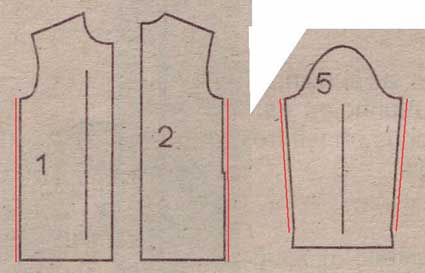
If you need 1 inch (2.5 cm) larger, add 1/4 inch / 6 mm to the pattern at side and sleeve seams, as in the diagram.
”addi-u-a”
(Butterick oop 5803)

If you need 2 inches (5 cm) larger, add 1/2 in. / 13 mm at each of the marked places.

If you need more than 2 in. (5 cm) added at the underarm, sorry this size is not a good starting point for you to make a pullover or layering top with minimal changes.

If you go up a size, you don’t only increase the underarm. You also lower the neckline, lengthen the shoulder seam, and enlarge the armhole. These are usually good for a layering top anyway. But it’s worth checking if the changes are flattering on you.

Or start from a pattern that is more loose fitting.

– – –

Ease

You don’t need to know about ‘fitting ease’ to assess patterns for layering, but it’s related. And it’s useful to know when buying patterns.

The difference between actual garment measurement and body measurement is called the ‘ease’.

For example, the McCall’s 5526 jacket size 14 measures 40 inches at underarm. My bust is 36 inches. So the underarm ease of this pattern is :
40 – 36 = 4 inches.

Here is a general post on ease levels.

And here’s a simplification of the Ease table in the Vogue print catalogue :

top :
fitted : 3 – 4 inches
semi fitted : 4 – 5
loose fitting : 5 – 8
very loose fitting : more than 8

jacket :
fitted : 4 – 5 inches
semi-fitted : 5 – 6
loose fitting : 6 – 10
very loose fitting : more than 10

The finished underarm measurement of a pattern isn’t usually given on the envelope. So you have to use the fit description when choosing a pattern.

For example, for a garment to wear over a thin sweater, I like at least 44 inches at underarm. So I need 44 – 36 = 8 inches of ease. The table tells me I can get this from a top pattern described as very loose fitting, or a larger jacket described as loose fitting, without having to make underarm changes.

– – –

A long top

While you’re experimenting, why not try out lengths as well. To make a fashionable thigh length top, most people need to add about 10 in./ 25 cm to a low hip length pattern, and add about 20 in./ 50 cm to a high hip length one.

Some people look better with a long top at mid thigh. Others look better with a top an inch or so above the knee. If you look good in several widths of pant leg, you may find you look best in different lengths of top, depending on how tight your pants are.

Robin has some good posts on body length proportions.
body quarters
body eighths
more on proportions
Detailed written instructions are in Fit For Real People pp. 62-73 or Looking Good pp. 31-33 ,(Palmer-Pletsch books).
Robin has the good idea of using a square to make the marks – much easier to do it without help. You don’t need a drawing instrument square. Any firm corner will do – a piece of cardboard, even a full pattern envelope !

– – –

Getting this information is like making a fitting sloper, but a lot less work. When you’ve done this once, you know your head size (previous post), the size you can get your shoulders through, and the sizes you need for layering items. Then changing a pattern from open to closed can be relatively simple.

And pattern making is an art not a science. So long as you can get the garment on, you can of course change anything in any way you like 😀

– – –

Patterns and links available November 2009.

= = = = =

From Shirt to Pullover – close opening, check neckline

Posted November 3, 2009 by sewingplums
Categories: pattern making for clothes

Changing from an open fronted design to a closed one looks as if it would be easy – just remove the button band.
But there are some important things to check !
– can you get your head through the neck opening ? – see below.
– can you get into the garment ? (links to advice below)

– – –

Removing the overlap

Removing an opening is fairly easy :

Assuming a front opening :
(If you’re starting from a pattern with a separate front band you’ll have to join the pattern pieces – overlap the seam allowances.)

Mark the centre front line (not the edge fold line) on the pattern (it should be printed on).

”cfline”

(I haven’t yet conquered high image quality, but hope the photos make the point.)

Trace the pattern to this line.
or
Fold the pattern on the line.

”foldbakc”

Add a note on the pattern, to remind you to place this edge on the fold of fabric.

Hey presto !

Though actually it’s essential to check the neck opening and underarm ease before cutting out.

– – –

Size of neckline opening :

Can you get your head through the resulting neckline neck opening ?

Measure your head. This is not your hat size, but your head measured loosely over hair, ears and nose. This is the size your neck opening needs to be for you to get it over your head. If you want to protect your hair-do or make-up, add an inch or two more.

On the front and back pattern pieces, draw in the neckline and shoulder seam stitching lines. This is easy to do with a French Curve which has 5/8″ (1.5 cm) marked along the curved edge.

”neckstline”

Measure the stitching line on the front and back patterns. Use the edge of a tape measure. Remember not to measure across seam allowances.

”

Then
(back neck stitching line length + front neck stitching line length) times two
is the length of the neckline opening.

Compare this with your head size.

For example, on my fitting sloper, the back neck stitching line measures :
3-1/8″
The front neck stitching line measures :
4-5/8″
So half of neckline is :
3-1/8 + 4-5/8 = 7-3/4″
And the complete neckline stitching line length is :
7-3/4 x 2 = 15-1/2″

My head measures 25″ (long hair up back of big head). So, if I want to use my fitting sloper as the basis for a pullover pattern, I need to make the neck opening much larger !

– – –

Changing the neckline

If the pattern neckline is not big enough for you, there are many things you can do.

To keep the same shape of neckline, lower the stitching line an 1/8″ (3 mm) at a time, until the opening is big enough.

”lowstline”

Or redraw the front neckline to a V or scoop neck, or widen the neckline at the shoulders to a boat neck.
It’s easiest to change neckline shape if you retain the shoulder point (where neck line and shoulder seam stitching lines cross). Then you can alter the front without having to alter the back to match.

Or add a neckline slit, front or back. Or a half-length closable opening, such as an exposed zip or henley/polo button placket.
Or transfer the neckline from another pattern.

I’ve taken several classes with Shannon Gifford at Pattern Review. So I’ve learned to trace my patterns. If you’re doing that anyway, making small pattern changes takes little extra effort.

– – –

Edge finish

Whatever neckline finishing treatment you use, make sure to lengthen it to match the new neckline.

Making a facing pattern

It’s easy to make your own facing patterns. Draw a line 2-3″ (5-7.5 cm) from the stitching line. That is the outer edge cutting line of your facing pattern.

”

If narrow facings flip out for you, use the 3″ / 7.5 cm width. For me, this happens with wider necklines.

Lengthening a collar

If the pattern has a collar, you’ll have to alter that to match the new neckline.

On the body pattern pieces, measure the neck stitching line from Centre Back to collar attachment point on the front.
On the (half) collar pattern, measure the neckline stitching line.
Calculate the difference between the two.
This is the amount you need to change your collar (you measured half the body pattern, so it’s the amount to change half the collar pattern).

On a straight collar, alter at centre back.

These collar templates have a choice of lengths marked at centre back.

”

With a curved collar, mark the position of the shoulder seam. Then slash and spread, or slide, by the amount needed. You probably need to spread more at the outer edge of a curved collar, so it will lie in the same way as the original.

”curvedspread”

If you want to test your new collar pattern before cutting fabric, cut it out in kitchen roll paper. This has much the same firmness as interfaced fabric, and sticks to clothing without needing to pin it in place.

– – –

There are some more important questions about turning a pattern with a full-length opening into a pullover top :
– can you get it on over your shoulders/bust ? I’ve got so much to say on that, I made it a separate post.
– is there enough ease at bust or hip level to be comfortable ? That’s also covered in that post.
And here’s a post on ease in general.

– – –

Links available November 2009

= = = = =

Wardrobe Styling – November 09

Posted November 1, 2009 by sewingplums
Categories: my choices, wardrobe planning

The November issue of ‘Sew Today’ (UK BMV magazine) has arrived, so it’s wardrobe planning fun time again 😀

– – –

Note : Butterick-McCall’s-Vogue has changed their websites. My BMV links now only get you to a page where you can search for a pattern number.
I apologise that I haven’t changed to the new individual URLs, but it would be a lot of work.

– – –

The focus in this issue is on dresses. As I rarely wear them these days, I leave out much that others would love. I do think the Chado Ralph Rucci Vogue 1135 dress is stunning. But I haven’t got the shape or personality to wear it, let alone the lifestyle. . .

”chadorrdress”

– – –

For a top pattern, I would happily own several of this tucked tunic/ shirt, McCall’s 5976. A familiar style, modernised by the longer length and full sleeves. I would make the band collar version to go under other clothes in this group.

”tuckshirt”

McCall’s 5973 is a dress pattern which could easily shorten to a tunic. It has options for an inset front which I like. The ‘V-neck bands and midriff’ style is worn by TV presenters as well as in the supermarket, so it’s still trendy. And a neat midriff looks good on me. Or leave out the midriff pattern piece for an empire effect, which is seen so often it could count as a modern classic.

”tunicdress”

– – –

For a fitted jacket, how about this Chado Ralph Rucci Vogue 1144. I love mandarin collars. Like many of his patterns there is interesting seaming, this time on the back. With my short waist, this would need a lot of fiddling with a muslin to get it right, and the help of a fitting buddy. Probably not a good pattern for people with back fitting problems !

And I would definitely leave off those large hip pockets. Not ideal for the pear shaped. The silhouette is long and slim, very current. As is the touch of military styling given by the pockets and collar. A band/ mandarin/ funnel collar is current anyway.

”chadojacket”

– – –

For light outerwear, there’s an attractive scarf jacket in McCall’s 5987.

”scarfjkt”

And there’s also McCall’s 5981, which has an interesting collar for a parka. Though it has a very low neck for a coat, presumably worn more for style than warmth. I would flare this a bit, to be more flattering for my pear shape.

”parka”

Both these jackets have large collars which would go well over the necklines of the tops and fitted jacket. So these styles make a ‘wardrobe’ by being compatible to wear together.

– – –

The Ralph Rucci Vogue 1144 pattern includes pants with a slim line, which is current and goes with all the tops. The waist is at waist level with no waistband, which suits me well. Though a side seam zip is not good on my high hip curves. I would move the zip to centre back. The vertical emphasis of the styling looks as if it might flatter those of us with larger hips (20 is the largest pattern size). And it could be a challenge to fit over high hips. All the styling details mean that making these pants would not be a quick project !

”chadopant”

– – –

Party time is approaching. For anyone who goes to so many formal events they need a special occasions capsule wardrobe, I think Butterick 5419 could be very useful.

”eveningcapsule”

Add the coverups from Elizabeth Gillett’s Vogue 8622 and you would have a huge range of combinations from just two patterns. Or, with the right fabric choice, I think I would happily wear one of these coverups over a ‘day dress’ to many evening events.

”coverups”

Personally, as I prefer to keep warm, I would choose Vogue 1290 if I needed a ‘formal’ wardrobe. Not a new pattern. This has been available for so long there aren’t any online line diagrams, but it’s still pretty.

”floaty”

For informal occasions, as transparency is current, a chiffon version of the tucked shirt (McCall’s 5976) would be good party wear for me. Though I’m always concerned about modesty and tidiness of what’s under transparency. Perhaps I’d wear a chiffon big shirt over matching turtleneck and pants.

– – –

For accessories, I don’t know if it’s fashionable, but it would be fun to find out if I look good in a giant beret, Vogue 8528. I think one of these would look good with the tucked shirt, the Chado Ralph Rucci jacket, or the scarf jacket. Even, on some people but not me, with the Vogue 1290 evening wardrobe. Well, I don’t know, I sometimes think I would like to wear clothes that make me laugh 😀

”berets”

And again of course all this planning is just for a dream world. . .

——————————-

There’s a relevant newsletter from Marcy Tilton. She links to fabric suggestions for some of these patterns, some of the patterns I liked in October, some of the patterns I like but didn’t pick for these wardrobes.

——————————-

Note : After this post WordPress sometimes automatically generates a link to a review of Marie Clayton’s book about Pattern Maker. My review of the book is at here at Pattern Review.

What can you make from one top pattern ?

Posted October 24, 2009 by sewingplums
Categories: pattern making for clothes

If you had to pick only one top pattern, to make everything except skirts and pants, what would it be ?

This question is inspired by Rusty Bensussen’s book “Making a Complete Wardrobe from 4 Basic Patterns” published in 1987. It’s not a book I would recommend whole heartedly. There are some odd ideas – for example using the same top pattern without any size changes for a shirt, a jacket, and a coat – just by changing the fabric and length. I wonder if any inexperienced sewer has tried that, and found themselves with too much interfering bulk at the underarm when they tried to wear even two of the garments together, let alone shirt + jacket + coat. Well, Bensussen’s top pattern is very oversized. So perhaps that is less problem than it would be with a fitted armhole.

The same top pattern used without size changes for both an evening dress and a coat. . . aargh. This clearly illustrates the great difference of opinion about what clothes should be like, between now and when this book was written.

There are some blind spots in Bensussen’s technique descriptions (both pattern making and sewing), which could confuse a beginner. But on the positive side, this book introduces simple changes which give a different garment from the same starting point. And that is something I would like to explore.

Following the book, from one top pattern I need to make patterns for : pullover top, open-front shirt, untailored unlined jacket, untailored unlined coat, vest, dress, evening dress.

Permitted changes are necklines and sleeve cuffs, front openings, and length. And I’m going to remove one limit. I am going to use different sizes for different purposes.

It would be possible to choose a similar pattern with modern proportions and follow Bensussen’s styles quite closely. But here I’m going to show how easily it can be done from other patterns. As my starting point I choose McCall’s 5664 (discontinued).

”

– – –

Here are the options.

”tunicshirt”

Pullover Top
closed front, collarless
Here is a post on converting from open to closed front.

Open-front Shirt
open all way down front

2018 : I now have a group of 4 posts about pattern making for front openings :
1. zip, button band
1b. adding extras to a front band
2. combined facing to front edge and neckline
2b. adding to a front-neckline facing.
These methods could also be used for changing from one type of placket to another, such as changing from a button placket to a zip, or changing between an integral button band, a separate button band, and a facing.

– – –

”vestjacket”

Vest
sleeveless, collarless, open-front, add facings or full lining.

The starting point pattern isn’t a layering top. So a vest might need to be one size larger to add ease for comfort.

This drapey style wouldn’t be a good pattern to use for a fur / quilted / upholstery fabric vest. I think it would be best in a less stiff fabrication. For a rich fabric, velour might be okay.

Untailored Jacket
open front, collarless, no cuffs, add facings

As this pattern has a modern fitted armhole, I would need to make some changes so the jacket would fit comfortably over the shirt. Going up one size would be a simple answer. That isn’t an ideal solution, there are some things that need to be checked. And if you’ve altered your starting pattern for a good fit, you won’t be able just to trace off a larger size.

It would be a good idea to make this jacket collarless and cuffless, to remove the problems of wearing shirt, jacket and coat together and all with the same collar and cuff style.

I think I would also break the rules a bit here, and remove the fullness at the sleeve head, so the jacket could be worn easily under a coat.

– – –

”coatdresses”

Untailored Coat
at least two sizes larger, knee length, full length sleeves, no cuffs

I might widen the collar by 1/2 to 1 inch, to give it more emphasis on a larger garment.

Dress
sashed, short sleeved, knee length

Evening Dress
sashed, scoop neck, floor length

This could be sleeveless. I would probably make it with long sleeves, as the places round here where formal events are held have minimal heating.

– – –

Much to my surprise, it is actually possible to do this quite easily. What an interesting exercise.

Bensussen focusses on making many different types of garment from one pattern. Burda WOF magazine takes a different approach. They don’t change the general category of garment but change its style. There’s a good example in the October 09 issue. They make 4 very different jackets from one simple straight pattern, using changes in trim and pockets.

”burda0910”

Chanel style jacket : patch pockets, braid trim.
Party coat : bow belt, inseam pockets, trumpet sleeves.
Safari style jacket : collar and cuffs, epaulets, bellows pockets.
Sporty blouson jacket : hidden placket closure, welt pockets, knit bands.
(Another sporty option would be a hoodie with exposed zip at centre front and kangaroo pockets.)

For more pocket variations there’s Diane Ericson’s pattern for 60 pockets. That could take a while to work through 😀

– – –

This restyling game can be played from many other starting points. Your best choice depends on your body shape and personal style.
People with square shoulders might prefer raglan or drop shoulders.
People who aren’t pear shaped could use a straight sided basic style, such as a classic shirt.
Those who look better with some garment shaping might start from a classic darted blouse, or a basic shoulder princess style.
More suggestions for starter patterns in this post.

Do you prefer a softer or a crisper effect ?
Does the thought of thinking up ways of making the garments all look different fill you with glee ?
Or does the prospect of having so many similar clothes make you shudder with horror 😀

But hey, once you get the hang of how to do the simplest of pattern alterations, one basic pattern can give you an amazing range of possibilities.

– – –

Post originally written and pattern available October 2009

= = = = =