The Classic Style

Posted April 20, 2012 by sewingplums
Categories: personal style, specific capsules, wardrobe planning

The ‘Classic’ style is well known and popular. Many basic wardrobe plans are based on classic styles.

Judith Rasband‘s simplest wardrobe cluster is a group of 5 items.

Her March 2012 newsletter makes the case for wardrobe basics very clearly, These simple clothes with very few added style elements are mainly what is called the ‘Classic’ style.

Buying into fashion lines that feature garments with simple design lines is the smart way to dress.  These clothes are called “basics” because you can build most of your wardrobe with them.  With simple design lines, basics don’t call a lot of attention to themselves.  Basics don’t have design lines that fight with other garment’s design lines.  Most basics don’t go out of style.  You can find basics that are affordable.  Some of my favorites are
basic blazer and bomber jackets,
basic V-neck tops,
basic sport [band collar] and camp shirts,
basic straight and flared skirts,
and basic straight-leg slacks. 
With a wardrobe built on basics, you can afford a more complex or decorative garment once in awhile because it will go with most of your basics, adding a surprise element to your usual looks.  Building your wardrobe on basics is the way to go! 

Rasband counts a style ‘basic’ if it’s so simple that it will co-ordinate easily with pretty well any other style. So, for example, a ‘basic’ top co-ordinates with almost any skirt or pants style.

One of each of her basics would give you a ‘cluster’ of 5 items, perhaps as many as 10 different outfits.

Basics which include a blazer jacket also make good business wear for many people. Their simplicity means they don’t draw attention to themselves but do look efficient.

Perfectly Packed suggests a basic business wardrobe of 8 classic items :
suit fabric : blazer jacket, straight skirt, pants.
dressier fabric : zip-front jacket, sheath dress.
lighter fabric : sleeveless top, a-line skirt (together make a 2-piece dress).
shirting fabric : shirt.

I reckon you can make 21 different outfits out of these, enough for every day of a working month. Add another blouse or shirt and that adds 9 more combinations.

Similar classic styles make the basis of many other published wardrobe plans. Such as Nancy Nix-Rice’s basic wardrobe, newsletter issues 21 – 28.

– – –

Reproducing the basic classic wardrobe

You only need a couple of wardrobe patterns and 4 fabrics.

Butterick 5760

”b5760-2”

darkest neutral suit fabric : jacket, skirt, pants.
lightest neutral shirting : shirt (shorten dress).
(the knit cardigan gets mentioned later)
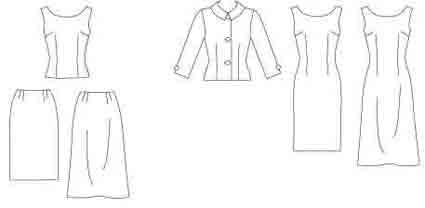
Butterick 5147

”b5147”

mid neutral dress weight : top, a-line skirt.
mid neutral dressy fabric : jacket (made without collar and with zip front), sheath dress.

– – –

‘Modern classics’

There are versions of the classic styles which look more ‘modern’ because they are crisp, close fitting, a little edgy.

The Vivienne Files frequently suggests basic minimum wardrobe groups in ‘modern classics’ style.
For instance some of her recent posts are on wardrobe groups consisting of neutrals plus one accent colour :
– 5 core dark neutral garments (for her that’s usually 2 tops, 2 bottoms, dress),
– a couple of white or light neutral tops,
– an accent jacket,
– 6 other garments in accent colour.
That’s 7 neutral garments and 7 accents.

Example here. And some of her other posts : one, two, three.

This modern take on classics includes many knits. Her basics include tees, knit classic cardigans, and leggings as essentials.

Tees, both fitted and looser and longer. Many tee patterns of course, one is McCall’s 6491.

”m6491”

Knit cardigan closing to neck, see Butterick 5760, first pattern mentioned in this post.

Slim pants pattern by Palmer-Pletsch, McCall’s 6440 (seams down back, 4 hem styles).

”m6440”

Leggings : McCall’s 6360 is one of many leggings patterns, 4 styles 4 lengths.

”m6360”

The ‘modern classic’ style is essentially sleek and close fitting, crisp in wovens. If you’d like to explore beyond Big 4 patterns, look to :
Burda Style downloads
styleARC

Notice I don’t call these ‘young classics’, as anyone can wear them if you’re the right shape 😀

– – –

Doesn’t mean of course that you have to wear these styles, or be limited to colours of black, white, grey, and denim blue. . . [aargh, eek]

As frequently happens, I find myself thinking about classics because many people write about them, even though I never wear them myself.

Does the classic style make you feel your best ? or make you feel constricted and constrained and unable to be your true self ? It’s very interesting this. The Vivienne Files recently posted on her everyday basics here. I actually shuddered. She loves these, but if I had to wear them I would find it completely soul destroying. Even if they weren’t all black, they’re the wrong shapes and fabrics for me. Fascinating that people can be so different.

For those of us who never wear classics ? We have to do a bit of thinking outside the box to work out how wardrobe plans like this match up with our own needs.

I have a whole lot of reactions to all this, some of which I’ve cycled through many times before. As usual I feel so strongly about this I found myself writing several hundred words, so it’s become a separate post (here).

There’s much to enjoy here. I’m fascinated by clothes and style, and I enjoy looking at and thinking about the classics. But it’s definitely not a style for me to wear myself !

– – –

Patterns and links available April 2012

= = =

Improving sewing success

Posted April 14, 2012 by sewingplums
Categories: sewing technique

How can we know what we’re getting before we finish sewing ?

I recently wrote some comments at Stitchers Guild on sources of wardrobing advice for beginners. Ejvc commented it’s easy to find garments in the right colours, shapes, personal styles (all except fit !) when shopping. Because you can try before you buy. But much more difficult to get it right when sewing, because you have to wait ’til you’ve finished to know what you’ve got.

Good points. But I think there are many things we can do to increase our success rate. We haven’t got to work completely in the dark until the last moment about what we’re getting.

Incidentally, these are all things that designers do.  They don’t expect to get their designs right first time without any testing of the real life item (as opposed to the mental dream or the glamourised sketch !). They develop on from styles that have been used before, rather than starting afresh for every garment. And they test frequently during development, so they can give up quickly and without guilt on styles that don’t work out.

Colours and fabrication

I always check colours and fabrics before cutting (preferably before buying !). Hold them up against myself in a full length mirror. Is it a flattering colour ? fabrication, texture, pattern in my style ? good on my body (too stiff or too soft) ?

Also hold the fabric up to test how it drapes.
If you have a dress form, pin the fabric on in a rough approximation of the style – does it look good ? drape right ? have the effect you were thinking of ?

There is no longer a fabric shop here. And buying fabrics on-line is a problem for me. Small differences in shade can make a big difference to whether the colour is flattering. And those small differences aren’t usually reproduced well on screen.
I have a rule not to buy without a sample. I still have problems with :
– fabrics that look different in a large piece than in a small sample.
– fabrics that I’ve bought samples of, and then a different dye lot turns out to be completely different. . .
But those problems happen less often than they would without taking any care.

Good on your body shape

Sketching a style onto a personal croquis is a great help (if you have the skills 😀 ).

Even if you don’t make fit alterations to patterns : know what wearing ease you like for this sort of style, and measure the pattern to make sure it won’t be too large or too small. I remember a top in a favourite fabric that looked so fool-proof I didn’t make any measurements or trials – and it had cut-on sleeves that were too tight round the armhole.

Though measuring doesn’t save me from all disasters. I made a top from a pretty print in just the right colour. PR reviews warned about the neckline. I carefully measured, and all seemed well. But when I tried the finished garment on, it slipped off my shoulders so much it was unwearable.

If I had tried on either garment part-made, a simple alteration could have solved the problem. The neckline problem wouldn’t have shown up in tissue fitting, as it was caused by the way fabric flexed on my sloping shoulders, which made the neckline much wider in wear.

There are many good reasons to make a muslin as part of the pre-planning – check the proportions, ease levels, style element placing, etc. as well as the fit, before wasting the good fabric.

Moral – much basting and frequent try-outs needed at each possible stage of making. . .  Many problems can be rescued (let out seam allowances, add a dart, pleat, or godet 😀 ).  If not, a UFO in the middle of construction is a better outcome than spending a lot of time finishing something that turns out to be unwearable. 

Personal style

Go to a store and try on new styles to see if they flatter you, then look for a similar pattern.

It helps to be aware of your own style – quickly filters out a lot of options. Remember one person’s ‘faves’ can be another person’s ‘never’. I enjoy a recent post from The Vivienne Files. Several of the softer items she avoids are my everyday wear 😀 (my thoughts on a successful cascade jacket are here). And most of the trim-fit ‘modern classics’ she loves would look dreadful on me – not flattering for my body shape, personal style, colouring. (Try Burda Style or styleARC patterns if you want to copy.) I do agree with her about many ‘no-no’ items, but a ‘goth’ or an enthusiastic fashionista would love those spikes and skulls or designer logos. Or perhaps you enjoy casual casuals (here are my posts on sweatshirts and hoodies). Or do you feel at your best in square cut loose fitting ‘arty’ clothes and love Sewing Workshop or Cutting Line patterns.

I’m lucky I have a good visual imagination. I stand in front of a mirror holding a picture of a possible style, and imagine myself wearing it. Also while I’m around locally I imagine myself wearing the style. Has saved me from many mistakes. I now know it’s waste of time starting a project that I’m not sure about, as that will just languish as a UFO.

Or find a designer that works well for you, and stick with their patterns. Not a 100% guarantee of success, but better than random.

If I had to use only one designer, it would be a few patterns by Loes Hinse. But she designs for people with very different shoulders and hips than mine. So her main patterns are not a good starting point for me. Instead I make ‘inspired by’ versions. Or morph the style elements onto my own basic blocks. I also don’t follow her fabric choices, as black, gold, and glitter are not good on me. Hmm, I haven’t got an overlocker (serger) and never wear shoulder pads. Obviously I’m not her ideal customer 😀

Repeat successful patterns

I tend towards a repeating wardrobe because I know what has worked well in the past. (And I’m a timid learner.) But not to worry – that fits in well with most wardrobe building suggestions 😀

Here’s a valuable comment from CCCouture at Stitchers Guild.

“I was just in Las Vegas for the International Textile Expo and lived a dream for a bit in the Chanel RTW Boutique in the Shops at the Bellagio.

I was quite surprised, that while the fabrics are gorgeous, there’s really not much sewing in the RTW pieces.   It’s the fabrics, trims and other findings (buttons) that make them so unique.”

Making small variations to a basic style is what some of the top designers do 😀

Improving your success rate is another good reason to develop new styles by changing details of familiar patterns. Or morph style elements onto good basic personal blocks. Rather than starting from scratch with a new commercial pattern every time.

Though repeating isn’t the best strategy for people who like a lot of variety in their wardrobe. Or variety in their sewing 😀

Practice unfamiliar skills

I always do this, and it amazes me that some people don’t practise before trying a new technique for real. But I know this is another strong personality feature, and many people would not be at all happy if they had to follow my slow and careful ways 😀

– – –

The use of time

For every aspect of getting things right (colour, fabric, shape, fit, style, technique. . . ), the best tool for success is try on, try on, try on, at every stage possible.

Many people enjoy the sewing but not the testing.  And many other people like to just ‘jump in and have a go’. I think they have to accept that their emphasis is on the sewing not the result. So, much of what they make will be samples to learn from, rather than wearable items. For me, the good results are well worth the extra effort.

Part of sewing success is a recognition of the use of time – it’s not just about sewing.
Pattern preparation, fabric preparation (my biggest dislike), cutting out, marking, developing sewing skills and finding good techniques for a particular process, pressing, checking what you’ve made so far – they’re all processes which take substantial amounts of time to get right. They can’t just be rushed through (or left out altogether !).

So find a way of making them fun. Sew in a way that makes all the processes a treat for you 😀

– – –

P.S. Despite all this, it still didn’t work out as you dreamed ? Here’s a special sewer’s frustration tool from Shirley Adams of Sewing Connection 😀

– – –

Originally written April 2012, links checked October 2019.

= = =

Speedy patterns 2012 : skirts, pants, jackets

Posted April 7, 2012 by sewingplums
Categories: speedy sewing

It’s the final weeks of the Stitchers Guild Sewing With A Plan contest for 2012. So here are some more speedy patterns to fill the last minute gaps 😀

I’ve already posted on the quick top and dress patterns available.

Here are some patterns for skirts, pants and jackets which the pattern companies claim can be sewn in 2 hours or less.

– – –

Skirts and pants

Few of the patterns in my previous post on quick skirts and pants are still in print.
Happily there are several to add.

Skirts

Textile Studio Brussels one-seam skirt with elastic waist

”tsbrussels”

Textile Studio Manhattan skirt with darts, zip, back slit, several lengths

”tsmanhattan”

McCall’s 5430 wrap skirt

”m5430”

McCall’s 6567 elastic waist skirt with various lengths and hems, there’s also a mock wrap version.

”m6567”

These patterns from my previous post on quick skirts are still in print :
Simplicity 2368 skirt with dirndl, mock wrap and 4 gore styles, 3 lengths.
Silhouette 2050 straight wrap skirt with darts, button closure, no vertical seams.

Pants

Butterick 5153 one-seam pants, for women, men, children, various lengths

”b5253”

McCall’s 6568 elastic waist pants, 3 lengths, 2 leg shapes

”m6568”

Silhouette 3400 yoga pants. Also webcast and DVD about using this pattern. Webcast and DVD say how to convert for wovens.

”sil3400”

Textile Studio Soho Pant, slim fitting with darts and invisible zip.

”tssoho”

Combination patterns

Simplicity 2414 tiered skirt + elastic waist pants

”s2414”

New Look 6816 for knit skirt, pants and top

”nl6816”

– – –

Layers

I haven’t found many new patterns for jackets, but fortunately several of the patterns mentioned in my previous posts are still in print.
Wardrobe patterns
Layers and capsules
Fast jackets

These are some to add :

McCall’s 6084 is a cascade shawl collar jacket for wovens with 4 sleeve lengths

”m6084”

In an e-mail Peggy Sagers says a couple of Silhouette patterns for knits can be made in an hour :

Silhouette Patterns 195 Sweater set

”sil195”

Silhouette Patterns 211 Nina’s top

”sil211”

Not so quick, but there’s a new version of the Palmer-Pletsch 8 hour jacket, McCall’s 6172.

”m6172”

Sadly the Butterick 4138 pattern which claims you can make a blazer in 2 hours is now out of print 😀

For outerwear, there’s McCall’s 6209 ponchos, which have a variety of shapes and necklines, not all shown here.

”m6209”

Still in print from previous posts :
McCall’s 2260 unlined vests
Butterick 5224 knit jackets.
McCall’s 5241 knit cascade style jacket has 3 front lengths all with the same back
Butterick 4989 cascade/ waterfall jackets
McCall’s 3448 ponchos

And nearly all the patterns in my post on fast jackets from independent designers are still in print.

– – –

This year the focus of the Stitchers Guild Sewing With A Plan contest is Tried ‘N True patterns you can use repeatedly to make clothes that work well for you.
Would any of these speedy patterns fill that role for you ?

So have you got time to complete your SWAP wardrobe ?

23 days of SWAP left. Goodness, make one garment a day and you have time for Nancy Nix-Rice’s whole 23 item wardrobe 😀

Holiday weekend – enough time to make a ‘Core 4’ of top, jacket, skirt, pants.

Or, if you’re just missing one item for SWAP, find 15 minutes a day for the rest of the month.

Happy Sewing 😀

– – –

(P.S. here are free patterns for ultra-quick skirts and pants.)

– – –

Patterns and links available April 2012

= = =

Wardrobe pattern co-ordination : ease for layering

Posted March 31, 2012 by sewingplums
Categories: co-ordinates

Yet more comments on how a pattern like McCall’s 6519 can be a good basis for building a core wardrobe.

”m6519wardrobe”

Two previous posts on this pattern :
– the interest and usefulness of wardrobe patterns with 5 rather than 4 items. And some other patterns with more items (post here).
– a few comments on how the shape elements of the different garments in this pattern work together (post here).

This post is about how shapes fit together for layering : is one layer large enough to be comfortable over another ? I’m not attempting to say everything there is to say about layering of all styles !

– – –

Movement ease

‘Ease’ is the amount the garment is bigger than the wearer’s body measurements.

The most basic is ‘movement ease’, the amount that needs to be added to be able to wear the garment at all. For wovens, this is usually either 2 inches/ 5 cm or 4 inches / 10 cm at bust level. Some people prefer a close fitting basic style. Other people like their basics a little looser.

Some personal pattern drafting instructions produce a basic block with 2 inches ease, some produce one with 4 inches. Check whether the drafting adds 1/2 inch or 1 inch to the quarter measure at bust level. If you’re going to draft your own pattern block from scratch, look for a method which produces the basic ease level you prefer.

As knit fabrics have stretch, they provide inherent movement ease. Even so, some people like loose knits, some people like no ease. Very close fitting garments made from very stretch fabrics (swimsuits, leotards) may even be designed with negative ease (cut smaller than the body).

So pattern making books have separate basic pattern blocks for knits and body fitting clothes. Different basic blocks for fabrics with different amounts of stretch.

Bending room

In the simplest fitting shell, ‘movement ease’ just means enough room to breathe. You may need more room for real movements.

For example, my sitting hip measure is about 4 inches larger than my standing hip measure. Many skirt and pants patterns have 2 inches ease at hip level. In those patterns, I need to go up a size, to add another 2 inches of ease. So I can wear that style without straining the fabric.

This isn’t a problem with the pants of McCall’s 6519 as they are very loose fitting, with hip ease of more than 9 inches.

It could cause problems with sitting down in that wrap skirt, and I would probably make a muslin to check.

If you are an active person, and like to be comfortable, you may find you need a larger armhole and more fabric at elbow and knee. And you probably know you only like some skirt styles, because you can walk and dance freely in them.

Design ease

Then add on ‘design ease’, the extra needed to give the garment the shape and style that’s wanted. This affects whether a garment is close fitting or very loose. The BMV ease table shows total ease, movement ease plus design ease.

There are modern jacket styles (not the one in McCall’s 6519) which are close fitting, with only movement ease. For example, Basic Patternmaking in Fashion by Lucia Mors uses the same block for making both jacket and dress. These close fitting jackets aren’t mentioned in the BMV ease table. They’re made in jacket fabrics with jacket styling, but not meant to be layered over anything more than a camisole. So it’s worth checking the ease level of your pattern. (Total ease = difference between finished garment measurement and your measurement.)

Layering ease

So ‘design ease’ includes ‘layering ease’ if need be. Make sure there’s enough room to put one garment on over another. Best to have at least 1 inch/ 2.5 cm extra ease for every additional layer something needs to be comfortable over, including a lining.

This applies to knits too, if you want them to be comfortable.

The ease levels in McCall’s 6519 at bust height are :
dress (knit) : 1-1/2 inches / 3 cm
top (woven) : 4-1/2 inches / 11 cm
jacket (woven, unlined) : 5-1/2 inches / 13 cm

So it might not look very good, but if you were cold you could wear all three 3 layers at the same time !

Armholes and sleeves

In this McCall’s 6519 pattern, dress and top are both sleeveless, so the problem of layering the jacket over another sleeve doesn’t arise.

If you want to layer one sleeve over another, then the outer armhole and sleeve need to be larger too.

It’s also easiest if all layers have the same style armhole : all fitted, all cut on, all raglan, all drop shoulder, etc. Most armhole shapes work over fitted, but not the other way round !

– – –

Now there are three posts inspired by McCall’s 6519. The first two were on :
5-item wardrobe patterns
co-ordination of shapes

In the first post I mentioned the easy ways of adding more items to a wardrobe pattern to make a core wardrobe : changing fabrics and lengths. Those easy ways may not add much to the sewing interest 😀

How to add more styles when starting from one pattern ? If you’re ready to try a little pattern altering, you don’t have to go straight to a full-scope professional-training pattern-making bible. There are many simpler sources of advice to use as a starting point. Am planning a post listing some of them.

Or if having ideas for capsules and small wardrobes is the point you get stuck at, look at The Vivienne Files or Polyvore. You may not share their ‘modern classics’ styling, but they’re full of ideas for combinations that make outfits and capsules.

Enjoy 😀

– – –

Patterns and links available March 2012

= = =