Archive for the ‘style and planning’ category

Dress in 5 Minutes coordinates : Tops

May 31, 2010

Sew in a weekend : dress in 5 minutes.

The key to dressing without thinking, yet still looking good, is a co-ordinated wardrobe. Most of us have at least a few days when we don’t want to think about clothes. And for that we need a small group of clothes that all go together. So we can grab anything and it will work.

We also sometimes feel we’d like to be able to choose a co-ordinated wardrobe without thinking. Or wish someone else would do the thinking for us.

The trouble is this doesn’t work, as we’re all different shapes, different colours, different lifestyles, and different personalities. I’ve found I can’t work from a theory. There’s no substitute for trying things out and looking carefully. From past experience, I know the clothes in the ‘system’ below are not right for me. But it has general ideas which are useful.

This example of co-ordination comes from Eileen Fisher. They’re very simple styles so, using super quick patterns, you might be able to make a capsule from her ‘system’ in a weekend 😀 Though simple clothes do look best in quality materials and quality techniques.

The current (May 2010) Eileen Fisher ‘system’ consists of :
– 3 sleeveless tops.
– 3 bottoms.
– 3 layering pieces.
– 3 accessories : 2 scarves and a belt.

Most of these garments are made from knits. But I’ve had my head full of speedy patterns for wovens recently, so that’s what comes to mind.

(SWAP 2010 recently finished at Stitchers Guild. Very inspirational wardrobes. But not usually quick to make !)

– – –

Sleeveless tops

”3tops”Eileen Fisher

All the tops do need to be suitable for wearing alone, as well as co-ordinating with all the layering pieces.

These three tops are sufficiently similar that they’re easy alternatives. All are sleeveless, collarless, unshaped, and long – either low hip or high thigh.

For a bit of variety there’s a camisole, and low and high necklines. One has neckline embellishment (self-coloured sequins).

There are few patterns just for sleeveless tops. But if you ever buy wardrobe patterns, you’re probably already well supplied with sleeveless top patterns.

Jalie knit patterns are popular. Jalie 2806 scoop neck tops include sleeveless styles.

”jalie2806”

If you need a pattern for wovens, oop Butterick 4987 is for making camisoles (left below) in 2 hours of sewing time.

Among current patterns, there’s a camisole in the Butterick 4989 2-hour pattern for cascade jackets.

McCall’s 5298 wardrobe includes a low neck fitted top (centre). This pattern isn’t timed, but is quick and easy.

Butterick 5948 is a pattern for 2 hour tops that are not fitted but include a range of necklines and body and sleeve lengths (right).

”3toppatts”

Or try the Textile Studio – Loes Hinse Tank Top and Shell.

”tstankshell”

Lengthen all these patterns to mimic the inspiration.

Personally, this sleeveless top is so simple I think I would start from my fitting sloper. At the beginning of the year I launched into developing TNTs, but got bogged down on finding a comfortable armhole. Now I’ve mercilessly scooped out the lower front armhole, I’m close to one that doesn’t bind.

I usually wear sleeves and a collar. But now I have a comfortable sleeveless top and the weather is unusually hot here – perhaps I will try some sleeveless shells !

(The next TNT problem is I have no idea how to get a sleeve head to match my armhole. . . but that’s another story. . .)

The easiest way to have interchangeable clothes is to make them the same shape and colour. But within that limit, there’s still huge potential for an almost infinite variety of embellishments. It’s even possible to morph these simple shells into vests, blouses and dresses. Shirley Adams’ Alternatives 500 Shell series includes add-on pattern pieces. Fun, but a long way from developing a co-ordinated wardrobe. Which is easiest if the components are fairly similar.

– – –

Tees

If sleeveless doesn’t work for you, you’ll be pleased to know there are many basic sleeved tees elsewhere on the May 2010 Eileen Fisher site. (Many of these tops are long too.)

Jalie 2805 pattern for knit tees is a favourite of Pattern Reviewers, one of the Best Patterns of 2009.

”jalie2805”

Or Simplicity 4076 (oop) is in the Pattern Review Hall of Fame 2009, if you like more varied tops. Though these styles are more difficult to combine successfully with a covering layer (I think it would best be simple and plain).

”s4706”

Some other popular patterns are Pamela’s Perfect Tee and Jennifer Stern’s The Tee.

If like me you don’t look good in knits (anything closely fitted makes it obvious how small my bust is), there are woven short sleeved tops in the Butterick 5948 collection of 2 hour tops.

Or try the Textile Studio – Loes Hinse Basic Top.

”tsbasictop”

I look better in these tops if I add front bust and back shoulder darts.

– – –

Cami dresses

Elsewhere on the May 2010 Eileen Fisher site, most of the dresses are ‘cami dresses’, lengthened versions of the simple tops.

Spaghetti straps slide straight off my sloping shoulders, so I wouldn’t be comfortable in this style. They’re minimal garments, not made with the support you get in a strapless formal dress.

If you do like this idea, New Look 6804 (oop) is a 2-hour dress pattern.

”nl6804”

– – –

On Trend

If you’re following the Pattern Review Wardrobe Contest for 2010, you need to include something that’s ‘on trend’ as shown in a fashion source. These items show just how easy that is ! You might make a classic tee and refer to the Eileen Fisher site to show you’re current 😀

There are several trends this summer that are relevant for simple tops.

Colour :
Lighter neutrals, such as nude tones or oyster grey, non-colours of beige, stone, greige, light coral, or pale muted pastels.

Minimalism :
One of this season’s key trends is minimalism, and these tops certainly follow that – the simplest of styles made in high quality drapey fabrics.
See ‘Clean Energy‘ at Style.com (US Vogue) (“Click for more fashion” to get a beautiful slide show.)

Lingerie look :
Make your top in charmeuse or sheers, with added lace or flounces. Or white lawn covered in heirloom stitching.
See ‘Pastoral Interlude‘ and ‘The Big Reveal’ at Style.com

– – –

Co-ordination and personal style

‘Dress in 5 minutes’ is possible because the clothes are interchangeable. Everything goes with everything else, so you don’t have to think or try things out.

Co-ordinating is helped by shapes and lengths, necklines and armholes, and colours. This ’system’ of clothes do co-ordinate, but is this the co-ordination that’s best for you ? I need to adapt the shapes and lengths, and the colours, to be more flattering for my body.

And the clothes also need to work with your personal style and lifestyle. For example, suppose you’re choosing tops for a travel mini-wardrobe. You might need a sunny top and a dressy top, but also a covered up top for visiting places with a dress code.

– – –

Shapes and lengths

This ‘system’ co-ordinates partly because of the similar shapes. All the pieces are simple in outline. They depend on knit fabrics for shaping to your body. If you’re not a straight shape, see my previous post for some thoughts on adapting simple patterns to be more flattering on other body shapes.

Use the high and low necklines that are most flattering for you (see post). Add darts if that works better for you. I need to flare the side seams or add side slits from waist level, so the tops aren’t strained over my hips.

Trinny & Susannah in ‘What not to wear’ have a lot of advice about t-shirt styles for different body shapes.

All the ‘system’ tops are long. That’s because two of the layers are cropped to give the ‘layered’ style. (Two meanings of ‘layer’ :
– a piece that goes over others.
– a look with the ‘layering piece’ shorter that what’s underneath, short over long.)

”layers” Eileen Fisher

Cropped jackets and vests are also a trend for the coming winter.

”me-layered” Me, ah perhaps not. . .

With my short waisted high hipped pear shape, this is not a good look for me. Puts a lot of important design lines across my hips, which is the last place I need to draw attention to. . .

In Trinny & Susannah’s “Body Shape Bible”, they only suggest short-over-long for their Pear shape – long body and short legs. Trinny herself is this shape, and uses the layered look to great effect so she appears to have perfect proportions.

It would be better for me to make these items the other way round, long over short : short tops and longer layering pieces.
But you may be one of the people the short-over-long look works well for.

It’s good to get the lengths right in a wardrobe. It’s also important to co-ordinate necklines, armholes and sleeves. In this ‘system’ the tops are all collarless and sleeveless, so that isn’t a problem. I do prefer to wear a collar. There are 2 easy ways of co-ordinating this :
– tops with collars, layering pieces collarless.
– tops collarless, layers with collars.

If you want sleeved tops that go under nearly all layering pieces, do make the tops with fitted armholes and sleeve heads.

– – –

Colour

Co-ordinating is helped by simple use of colour. In this Eileen Fisher ‘system’ all the clothes are neutral colours and accessories are accent colours. There are two main neutrals, a light and a dark. Bottoms are in the dark neutral. Most of the tops and layering pieces are in the light neutral. There is added interest because they have different textures.

What are your best lighter and darker neutrals, and favourite accent colour ?

Personally I don’t look good in strong contrasts, and I wear mainly lighter colours. A light top and dark bottom means there’s a strong line across you somewhere. You need to make sure this is at the right height, and with the right balance of light and dark, to be flattering on you.

”contrast”

I like wearing neutrals, but mainly light ones. The monochromatic look is right for me. And I like textures. But soft florals, and animal or ethnic prints, are ‘in’ this season, if you prefer prints to textures. Or multicoloured abstracts if you like a hard edged look.

Do you know your own ‘colour personality’ ? (see posts on individual colour types in her April 2010 archive). Would you prefer to wear a couple of pastels, or olives and rusts, rather than neutrals ? Nude tones or khakis are very current. So is monochromatic denim blue. Or perhaps you like a variety of strong colours. In that case you may already know that colour-blocking of near-primary colours is ‘in’ this year !

In the Eileen Fisher ‘system’ , the clothes are all in neutral colours. Accessories add life and variety. Scarves and belt are in accent colours and obvious textures – crinkles and weaves. The long scarves (70 – 84 inches/ 1.75 – 2.10 m) have fringed ends. Many are wide enough (20-28 inch/ 50-70 cm) to use as a light wrap. A lot of stylish people round here are wearing these long big scarves to add colour and individuality.

– – – –

These are good relaxed styles. Some of the patterns I’ve mentioned are not timed patterns, but are easy.
Make a ‘capsule’ of top, bottom, and layering piece in a weekend. (More posts, on the Bottoms and Layers.)

So you need a month of speedy sewing weekends for clothes and scarves, and a little shopping for belts if you like them, to get the complete wardrobe 😀

– –

Patterns and links available May 2010

Four current styles ? Styling some Visitors

April 17, 2010

Have just seen a fascinating ad for a new TV series (‘Visiting Time’), in which the personality of each character is clearly signaled by what they’re wearing. (Haven’t seen an episode, so don’t know what the characters are actually like.) They are supposed to be visiting aliens. It looks as if the aliens are trying to fit in by wearing the most current styles. . .


Pity it’s a difficult photo to scan well.

One (the leader ?) wears a classic blazer, white shirt, and trousers. The outfit so many stylists who suggest minimum wardrobes try to get us all into. Another wears a sheath dress, much in style this season. One wears a tightly fitted possibly hoodie jacket with fitted shoulders, skin tight jeans/ leggings and knee high boots. And there’s one wearing a drapey cascade jacket with equally soft pants.

Easy to find patterns to mimic these looks.

The girl far left is mainly styled by long blonde hair, so it’s a bit difficult to see her jacket, but it’s obviously close fitted, minimally styled except for edge trim, possibly with a hood as a style feature.

”fitted”

Butterick 5427 could be a starting point. Narrow trim on all edges.
It’s very current to use colours, fabrics (and pressing !) so the fitting seam and dart lines disappear.
She gets paired with a man with longer hair, black leather jacket and blue jeans. What’s the betting he’s also wearing boots . .. .

Classic blazer : button at bust level, collar notch quite high.
Many blazer patterns available, but most of them have long lapels and button at waist level. This character is buttoned at bust level, perhaps she’s supposed to be ultra-classic.

”classic”

New Simplicity 2446 jacket is just right.
Not surprisingly this character gets a man in a suit.

Sheath dress – could make a sheath from one of the standard fitting shell patterns. (Butterick 5746 also includes a sheath dress, though it’s an easy adaptation of the ones which are just fitting shells, McCall’s Palmer-Pletsch 2718, which includes 5 fronts for different cup sizes, and Vogue 1004.)

”sheath”

This is the dress from wardrobe Butterick 5428 – add a self fabric belt.
(The wardrobe jacket with a bow doesn’t go with a sleek efficient version of sheath style, but would be good for “from day to date”.)
From a close look at the dress in the photo, it may have hip pockets for a bit of subtle detail. That would mean a waist seam.
There are many sheath dress patterns available at the moment, with small style elements to add interest. This is the season of the dress, and there are patterns to suit all personal styles, not just romantic or boho. This style is definitely sharp and crisp.
She gets paired with an equally sharp crisp man – close fitted jacket with mandarin collar.

Drape jacket – lots of patterns available for this more relaxed look. The closest to the one in the photo is probably McCall’s 6084.

”cascade”

This most laid-back of the characters gets paired with another man in a suit, but a minority one.

These do show clearly that fitted styles are the main silhouette at the moment. My problem is that a fitted jacket style isn’t what I’m looking for. I usually wear a jacket over several warming layers, so it needs to be something loose. I’m pondering on this.

As these characters are aliens, am not sure how much we need be influenced by the fact that they’re all wearing grey, black or dark blue. . . Hadn’t any of the aliens’ style scouts noticed that brown is supposed to be the clothing colour which humans think is the friendliest. 😀

– – –

Patterns available April 2010

– – –

P.S. Look at the comments in the related post automatically generated by WordPress. There are many good suggestions about making sheath dresses.

Clothing Values

March 21, 2010

I’m currently enjoying working through ‘Dress Smart’ by Anne Fenner and Sandi Bruns.

Yes, it is a workbook, full of questionnaires and exercises, as well as insights. Takes time and thought.
Expensive (not good value) and mainly focussed on work clothes, but a lot of interesting ideas and clarifications which work in a wider context.

What I’m particularly interested in is that it adds an extra dimension to the mix of deciding what are the best clothes for you, not just :
– your colouring,
– your body shape,
– your lifestyle,
– your personal style,
but also :
– your clothing values.
This doesn’t mean how much your clothes cost, or how much they cost per wear, but how important you think different aspects of clothing are.

This is somewhat related to personal style (classic, romantic, casual, dramatic, etc.), but I’m finding it greatly clarifies things for me to see this as separate.

They identify 7 values. (I’ve put ‘ ‘ round a couple of labels as I think their meaning isn’t obvious.)

– – –

Economic
How much money and time you’re willing to invest in your clothes and their care.
For sewers I think this includes how much and what type of effort we want to put into making our clothes (time, complexity of skill we enjoy using, time to gain new skills, etc.).

‘Theoretical’
Are you ‘interested in clothes’ – how they’re made and designed, how fashion works, the history – as an interest separate from being fashionable or enjoying sewing. This I realise is very important to me. A big ‘aha’.
Or ‘concept’ clothes, clothes which express an idea ?

Physical Comfort
I got the highest possible score on this !

Aesthetic
Beauty and quality.

Body awareness
How important it is to you that your clothes enhance your body.

Social
Social acceptability, fitting in, belonging to a group with a particular dress code, being fashionable.

‘Political’
How important it is to you to be “the best”, or to enhance your power by how you dress.
My ‘least important’ score here 😀

– – –

Creativity
I think we sewers have another important value which probably doesn’t occur to people who are studying clothes buying habits : how much we want opportunities for individual creativity.
And what form that creativity takes – whether our pleasure comes simply from making things, or using the equipment, choosing fabrics/ patterns/ techniques, making our own styles or patterns, or designing our own embellishments, etc.

– – –

And all these ‘values’ can be reasons why we sew, as well as just because we enjoy sewing. I’ve realised the reason I’m so uncomfortable with buying RTW is that most of it goes against my clothing values.

Very intriguing – this has helped me to understand important ways I differ from some people who otherwise seem very similar to me. Often I dismiss some issues that other people are greatly concerned about. Or what I think is important are things which other people aren’t bothered by.

Choosing and Changing Necklines

February 20, 2010

This post has been updated in 2 sections :
Choosing necklines
Changing a pattern neckline

Do you know what is the best neckline for you ? There’s much to consider. There’s the shape of neckline that enhances your upper body. There’s the shape of neckline that flatters your face. And the widths and depths of neckline that go best with your proportions. All that before you even think about pattern making techniques for changing a neckline.

– – –

The neckline shape that flatters your body :

If you search ‘choose neckline’ you’ll find a lot of guidance, especially about the best necklines for your body shape, your combination of neck, shoulders and bust. These are some of the links I like, and which give different perspectives :

[The links I gave in early 2010 are now very out of date. Search ‘neckline” to get a useful selection.]

(P.S. see also Amy Herzog’s ‘Fit to Flatter’ tutorial on necklines.)

– – –

What about flattering your face :

To think about this, you need to be aware of the shape of your facial features – your jaw, lips, nose, eyes, eyebrows – are the edge lines straight or curved ?

‘The Triumph of Individual Style’ is an expensive beautiful book with many reproduction art works of women. The aim is to show that, whatever your shape, someone has found it worth celebrating. There’s an interesting section on facial features, pp. 16 – 21.

Once you’ve decided whether your features are straight or curved, there’s confliciting advice about what to do with this information. Some people say the best neckline echoes the shape of your features. Others say the best neckline counteracts your features, so use curved shapes if you have an angular face, angular ones if you’re curved. Perhaps the choice between these attitudes depends on personal style, rather than there being one answer which is right for everybody.

The shapes of your face might influence for example whether you look better in a V-neckline with straight edges or with a slightly curved shape.

So do some experimenting. Cut neckline shapes from kitchen towel and try them out.

‘The Triumph of Individual Style’ says you can wear any shape of neckline, so long as it balances your face with your body. Though they recommend echoing your jawline.

Personally I agree with going for shapes that echo the curves of my features. Necklines with sharp angles seem out-of-kilter with my face. But then I prefer softer curved looks anyway. And also, I’m old enough to have ‘jowls’. I find my best neckline is the shape that echoes what my jawline shape used to be 😀

– – –

Width of neckline :

Gale Grigg Hazen has an ingenious suggestion about measuring necklines, in her book “Fantastic Fit for Every Body”. Use a 6 inch x 24 inch transparent (quilters) ruler to measure how wide your neck is, and how far your straps are from your centre line.

”gghneck” (GGH-FFEB p.170)

Use these measures to check pattern necklines : wide enough for your neck ? too wide to cover your straps ?

‘The Triumph of Individual Style’ says your neckline or collar opening should be wider than the widest part of your face. For most of us that means we aren’t at our best in a jewel neckline which is close fitting round the neck.

– – –

Depth and balance :

‘The Triumph of Individual Style’ has some fascinating suggestions about flattering neckline depths, pp. 49 – 55. They suggest two ‘balance points’, for high necklines and low.

All their measurements need to be made vertical and straight, with a ruler. Not over the bumps, as you would using a tape measure.

High neckline

Measure vertically from the widest part of your face to the tip of your chin. Your widest point could be at your forehead, your check bones, or somewhere on your jaw.

I’m 3-1/2 inches vertical from cheek bone to tip of chin.

”upperpt”

Measure that distance down from the neck end of your shoulder.
Across from there is the most flattering point for your upper neckline.

On me this comes at the level of my collar bones. I’ve long known that a neckline closely fitting my neck doesn’t look good on me.

Low neckline

Measure vertically from your hairline to the tip of your chin.
Or, if you always wear a hair style that substantially covers your forehead, measure down from your hair.

I have a long face, and on me this is 8 inches.

”lowerpt”

Wear something that you don’t mind sticking a pin into or marking.

Measure the length of your face down from the tip of your chin, On me that comes near my bust point.
Mark that level, which is said to be the most flattering level for lower necklines.

You need to convert this to a measure that can be compared with a pattern. So measure from the neck end of your shoulder down to the pin or marker, this time using a tape measure on your body. Because of collar bones and bust, that is likely to be longer than the vertical measure down from your chin.

I’ve got prominent collar bones, and on me this measurement is 11 inches.

If this point comes low on you, you need to think what this means for you personally. With my long head, the low neckline point comes so low it would need a lot of double sided tape to be at all decent, and would be much more revealing than suits my style. But that doesn’t mean I can’t emphasise necklines to this level. It explains why I like wearing long necklaces, and deep V necks on layering tops and jackets, which are all coming down to that level.

So if you need modesty you could have a more obvious neckline going down to this point, filled to a higher level by something less obvious. And I’m trying out emphasising this level using embellishment, a corsage, or a necklace pendant.

(P.S. Now I know about these balance points, I keep spotting celebrity examples. Wear your neckline below the low balance point if you want all the attention to be on your cleavage !
I think the necklines of most patterns are developed on models with long necks.)

Cut test necklines from kitchen towel, or drape scarves, and see what you think. Image consultant suppliers sell sets of basic neckline shapes made from calico. You can try a much wider variety if you make your own !

– – –

To change a pattern neckline :

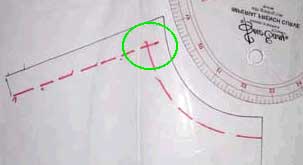
To change a neckline, first draw in the stitching lines on the existing pattern. It’s easy to do this with a transparent French Curve with 5/8 inch marked round the curved edge. These lines show the position of the shoulder seam and the finished neckline edge.

”nkptcircle”

The crucial point to identify is where the neck edge meets the shoulder seam, sometimes called the neck point.

So long as you draw your new front finished neckline through this point, you won’t have to alter the back neckline (or vice versa).

”v-neck”

If you want a wider or narrower neckline, draw in the new finished neckline position. Then measure how far the new neckline is from the old neck point, along the shoulder seam. Use this measure to find where to start the new back neckline.

”lowneckarrow”

To add the new cutting line :
– make some marks 5/8 inch from the stitching line.
The ends of both a tape measure and a seam gauge are 5/8 inch.

”cutlinemark”

– Then join the marks into a smooth curve – easy to do with a French Curve.

”cutline2”

Changing the neckline of a wrap top/ dress is a bit more complex. Here’s a tutorial.

P.S. There’s now a Craftsy class by Suzy Furrer on drafting necklines.

– – –

Collars :

Of course, getting the best neckline shape is essential, but only the first step. Then there are collars, bias drapes, bows, ruffles, whatever. But presumably these additions follow the same principle – that they are best when they coordinate with the lines, shapes, and proportions of our bodies.

For example, big collars need to be in proportion to our overall build. (I’ve just been attracted by a large collar jacket pattern, but fortunately thought of checking my personal croquis. A deep collar wider than my shoulders, on a short jacket, would make me look like a heffalump. . .) ‘The Triumph of Individual Style’ has illustrations showing how to adapt classic collar shapes to high and low neckline balance points. And Darlene Miller’s book ‘Your shape, your clothes and you’, has illustrations suggesting curved collars go with curved bodies and straight with straight.

(P.S. There’s a class on drafting simple collars at eSewingWorkshop.

There’s now a Craftsy class by Suzy Furrer on drafting collars.)

Lots of possibilities to think about and try.

– – –

Links available February 2010

– – –

To get to main blog, click on red header.