Archive for the ‘fit + patterns’ category

Sewing a Wardrobe in a Weekend : Pattern and Body Shape

April 25, 2010

There’s a fascinating article by Sue Neall on sewing a 6-piece wardrobe in a weekend.

The Vogue 2910 Adri pattern is oop but still available.

”adri2910”

Sue Neall is an expert sewer. Look at that pattern : sheer fabrics, double welt seams, top stitching, lined bias cut top and skirt, skirt also has side-seam zip and shaped hem, pants with darts, curved pockets, zip and waistband. How did she do it all ? Whew, I get flustered just thinking about it !

Are there pattern possibilities and sewing processes which might make a weekend wardrobe an achievable aim for the rest of us – even for people who don’t sew knits and haven’t got a serger/ overlocker. . . ?

There are many patterns labelled Very Easy which are not also Super Quick. Although the processes are easy they’re not fast, for example simple collars. Or there are a lot of processes, such as an eight-gored skirt.

For speedy sewing, most of us need patterns with a small number of easy processes. Something like Park Bench Central Park (quick to sew, but sizing only for people with some experience).

”central-park”

Another problem with patterns that are both quick and easy is they’re usually straight up and down, and about half of us aren’t.

– – –

Pattern and body shape

Styles which are straight up and down are only flattering for those of us who are straight up and down. And this is related to speedy sewing. You don’t have to be full busted for it to be well worth taking the time needed to add bust darts to most of these patterns. And do some side seam shaping : curving in for a waist or flaring out for larger hips.

”3alters”

Moving the pattern side seam by 1/2 inch changes the garment by 2 inches or 1 size.
Moving the pattern side seam by 1 inch changes the garment by 4 inches or 2 sizes.

Nancy Nix-Rice (“Looking Good” p. 36) comments about rectangular shape garments :
– pears/ triangles : need shoulder pads to balance shoulders to hips.
– inverted triangle : rectangles make hips look as wide as shoulders.
– hourglass : rectangles hide best feature – small waist.

Nancy Nix-Rice uses the ‘Vogue’ body shapes of inverted triangle, triangle, rectangle, and hourglass. She doesn’t separate people who are rectangular (straight up and down) from round (waist larger than bust). ‘The Triumph of Individual Style’ does. They suggest round / apple shape people need soft curved shoulder shapes rather than square ones. Big shoulders may not be fashionable these days, but fitted shoulders are. Happily so are cut-on and raglan sleeves, which have a softer effect. And are quicker to sew.

– – –

Triangle/ Pear

Smaller above the waist, larger below. If you have a clearly indented waist, also look at Hourglass advice.

For a pear, a rectangle shaped garment big enough to go over the hips is huge at the top. That’s why shoulder pads are recommended, to stop all that spare fabric from sagging. Not a good starting point. I prefer flare at the side seams, from shoulder or underarm.

”2pears”

Vogue styling advice for pears usually suggests shoulder emphasis and a neat waist with full skirt. And these are not quick techniques.

Easiest to start from a-line or flared patterns. Or perhaps ones with a bit of gathering, though that’s not a super quick technique. There are surprisingly few of these patterns, considering how many there are of us with this shape.

One possibility is oop VE Vogue 8371. Those ‘handkerchief’ corners would look very droopy on me, but easy enough to cut them off.

”v8371”

Make a larger size and add a front opening to the sleeved version, for a jacket.
Change the length of top and skirt for more current proportions.

An equivalent is See & Sew Butterick 5203 (add a skirt), or Vogue 8542 for knits.

There are of course other a-line and flared patterns. I chose V8371 to show some of the extra steps you may need when there is not a wide choice of suitable quick patterns.

Being small busted, I look better with an interesting neckline/ front. VE Vogue 8482 with an easy drape neck is a possibility (flare the side seams).

”v8482drape”

This is an example of what keeps coming up – those of us who are not rectangular may have to do some pattern altering or change style features to get flattering patterns.

– – –

Inverted triangle

Larger above the waist, slimmer below. It’s helpful to separate people who have large cup size but narrow shoulders, from people with wide shoulders but a small cup, and people with both large.

Big shoulders – taper a rectangle.
Big in front – well worth the effort to do an FBA, or at least add bust darts.

For people with bigger shoulders, there are Very Easy patterns which assert the shoulder emphasis with a strong horizontal line. Such as VE Vogue 8552. (possibly remove zip and centre back seam).

”v8552”

(I think the pockets might look good on someone with large shoulders, but less so on someone with a large cup size.)

Inverted Triangle is the body type that’s most likely to have difficulty getting into a more fitted design without an opening. See my post on size. You may be surprised by what you can get over your shoulders or bust without needing a zip. If so, you can also leave out the centre back seam.

But you are more likely to need a zip or other opening in a more fitted design. In that case, for a quickly made pullover style you might prefer drop shouldered loose fitting rectangles, like Anything But Ordinary by Louise Cutting.

”abo”

– – –

Hourglass

Balanced above and below a clearly indented waist.

What a pity to waste a good figure by not adding bust darts.

Nearly all patterns from the big companies have at least a little side-seam waist shaping, so increase it.

Sadly, belting a rectangle garment gives what Nancy Nix-Rice (“Looking Good Live” DVD) calls the ‘sausage effect’ – fabric bulging above and below the belt.

There are Very Easy patterns with simple princess seaming combined with cut on sleeves. Not so much extra work after the fitting is done. Perhaps VE Vogue 8512.

”v8512”

(Change the neckline if this isn’t right for you.)

Again see my post on size. You may be surprised how much you can narrow the waist and still get it over your head without a zip.

Or add fish eye darts at waist level. But make sure they don’t make the waist area too small to get your shoulders through.

”hgdarts”

Best to add bust darts as well, or you may get odd fabric strain lines.
Princess seams are probably much less work once the fitting is done !

It’s not very flattering for people with an indented waist to wear styles without side seams.

– – –

More shape means more work

For us non-rectangles, it’s adding shape which takes the pattern adjusting and sewing time.
Unless we just use fabrics which fall into place to show our curves : knit fabrics, soft fabrics with little body, or cut on the bias.

Sadly, tapering or flaring the side seam gives a curved hem, which is much slower to sew than a straight one !

As there are so few Super Quick patterns for us non-rectangles, we may need to do a lot of pattern preparation :
– fitting work : add darts, change side seam shape, adjust lengths.
– adapting suitable patterns : change necklines, add or remove openings, etc.

Or use very oversized ’boutique’ style patterns, as in the Shapes pattern line. These envelop all body shapes, but are not to everyone’s taste.

”shapes”

Sue Neall, who sewed the 6 item wardrobe in a weekend, did her pattern altering as part of her weekend. But the only pattern adjustment she made was an FBA. For us less expert more oddly shaped sewers, there isn’t time in one speedy weekend for basting, trying on, and fiddling with the fit. So it’s either use a TNT or make a muslin beforehand.

So I think we less experienced sewers with less straightforward shapes should do our pattern preparation before the main weekend, as well as fabric preparation, collecting notions, and winding bobbins. So we just leave the cutting and sewing for the breakneck phase. Though admittedly even two express weekends, a cutting one and a sewing one, would be a super-challenge for most of us. . .

– – –

6 becomes 4

Apart from changing the side seam shape, most ways of improving things for us non-rectangles involve more sewing processes. So while there are Very Easy patterns for us, they’re nowhere near as quick to make.

Perhaps those of us who are not rectangles are going to have to settle for making only 4 items in a weekend, and leave the 6 item wardrobes to the rectangle shapes among us 😀

It is of course ridiculous for me to be writing about speed sewing, as I’m the world’s slowest sewer. On the other hand, perhaps that’s why it’s a topic that fascinates me so much. . .

I’m planning more posts, on speedy processes and specific patterns.

– – –

Patterns and links available April 2010

Fabric wedges for body bumps below the waist

March 28, 2010

Many fit alterations can be dealt with just by adding super wide seam allowances to a muslin, and playing with them in a trial garment. Or by adding in or folding out pattern strips.

But there are some fitting problems which mean you have to change the shape of the pattern piece to get fabric where it’s needed. These alterations add wedges rather than strips. A wedge is wide at one end and narrow at the other, it adds different amounts of fabric in different places. So it changes the angles of pattern pieces, not just the length. Once the fabric is cut out, it’s too late to make this sort of change.

These wedges may be needed to cover extra large bumps front and back, above and below the waist, as well as on the arms. Usually the aim is to add fabric to the middle of a pattern piece, while only changing the length of one side of the pattern at most.

This post is on wedges for skirt and pant fitting. Above the waist, the best known wedges are the FBA, and for larger arms.

(I should say I’m not a fitting expert. I’m just trying to make sense of all the different guidance I’ve found.)

In summary : this post talks about 3 wedges which are related to crotch length :
– adding a wedge at waistline – if you have a tilted waist or large tummy.

– adding a wedge at middle CB seam – if you have a larger butt.

– adding a wedge at crotch extensions – if you have a deep torso.

Since writing this I’ve heard about a fourth wedge :
– adding with the wide end of the wedge at side seam. Not related to crotch length. People with very shaped hips/ thighs silhouette may need this.

My examples show changes to the pattern. But it isn’t necessary to do this on the pattern before making a test garment – you can slash and spread a muslin. And that way you don’t need to guess how big a change you need, you let how far the slash opens tell you. Here’s an example of above waist changes

from Craftsy.

– – –

Fullness front and back below the waist :

There are many ways of adding fullness to cover bumps front or back below the waist.
Method 1 : add at waist.
Method 2 : add a horizontal wedge at bulge level from centre to side seam.
Method 3 : add an angled wedge, like that for an FBA.
Method 4 : add to crotch extensions (pants only).

Sadly there isn’t yet universal agreement about which method to use. Perhaps that reflects how many factors influence good pants fit.

(I haven’t come across names for all these methods, so I’ve given them labels for convenience.)

– – –

Method 1 : Add at waist :

The easiest way to add fabric to cover vertical fullness below the waist is by adding fabric at centre waist level.

For example, Vogue pants fitting pattern Vogue 1003.
This is the only method this fitting pattern suggests. Odd, as the Vogue Sewing Book 1963 and Vogue Sewing 1982 both mention the next method.

”

This is okay for small amounts.
But here (left) is an example of adding a large amount this way :

”addwaist”
(Waist level addition left, horizontal wedge method right.)

If you add a large amount at the waist, the added fabric may be in the wrong place (at your waist, not over your curves). So the result may be added strain lines in the wrong places, rather than a solution to your fitting problem.

The very exaggerated wedges in the photo add about 2 inches. I’ve used them to show the effect clearly.
In practice, Morris and McCann in “Every Sewer’s Guide to the Perfect Fit’ p.73 suggest you only add fabric at the waist to make a change up to 1/2 inch.

– – –

Method 2 : Horizontal wedge :

The easiest way to add fabric in the centre of the piece is with a horizontal wedge, wide at centre narrowing to side seam stitching line.

”buttwedge”
(wedge about 2 inches)

This changes the whole angle of the top of the pant back. It’s also necessary to smooth and fill out the side seam curve. The result has a characteristic tilted shape.

I don’t know if there’s something about the Dutch – but all pant patterns in KnipMode magazine are like this.

”knipflipped”

So if you’re this shape you might like to get hold of this magazine !
(No need to go to the Netherlands, I’ve since heard this shape is known as ‘Burda butt’ 😀 )

You might get an idea of how big a pants wedge you need to add by measuring over your bumps. Taking the centre line crotch length measurement of your back probably won’t help, as it may to be somewhat shorter than your protuberances !

Sadly there are some problems with this simple horizontal wedge method.

You can’t use it on the front of a skirt, if you want the centre front on a fold, as the centre seam isn’t straight.

You can’t use it on skirt or pants centre seam if you want to use a zip, as the centre seam isn’t straight.

Palmer and Alto in ‘Fit for Real People p.180 say they don’t like to use this method because of the changes to the centre and side seam shapes.

This method adds the most fabric at the centre line of the body. And the extra is actually most needed in the centre of the pattern piece.

So Morris and McCann in “Every Sewer’s Guide to the Perfect Fit’ p.88 say you should only use this method for alterations up to 1 inch

– – –

Method 3 : Angled wedge :

For larger changes you may need a method which adds more fabric in the centre of the pattern piece.

This method is described by Morris and McCann ‘Every Sewer’s Guide to the Perfect Fit’, pp. 75-6 for skirts and pp. 89-90 for pants. Palmer and Alto describe it for skirts in ‘Fit for Real People’ p.180. They say it comes from Judith Rasband ‘Fitting and Pattern Alteration’, which I haven’t seen.

”anglewedge”
(wedge about 2 inches)
(Example wedge rather high, as the darts in the sample pattern are short.)

Slit across horizontally to the bottom of the first dart, then across to the second dart (if any, and angled if need be), and then up to the waist-side seam corner at the stitching lines. (This of course interacts with where and how long the ideal darts are for you, so some adjustments may be needed.)

Spread vertically by the extra amount needed to cover the bump. Make sure the upper edge of the first part of the added strip is parallel to the lower edge, by spreading out the darts.

This changes the pattern shape at the waistline, and lengthens the centre seam, as well as widening the darts.
Happily it doesn’t change the side seam shape.

One problem is that the centre seam can’t be more angled than straight up.

”wedgecorrect2”

Cut off the section of the altered pattern which extends beyond the centre line.
This shortens the waist length.
So restore the proper waist length by making the darts more shallow.

Morris and McCann in “Every Sewer’s Guide to the Perfect Fit’ p.75-6 say you can use this angled wedge method to add up to 1 inch on skirt front and back. And on pants to add up to 1 inch on the front and 2 inches on the back, p.90.

They don’t say what to do if you need more than 1 or 2 inches. If you do need to add more than this, you might use a combination of methods, adding at waist level, at hip level, and at crotch extensions (below). Or you might consider using designs with added seams. It’s much easier to add extra fabric to seams than to the middle of a pattern piece. Vertical seams can be added by extra gores on a skirt, or ‘princess’ seams on pants. Horizontal seams can be added by a contoured waistband, a horizontal yoke, or the classic jeans angled yoke shape.

– – –

Method 4 : Add to inseam / crotch extension :

In ‘Pants for Real People’, Palmer and Alto don’t use either of the methods for adding a wedge in the middle of the fabric piece.
They add only at the waist and at the inseam crotch extension. pp. 30-32.

”crotchext”

Personally I add long crotch extensions because I have a deep torso so I need more fabric front to back. I haven’t got a protruding rear.

Other people need longer crotch extensions to accommodate large thighs.

Even 1/4” or 0.5cm change in the crotch extensions can make a difference.
Small amounts you can change by adding on, as in the previous photo.

But it’s best to change a longer amount by slash and spread, so you don’t change the length of the in-seam.

”extension-wedge”
(haven’t been able to find the source of this image)

This may make a ‘crotch peak’, which you’ll need to straighten out. (If you have a big crotch-peak, test the result of straightening it out, as you will have removed some crotch length.)

”crotch-peak”
(image source)

– – –

Some comments on wedges below the waist :

Some well known names talk about pants fit without mentioning these wedges at all. (Most people just tell you to solve every crotch length issue by changing crotch height. Those of us who need long crotch extensions know that can give very odd results.)

Palmer and Alto ‘Pants for Real People’, and McCall’s Palmer-Pletsch pant fitting patterns, don’t mention either of the methods which add fabric in the centre of the pattern piece. They only add at waist line and inseam.

They do mention the angled wedge method for skirt fitting in Palmer and Alto ‘Fit for Real People’ pp. 179 – 180.

Morris and McCann in ‘Every Sewer’s Guide to the Perfect Fit’ also use all the methods.

By contrast Joyce Murphy of JSM patterns thinks all these methods of adding wedges to pants put fabric somewhere where it isn’t wanted, so give distorted results. Instead she lengthens or shortens the horizontal part of the crotch curve by moving the whole top of the pants pattern sideways above crotch level.

So obviously experts have greatly different opinions about what to do to fit large bumps below the waist.

The waistline method adds fabric at high hip level. The two methods which slash and spread the pattern piece add fabric at mid hip level. And longer crotch extensions add fabric at low hip/ upper thigh level. So perhaps the best method to use depends on how high on your body your biggest bump is.

”hiplevels”

Could be worth experimenting, to see which combination of methods gives the best result for you.

– – –

The biggest fitting hurdle I had to get over was expecting to get fit right first time (or with just one muslin !). Now I’m only looking for improvement, the whole process is much less stressful. . .

Good Luck with all your fitting issues 😀

– – –

Originally written March 2010, links checked December 2018

= = =

To get to the main blog, click on the red header

Choosing and Changing Necklines

February 20, 2010

This post has been updated in 2 sections :
Choosing necklines
Changing a pattern neckline

Do you know what is the best neckline for you ? There’s much to consider. There’s the shape of neckline that enhances your upper body. There’s the shape of neckline that flatters your face. And the widths and depths of neckline that go best with your proportions. All that before you even think about pattern making techniques for changing a neckline.

– – –

The neckline shape that flatters your body :

If you search ‘choose neckline’ you’ll find a lot of guidance, especially about the best necklines for your body shape, your combination of neck, shoulders and bust. These are some of the links I like, and which give different perspectives :

[The links I gave in early 2010 are now very out of date. Search ‘neckline” to get a useful selection.]

(P.S. see also Amy Herzog’s ‘Fit to Flatter’ tutorial on necklines.)

– – –

What about flattering your face :

To think about this, you need to be aware of the shape of your facial features – your jaw, lips, nose, eyes, eyebrows – are the edge lines straight or curved ?

‘The Triumph of Individual Style’ is an expensive beautiful book with many reproduction art works of women. The aim is to show that, whatever your shape, someone has found it worth celebrating. There’s an interesting section on facial features, pp. 16 – 21.

Once you’ve decided whether your features are straight or curved, there’s confliciting advice about what to do with this information. Some people say the best neckline echoes the shape of your features. Others say the best neckline counteracts your features, so use curved shapes if you have an angular face, angular ones if you’re curved. Perhaps the choice between these attitudes depends on personal style, rather than there being one answer which is right for everybody.

The shapes of your face might influence for example whether you look better in a V-neckline with straight edges or with a slightly curved shape.

So do some experimenting. Cut neckline shapes from kitchen towel and try them out.

‘The Triumph of Individual Style’ says you can wear any shape of neckline, so long as it balances your face with your body. Though they recommend echoing your jawline.

Personally I agree with going for shapes that echo the curves of my features. Necklines with sharp angles seem out-of-kilter with my face. But then I prefer softer curved looks anyway. And also, I’m old enough to have ‘jowls’. I find my best neckline is the shape that echoes what my jawline shape used to be 😀

– – –

Width of neckline :

Gale Grigg Hazen has an ingenious suggestion about measuring necklines, in her book “Fantastic Fit for Every Body”. Use a 6 inch x 24 inch transparent (quilters) ruler to measure how wide your neck is, and how far your straps are from your centre line.

”gghneck” (GGH-FFEB p.170)

Use these measures to check pattern necklines : wide enough for your neck ? too wide to cover your straps ?

‘The Triumph of Individual Style’ says your neckline or collar opening should be wider than the widest part of your face. For most of us that means we aren’t at our best in a jewel neckline which is close fitting round the neck.

– – –

Depth and balance :

‘The Triumph of Individual Style’ has some fascinating suggestions about flattering neckline depths, pp. 49 – 55. They suggest two ‘balance points’, for high necklines and low.

All their measurements need to be made vertical and straight, with a ruler. Not over the bumps, as you would using a tape measure.

High neckline

Measure vertically from the widest part of your face to the tip of your chin. Your widest point could be at your forehead, your check bones, or somewhere on your jaw.

I’m 3-1/2 inches vertical from cheek bone to tip of chin.

”upperpt”

Measure that distance down from the neck end of your shoulder.
Across from there is the most flattering point for your upper neckline.

On me this comes at the level of my collar bones. I’ve long known that a neckline closely fitting my neck doesn’t look good on me.

Low neckline

Measure vertically from your hairline to the tip of your chin.
Or, if you always wear a hair style that substantially covers your forehead, measure down from your hair.

I have a long face, and on me this is 8 inches.

”lowerpt”

Wear something that you don’t mind sticking a pin into or marking.

Measure the length of your face down from the tip of your chin, On me that comes near my bust point.
Mark that level, which is said to be the most flattering level for lower necklines.

You need to convert this to a measure that can be compared with a pattern. So measure from the neck end of your shoulder down to the pin or marker, this time using a tape measure on your body. Because of collar bones and bust, that is likely to be longer than the vertical measure down from your chin.

I’ve got prominent collar bones, and on me this measurement is 11 inches.

If this point comes low on you, you need to think what this means for you personally. With my long head, the low neckline point comes so low it would need a lot of double sided tape to be at all decent, and would be much more revealing than suits my style. But that doesn’t mean I can’t emphasise necklines to this level. It explains why I like wearing long necklaces, and deep V necks on layering tops and jackets, which are all coming down to that level.

So if you need modesty you could have a more obvious neckline going down to this point, filled to a higher level by something less obvious. And I’m trying out emphasising this level using embellishment, a corsage, or a necklace pendant.

(P.S. Now I know about these balance points, I keep spotting celebrity examples. Wear your neckline below the low balance point if you want all the attention to be on your cleavage !
I think the necklines of most patterns are developed on models with long necks.)

Cut test necklines from kitchen towel, or drape scarves, and see what you think. Image consultant suppliers sell sets of basic neckline shapes made from calico. You can try a much wider variety if you make your own !

– – –

To change a pattern neckline :

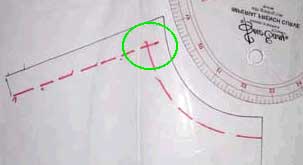
To change a neckline, first draw in the stitching lines on the existing pattern. It’s easy to do this with a transparent French Curve with 5/8 inch marked round the curved edge. These lines show the position of the shoulder seam and the finished neckline edge.

”nkptcircle”

The crucial point to identify is where the neck edge meets the shoulder seam, sometimes called the neck point.

So long as you draw your new front finished neckline through this point, you won’t have to alter the back neckline (or vice versa).

”v-neck”

If you want a wider or narrower neckline, draw in the new finished neckline position. Then measure how far the new neckline is from the old neck point, along the shoulder seam. Use this measure to find where to start the new back neckline.

”lowneckarrow”

To add the new cutting line :
– make some marks 5/8 inch from the stitching line.
The ends of both a tape measure and a seam gauge are 5/8 inch.

”cutlinemark”

– Then join the marks into a smooth curve – easy to do with a French Curve.

”cutline2”

Changing the neckline of a wrap top/ dress is a bit more complex. Here’s a tutorial.

P.S. There’s now a Craftsy class by Suzy Furrer on drafting necklines.

– – –

Collars :

Of course, getting the best neckline shape is essential, but only the first step. Then there are collars, bias drapes, bows, ruffles, whatever. But presumably these additions follow the same principle – that they are best when they coordinate with the lines, shapes, and proportions of our bodies.

For example, big collars need to be in proportion to our overall build. (I’ve just been attracted by a large collar jacket pattern, but fortunately thought of checking my personal croquis. A deep collar wider than my shoulders, on a short jacket, would make me look like a heffalump. . .) ‘The Triumph of Individual Style’ has illustrations showing how to adapt classic collar shapes to high and low neckline balance points. And Darlene Miller’s book ‘Your shape, your clothes and you’, has illustrations suggesting curved collars go with curved bodies and straight with straight.

(P.S. There’s a class on drafting simple collars at eSewingWorkshop.

There’s now a Craftsy class by Suzy Furrer on drafting collars.)

Lots of possibilities to think about and try.

– – –

Links available February 2010

– – –

To get to main blog, click on red header.

More on Advice to Ignore

February 6, 2010

Elizabeth commented on my previous post :
“No, no, I’m going to ignore you and slavishly follow some magazine editor’s tips for skinny urban women with a professional job.

But seriously — the points you raise are not always easy to figure out. If they were, we would have done it by now, no?”

– – –

I agree that finding your best colours, shapes, and styles is not easy or quick. Once I started thinking about this I had a whole lot to say !

Styling books are a big industry because they’re selling a dream – that someone will wave a magic wand and it will all be obvious and easy and we will look marvellous. And I think many stylists are, very humanly, best at giving advice to people in similar circumstances. In the same way that fashion journalists focus on the showrooms of the fashion capitals of the world. (You only have to look at the people actually walking along the key fashion streets of Paris, Milan, London, New York, to realise that most people don’t dress like fashion magazines at all 😀 )

Perhaps some people don’t have as many difficulties with recognising themselves in the style books as I do. But I suspect many do.

I admit I’ve got a large collection of style books bought in hope. . . and yes of course, they suggest a whole lot of interesting things to try which I might not have thought of myself. But it isn’t the case that everything they suggest is right for everybody. If I did follow exactly what they say, I would often be wearing the wrong colours, the wrong shapes, and the wrong styles. Fortunately I know enough about myself and my life usually to recognise when I would be unhappy with what they suggest.

– – –

I’m sure anyone who’s read a styling book has their own examples, but here is some of the advice that goes wrong for me :

Colour :
I’ve never managed to identify my colour category from a book. More than 20 years ago I had a personal session with an inspiring Color Me Beautiful consultant. She identified me as ‘Clear Spring’. But Clear Springs are assigned the dreaded black. The consultant sorted out about half the Clear Spring colours which were marvellous on me, and the others which were best avoided. A personal consultation using all the big colour swatches is definitely needed for that, and a gifted expert. (Though she did recommend coral as my accent colour. She appears in one of the CMB books as the example of Soft Autumn colouring.)

My previously auburn tinged dark hair has become light heathered grey. My skin is still warm toned, so I’m a mixture of warm and cool tones which doesn’t fit anyone’s categories. (And I have a very low opinion of the recent London published CMB books.)

I have now chosen paint chips which match my skin and eye tones, plus a lock of hair. They’re subtle colours which rarely appear in fabrics. But I always compare fabric samples with them, to check what ‘goes’ and what ‘jars’ (often surprises).

Shape :
Standing, my hips are 2 sizes larger than my top. When I sit down they spread another 4 inches. Definitely a pear. I’ve already gone on at length about the odd advice given to the pear-shaped in the Lucky Shopping Manual.

Most stylists tell the pear shaped to wear shoulder pads so their shoulders are as wide as their hips. I would be wearing those 80s pads that were so wide you had to go through a door sideways (see some astonishing examples in re-runs of Murder She Wrote). I am more interested in advice on how to make my hips look as small as my top. And sorry stylists, I know you all say everyone looks better in shoulder pads, but I never wear them. They’re just not my style. Hurrah for sewing – we can change the shoulder seams and darts of what we make so that clothes fall well from our shoulders whatever shape they may be.

Most stylists also tell pears to wear horizontal lines across our shoulders. I’ve always known that was wrong for me, but never understood why until I read Trinny and Susannah’s Body Shapes Bible. I’m a short waisted pear. Horizontal upper lines make us look even more squat. Horizontal upper lines are good on long-waisted pears. And T and S couldn’t find any short waisted pear celebrities to use as encouraging examples (the only body shape they failed with). Oh dear. I don’t think it is actually impossible for us to look good, I’ve managed it myself in the past. But it’s certainly a challenge !

Some stylists go into more detail about body shape with recommendations for specific body parts : long and short neck, wide and narrow shoulders, etc. The trouble is this makes for incompatibilities in what they advise. ‘The Triumph of Individual Style’ is a beautiful book full of fascinating insights. But most of the advice they give on one page is incompatible with what they say for me on the next page. . . Nancy Nix-Rice ‘Looking Good’ is another favourite book (very dated illustrations but covers the widest range of topics). About me she says :
To Broaden Narrow/ Sloping Shoulders : DO Select details (…) to maintain a horizontal shoulder emphasis.
To Lengthen a Short-Waisted Body : DON’T use horizontal bodice details.
Aaargh – Help !

I do try out the suggestions in style books. Darlene Miller’s ‘Your shape, your clothes and you’ has very detailed ideas. As usual, I don’t fit neatly into her scheme (my head, upper and lower body all meet different criteria !), but I do find her suggestions interesting. I use a personal croquis. Snoop shopping upsets me, as RTW fits me so badly. Instead I hold pattern and fashion magazine photos next to me in the mirror, as I wonder if they would look good on me. And I keep an eagle eye out for what flatters and what doesn’t.

Style :
I rarely feel comfortable with any of the personal styles in books, though some come close. In David Kibbe’s ‘Metamorphosis’ I’m a ‘Soft Classic’. Lots of good insights in the text. Then there’s a photo of someone styled this way, and she’s wearing a ‘Mother-of-the Bride’ dress and picture hat. Oh dear. I would never want to look like that (even if I had been a mother-of-the-bride). From the other photos, I would guess Kibbe has difficulty with styling less exuberant people. I think Soft Classics are better catered for by Loes Hinse’s designs.

A lovely Color Me Beautiful consultant in the early 90s described me as a ‘Eurochic with Romantic accessories’, a heart warming phrase I still keep in mind. Eurochic is a concept you don’t see mentioned these days – a sort of elegant current casual. (It’s in Mary Spillane’s CMB book.) At the time Armani was super-fashionable. I don’t at all agree with one style book which says it’s impossible for casual to be chic, as one is precise and the other is don’t-care. That seems an oddly blinkered view. But that writer (Angela Marshall) is an extreme classic. She admits to having difficulty knowing what to wear at weekends. Though her expensive repetitive little book is the best at recognising personal style isn’t only clothes but also work, hobbies, manner, home, relationships. . . I think many designers and fashion magazines do recognise the need for high quality stylish relaxed clothes.

To identify my personal style, I notice what I wear consistently. I particularly enjoyed the style exercises in Brenda Kinsel’s ‘Fashion Makeover’. (The rest of the book isn’t right for me at all. No, I wouldn’t find it a treat to lounge by my pool waiting for a bevy of masseuses and chefs to give me an at home spa day. I won’t even have my hair and make-up done. But I did get insights from the style exercises !) I keep in mind long ago clothes which I remember with affection. (That velvet dress with a lace collar my mother made when I was 12, which I rapidly grew out of. Wouldn’t fit my active lifestyle, but I need touches of it as I loved it so much.) And I imagine myself wearing what appears in pattern and fashion magazines, and check if I would feel happy. I’ve made a list of ‘would love to wear’ patterns which have lasted beyond initial enthusiasm, and it’s not as short as I thought it would be.

– – –

I think the good style books guide personal exploration, rather than dictating. Such as Brenda Kinsel’s ‘Wardrobe Companion’. I also enjoy Garza and Lupo ‘Nothing to Wear’, a fun read. Mainly general encouragement, but then they fall in the trap of giving specific examples, which are all ‘urban cocktail’. Good for their clients in NYC no doubt, but not relevant to this suburb (even though estate agents describe us as ‘exciting and cosmopolitan’ now we have a Starbucks where the local radio host holds court 😀 ).

That seems to me a key problem for style books – this uneasy balance between general advice about exploring, which works for everyone, and specific examples. I know I feel more secure when writers give specific visual examples. I feel I know more clearly what they mean by their words. And I feel more confident when I know the alternatives to choose between. But I usually don’t recognise myself in any of the specific examples. So my desire for confidence that I understand the message actually backfires.

I think there are some things you can sort out for yourself fairly painlessly. My list of Personal Style questions is possible food for thought.

I do still occasionally buy styling books, but I’m looking for tips rather than expecting them to solve my problems. I now find it more helpful to follow discussions at Stitchers Guild, which are full of useful comment and inspirational wardrobes from a wide variety of real people. I’m getting much more clear about what is right for me, by thinking out my answers to the style questions people ask there.

This may be an unending process, as fashion styles (and we) change. I’m still far from being confident I’ll get it right every time, but I’m a lot closer than I was a year ago. . .

Sadly, there isn’t any way of avoiding doing the work of trying things out. Or of avoiding big mistakes – try to make them in cheap fabric ! I once bought a red fake fur coat. I love red, and fur coats, and I loved myself in the coat. But I only ever wore it in public once. I’m a quiet and private person !

This trying out doesn’t have to be a miserable process. It’s like fitting. We take one small step at a time, and see if we’ve made things better or worse – and it works out in the end. Every move in a better direction is a big plus 😀

– – –

P.S. Training to be a Style Consultant is lengthy and expensive. There are even college textbooks on it (see Fairchild Books on Image Management). So people in the business reoognise this process isn’t all that easy.

– – –

Links available February 2010

= = =