Notch collar jackets – sources of sewing advice

Posted April 2, 2011 by sewingplums
Categories: sewing technique

There are many classic notch collar blazers in high fashion magazines this season.

I last made a notch collar jacket in the early 60s (50 years ago – aargh !!). Many memories of making and wearing it. A Vogue Dior double breasted suit with wide collar. Made in an asymmetric stripe wool. I still remember the stripes matching across the bound buttonholes with amazement and pride. And I chose to use the first non-woven interfacings, which were like cardboard. I suspect I’m never going to recover from my resulting dislike of non-wovens 😀 Ah but beautiful beautiful buttons.

That was a work suit. Long before Yves Saint-Laurent made pant suits acceptable for women (no tights/ pantyhose either). For me, a previous sewing and styling lifetime (I didn’t make clothes at all for about 30 years). Goodness, reminds me of the bed-sit I was living in at the time – complete with one-bar electric fire, putting shillings in the meter for hot water, and a handwheel black and gold Singer sewing machine.

Aren’t we lucky with modern standards of living – and the modern free choice of wearing our own style. But I still keep thinking I ‘ought’ to make one of these ‘proper’ jackets as they represent the height of sewing skills, even though I know I would never wear it. That ridiculous requirement has kept me collecting information. So here are some links, in case they’re useful to anyone.

– – –

Patterns with fit guidance

There are innumerable notched collar jacket patterns. I mentioned some in a previous post on classic jackets for work.

There are many different design details in blazers, as I talked about in my post on notch collar styles. And any of these details might affect whether you feel comfortable and happy and at your best. So get to know what works for your shape and personal style. I’ll just mention a few patterns for specific purposes.

If you’d like a pattern with help on fit, there’s :

Palmer-Pletsch McCall’s 6172 (left)

”fitblazers”

If you’d like pattern pieces for several cup sizes :

“Amazing Fit” pattern with 3 cup sizes Simplicity 2446. (right) (instructions not recommended at Pattern Review.)

Silhouette patterns 4 button jacket, also shoulder princess, pattern pieces for B, C, D cups (no comments at PR).

Or choose any shoulder princess seam style. Add a centre back seam and 1 inch/ 2.5 cm seam allowances to your muslin, to make DIY fitting easier.

– – –

On-line sewing advice – written tutorials

Methods of sewing notched collar jackets range from simple to challenging tailoring. And there are different opinions about the best descriptions of how to do them.

There’s a whole section of Sigrid’s sewing tutorials on jackets.

Here’s another listing of tutorials from Couture et Tricot, with many on jackets.

Ann Rowley has a photo tutorial showing how she made a high quality jacket from a Burda magazine pattern.

Here’s an on-line tutorial on speed tailoring a notched collar and lapel using fusibles.

And here’s an on-line tutorial from Couture et Tricot on giving full support to a collar using specialised interfacings (scroll down for English version).

– – –

P.S. Marie-Christine has suggested 2 other excellent sources of jacket tutorials :

Kathleen Fasanella’s Fashion Incubator site on pattern making and sewing. Jacket tutorials are mainly on linings.

Pattern-Scissors-Cloth, scroll down for a jacket sewalong.

And there’s Kathryn’s Jacket making journey.

– – –

Books, DVDs, on-line videos

Collars aren’t all there is to consider with high-end jacket making skills. There can also be multiple layers of special support structures for roll line, shoulders and armholes, sleeve head, and vents, as well as techniques for quality buttonholes and pockets.

One way of sorting out all the different techniques is to say there are three levels of difficulty. This popular book gives instructions for using : fusible interfacing, machine sewn – not fusible interfacing, custom sewn with traditional handwork : Tailoring : the classic guide.

(P.S. Two new (2013) books which are enthusiastically reviewed :
Vintage Couture Tailoring by Thomas von Nordheim.
Couture Sewing – Cardigan jacket by Claire Shaeffer.)

There’s the Palmer-Alto Jackets for Real People book and DVD on speed tailoring (using fusible interfacing).

Peggy Sagers’ DVD Factory Tips and Techniques 1 : Making Blazers also shows quick and easy techniques. (The only jacket DVD I’ve watched. Mixed enthusiasm about recommending it as there’s no menu. But the content is good, if you can bear to go through it making a list of timings so you can re-view it without too much pain. You’d never guess without viewing, but it also has good tips on sewing band collars and fly zips.)

Petite Plus Patterns have a DVD on Constructing the Princess Seamed Blazer.
Demos of sewing and pressing for two levels of difficulty. The instructions are usable with any size pattern.

The Sewing Guru has extensive on-line sew-along videos about two types of jacket making : industrial and tailoring. Use the free sign up to have a good look round – when you sign up you get an e-mail on how to log in. With a PayPal account it’s easy to cancel.

Kenneth King has a Craftsy class on a Carefree fly-front coat.

– – –

Good instructions with the pattern

The simplest blazer patterns involve no more skills than a basic blouse : darts or princess seams, buttons and buttonholes, faced neckline, collar without band, one-piece fitted sleeve without cuff. Such as Butterick 4138, with interfacing only in collar and facing, shoulder pads, 1-piece sleeve, simple or no pockets, and no lining. (Now oop, and just an example of a very simple style, the instructions aren’t special.)

”b4138-2”

More complex jacket patterns include more support structures, 2-piece sleeves, welt or flap pockets, and lining. These are some patterns which people have recommended for the instructions :

McCall’s 6172 Palmer-Pletsch (left below)

Vogue 8333 Claire Shaeffer (right) (2 levels of instructions, for quality RTW and couture).

”2bmvblazers”

And these are patterns from independent designers which people recommend for instructions to get a quality tailored result :

Nancy Erickson’s 1945 jacket. (left below)
She also has a Jackets Workbook with extra instructions (she’s a fan of using fusibles), and dozens of ideas for pattern altering to make new styles.

Cecelia Podolak’s Fearless notched collar jacket (right)

”indepblazers”

– – –

As usual with such a wide range of possible techniques, most of us need to experiment to find the methods and results we enjoy best.

If you need inspiration about choosing and making jackets, there’s the Stitcher’s Guild Jacket a Month sewalong.

That itself was inspired by Gigi Louis’ Year of the Jacket.

Pattern Review usually has a lined jacket making contest each year. The discussions include much advice.
Lined jacket contest 2011
Lined jacket contest 2012
The 2013 one will be in October.

There are many people making beautiful jackets who are generous with helping us develop our skills 😀

– – –

Originally posted April 2011, patterns and links updated May 2013

= = =

Jackets of the season – notched collar blazer

Posted March 26, 2011 by sewingplums
Categories: body shape, current fashion

The key jacket for this Spring/ Summer 2011 is a notched collar blazer.

Eileen Fisher has picked out 3 versions.

”3-notched”

The most obvious difference is length : mid hip, low hip, or mid thigh. Which is the best length proportion for you ? (Notice the under layers are all about the same length.)

All have collar notch at front neck level. Good if you want to draw attention up to your face.

All have similar shape and angle of notch. In some seasons there can be big changes in these, but a simple notch is popular this year.

And lapels that are 1/3 to 1/2 the width along the shoulders to the armhole.

All of them are loose enough to layer. While many jacket patterns are more fitted and meant to be worn closed, with perhaps only a camisole under.

As I never wear a blazer myself, I used to think a blazer is a blazer is a blazer. Notched lapel collar, fitted sleeves, single breasted, boxy shape. Well, that’s in women’s clothing. In men’s clothing it’s a similar shape but usually navy fabric with brass buttons and patch pockets. Or in sports club or school colours. But in women’s fashion, there’s actually a wide variety of style details.

– – –

Round or square corners ?
Two of these jackets have square and one has rounded corners, so choose which is best for you.
Are your body lines straight or curved ? Is it your style to be crisp or soft ?
And some stylists say square corners make you look slimmer. . .

Width of lapels and collar
A wide variety of lapel widths are fashionable at the moment. Though Eileen Fisher hasn’t featured one, shoulder-width lapels are also current if that looks good on you.
For me it’s not a simple choice.
Wide lapels give me upper body emphasis, which I need as I’m small busted and wide hipped. And they visually strengthen my sloping shoulders.
But a slim lapel adds a vertical line, which I need as I’m short waisted.
Which looks best on you ?

These styles all have collar and lapels the same width. This is classic style, but it isn’t essential, it’s a design decision.

Also the edges of collar and lapel are straight. That’s another style feature which is current classic, though there are many patterns with curved lapels.

X or Y neckline ?
In these examples, the 3 button style has a front edge Y shape, and the 1-button styles have a front opening X shape, which I talked about in my shawl collar blazer post.
Would you look better with the front cut away below the lowest button ?

Soft roll or firmly pressed edge to the collar fold ?
Which is more to your personal taste ? Which flatters your body shape ?
Do you want to look more formal or more casual ?

Style, location, angle of pockets ?
Men’s blazers have patch pockets. Women can use nearly every pocket style on a blazer : patch, in-seam (perhaps with hidden zip), flap, single welt, double welt. (An exposed zip is more edgey than classic. And pleated or bellows pockets are more safari/ artisan.) It’s possible to go on at length about pockets. There’s a lovely old book, ‘Just Pockets’ by Patricia Moyes. Start from the simplest jacket pattern and make multiple versions which look different because of the pockets.

Added back interest
Do you do the sort of work where you have your back to onlookers, so jackets with back interest would be a good idea ?
Or do you usually sit down, so need a plain back that doesn’t crush easily ?
One of these Eileen Fisher jackets emphasises the curved shaping of multiple princess seams at the back. Another has an inverted pleat at centre back.

People round here are wearing jackets with multiple seams or inverted pleats at the back, often below a yoke, and with a 2-button tab at waist level.

Perhaps Project Runway Simplicity 2810.

”s2810”

Lined – unlined ?
It’s relatively easy to leave out the lining of a lined jacket – unless there’s a lot of inner structure to hide.
Adding a lining to an unlined pattern is not difficult once you know how. See oop book ‘Easy Guide to sewing linings’ by Connie Long.

Notch height and shape
There are some style elements which it’s best to leave as they are on a pattern, as they’re difficult to change unless you know what you’re doing.

The notch shape and height and the break point of the collar are all best left alone. (Though they can be changed in pattern making software like Pattern Master Boutique. Not in Bernina My Label. Those are the only software I have personal experience with.)

These 3 jackets all have the notch at front neck level.
But it has recently been fashionable to have notches much lower, even at bust or waist level. Particularly on ‘boyfriend’ jackets.

Being closely analytic, there are 3 angles at the notch – the collar corner, the notch, and the lapel corner. And all 3 are design decisions. The Eileen Fisher jackets have the corner angles close to square. This is the classic choice.
This is a fashion thing, other angles and shapes have not been so fashionable recently. (And they’re not so easy to manufacture.)

The origin where the lapel fold line starts – the ‘break point’
On these jackets, you have a choice of folding back the collar from bust level or waist level.
Which is more flattering on you ?
I’m best with a lapel down to waist level. That gives me a vertical line on my short waisted upper body. And a lapel folding out from bust level draws attention to the fact that I haven’t got one.
Does one of these break points make you look or feel older/ younger ? slimmer/ wider ? larger/ smaller cup size ?

In the example jackets, the lapel from bust level goes with the shortest length jacket, but that isn’t necessary.

Number and position of buttons
On these jackets the button positions are simple and classic : a single button at waist level, or three buttons spaced from bust to waist level.

It’s easy to change the number and position of the buttons within the space available. This is the strip where the centre fronts overlap. The top of the strip available for closures is just below the break point where the collar turns out. The bottom of the strip depends on whether or not the lower jacket is cut away.
Once these are set it’s relatively easy to change how high or low the top and bottom button are, and how widely spaced they are.
No doubt if you’re generous busted you’re already know it’s best to have a button level with the bust point, if that area is buttoned over.

Choice of 3 buttons or 1 (or 2 ?). Which is best for you ?
This depends on details of your body shape (and how fitted the style is, just to complicate things).
Perhaps do some snoop shopping of jackets. Which button layouts make you look longer/ shorter waisted ? Which make you look larger/ smaller busted ? Which make you look more efficient/ more relaxed ?

One button needn’t be a waist level. There are several Simplicity jacket patterns with 1 button at bust level.

– – –

Just for contrast, here’s a design with very different style decisions, Vogue 8638. (The pattern has a choice of notch shapes.)

”v8638”

– – –

This was all getting a bit much. So I’ve put some comments about notched collar blazer patterns and sewing advice in another post.

And not to worry if notched collar blazers are not your style. Some people love them, but they’re not for me.

I remember wearing a few RTW notched collar jackets, but never one that could be described as a blazer. I did once own a shawl collar structured blazer. Bought it because a stylist said “Every woman should own a blazer”, and that was in the days when I didn’t know better about such opinions. I only wore it one time. A colleague said “You look very. . . um. . . straight” – and I never wore it again 😀

I do wear trenchcoat styles, which are also current. Not at all the same as a blazer. Double breasted, wide lapels, closing up to the neck, wide collar based on a band, added yokes for shoulder emphasis.

There are three other key jacket styles picked out by Eileen Fisher for this season (cascade, collarless, and biker/aviator). I’m planning a post on them too.

– – –

Patterns and links available March 2011

Jackets of the season – shawl collar

Posted March 19, 2011 by sewingplums
Categories: current fashion

Eileen Fisher’s jackets are current classics, so we can wear them for several years. But each season she picks out one style to emphasise. And this season it has a shawl collar.

”shawl-collar”

Style details : long lapels down to a single button, and lapels about 1/3 the width of the shoulders. The turn of the collar is softly rolled, not pressed flat. Cut away fronts below the button. Slightly angled welt pockets. But otherwise this looks an easy fit classic boxy blazer shape.

I’ve found surprisingly few classic jacket patterns with shawl collars. Most shawl collar patterns are for outerwear with wide picture collars.

Here’s a possibility, Burda.8201.

”burda8201”

– – –

Understanding the shawl collar pattern

Shawl collars are cut differently from most jackets, the collar is cut in one with the front.
There’s an explanation of the difference between shawl and notched collars in Threads magazine.

Here’s the characteristic corner joining body and collar, from Vogue 8605 (which happens to be the only current pattern with a full shawl collar that I’ve got !).

”v8605shawl”

The corner needs to be stay stitched and clipped, so one side of the angle makes the front shoulder seam, and the other side goes along the back neck.
Not a trick for sewing beginners (see later).

And for pattern making, it’s not a trivial enterprise to add one of these to the neckline of a favourite jacket pattern.

Here’s an on-line lesson on how to draft the shawl collar.

If you really need convincing that drafting a shawl collar is no simple process, here’s a YouTube video on how to draft a shawl collar pattern using OptiTex CAD software !

– – –

Types of shawl collar

It’s a bit difficult to tell from a design drawing how an integral shawl collar is cut. There are two ways of doing it.

One has both the upper and under collars cut on. So there’s a front-under collar pattern piece (see previous diagram) and facing-upper collar pattern piece. The front-under collar in one piece makes the under collar look neat and tidy, if you want to turn the collar up. Good for outerwear, but less needed on an indoor jacket.
Both the sewing videos (see later) are about that type of collar.

The other approach is to cut the front and under collar separately, and the front facing with the collar cut on.

Palmer-Pletsch oop McCall’s 4598 is an example. Here are the front and under collar pattern shapes (left), with the front facing for a notched collar (centre) and a shawl collar (right).

”m4598collars”

It helps to be able to look at the pattern to see how the collar is cut.

But if that isn’t possible, one clue that patterns must have a separate notchless collar, rather than an integral shawl collar, is if there’s a curved neckline. So the neckline can’t be on a fold, and upper and under collar must be added pieces. This happens in many current jacket patterns, which have an open soft curved V neckline and a ‘picture’ collar. Such as Butterick 5570.

”b5570”

And here’s another reason to make a separate collar. One Eileen Fisher jacket uses a different fabric for the collar.

”sheer-notch”

Difficult to see in black, but the collar is layers of transparent fabric.
So of course that has to be cut separately.
And patterns with the collar/ lapel cut separately are much easier to change the neckline shape and depth if you want to.

Nancy Zieman’s McCall’s 6293 could be a starting point.

”m6293”

– – –

Sewing a shawl collar

I haven’t found any good on-line written tutorials for sewing that tricky corner on shawl collars.

There are a couple of YouTube training videos for industrial sewing machinists.
The videos use different methods for sewing front-plus-collar to back.

In this first one, you start stitching from centre back, and back neck and shoulder seam are sewn in one continuous step. Two machining steps. This is also the method used in the book ‘Professional Sewing Techniques for Designers’.
Shawl collar sewing

In this second one, shoulder seams are sewn first, then across the back neck. Three machining steps. This demo includes adding the facing. Much of the commentary is not in English, but if you’re not a beginner sewer it’s not too difficult to understand what is going on.
Shawl collar part 1
Shawl collar part 2

There are several other methods. Some people avoid getting kinks in the fabric by hand sewing the corner. I prefer to machine sew each corner in 2 separate steps, starting from the corner each time. Four machining steps, so not used in industry ! Make samples and see which technique you like.

– – –

Style elements

What about the details of these shawl collar jackets.

Single button. Try out the best height for you. Should it be where your body bends, higher, or lower ? I’m short waisted so look best with a single button below waist level.

With my high round back and forward neck, I always have to change necklines and collars to get a good fit. I would need to check there’s no gapping on that long V-neck.

What about the soft roll of the colar. Is this right for you, or is a firmly pressed flat collar more to your personal style ? Which would give the best emphasis to your body shape ?

And notice how the fronts are cut away from the centre line below the button. This adds vertical lines below the waist, even when the jacket is buttoned. Flattering for some of us.

Also means that, when buttoned, the edges of the front opening make an X shape (look at the photos) rather than a Y. Which shape might be more flattering on you ?

Try out how much (if any) cut away of the lower fronts would be good. Perhaps by folding existing jacket fronts away at the front edge to see what looks best.

And the placing and angle of the pocket welts ? On me, emphasis at high hip level is best avoided, so I would make these nearer vertical.

So, if I made one of these jackets, there are several good reasons to start with a test muslin to try out the details.

Some stylists say a shawl collar looks matronly. Others think it’s flattering as it frames your face and adds vertical lengthening lines. I certainly think they can look good if you get the details right for your own body shape and style.

– – –

Easiest continuous neckline

The easiest way of getting the long lines of a notchless collar look, though not the same effect as an integral shawl collar, is simply to add a neckband wide enough to fold over. There are several patterns for this, such as Christine Jonson’s 511 Boyfriend jacket (left), or the Shawl jacket from Loes Hinse (right).

”cjboyfriend” ”lh-shawl-collar”

– – –

Well, obviously when I’m let loose I can go on for rather a long time about a single garment 😀

Classic notched collar blazers are the main fashion jacket this season. And there are several in the group of jackets picked out by Eileen Fisher, see next post. Plus some other jacket styles. More jacket posts planned !

– – –

Patterns and links available March 2011

Oriental style – Cheongsam

Posted March 12, 2011 by sewingplums
Categories: current fashion

Oriental styles are fashionably ‘ethnic’ this season (2011). My previous post was on the Japanese kimono, rather a long post as it’s a popular shape. The second trendy oriental shape is the Chinese cheongsam (qi pao), which I’ve found less about.

And (mid 2020) the number of patterns available has been getting smaller and smaller. The big pattern companies have been sadly over-rationalising their pattern collections. Many slightly different versions of some costume possibilities, and none of others.

The cheongsam is a western influenced version of traditional Chinese dress, a sheath dress with mandarin collar and side angled neck opening.

Many different style details in the designs here : whether the opening goes into or below the armhole, the darting, whether and where there’s a zip, and the sleeves.

Here are a couple of dress patterns. Burda 8438 (left) and New Look 6812 are both now out of print. (The Burda dress has a centre back zip, the New Look dress has no zip.)

”burda-nl”

Here’s a pattern for a vintage style cheongsam : Simplicity 8244, also now discontinued. It has short cut-on sleeves, opening to below armhole, vertical waist darts only, and side seam zipper.

New Look 6203 was a pattern for a top (no zip) with skirt and pants. Oh dear, that went to being available only as a download pattern, and now is also discontinued.

”nl6203”

The Great British Sewing Bee book – From Stitch to Style includes a pattern for sleeveless qi pao inspired top, with opening to below armhole, angled darts, and side seam zip.

Folkwear has patterns for a cheongsam, Folkwear 122 (left) (no zip) and for a jacket with similar side opening Folkwear 114 (right).

”fw-cheongsam”

There is a free download sleeveless cheongsam pattern here (side seam zip). Swap the right and left front pattern pieces to get the opening towards the left side, as in the other patterns.

”freecheongsam”

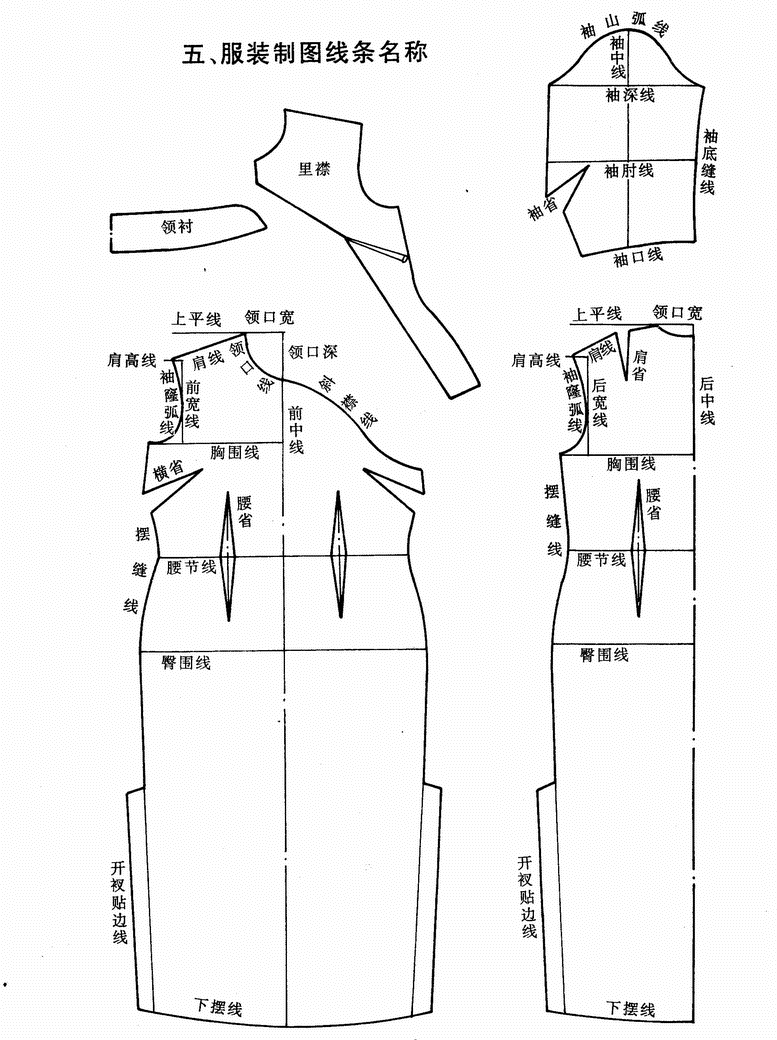
The cheongsam is not a wrap style. Here’s a Chinese diagram of the pattern piece shapes. Could you use that as a guide to adapting your favourite sheath dress pattern ?

Notice the Chinese diagram of the pattern pieces has the opening to below the armhole, and angled darts (‘french’ darts up from below bust level). Some of the other patterns have the opening into the armhole, and horizontal bust darts. I suspect the free non-Chinese pattern, with opening to below armhole and no dart that side, may be difficult to get to lay neatly against the body.

For a beautiful book, there’s Cheongsam by Pepin van Roojen, which includes a CD of dress and fabric images.

Japanese company Clover had templates to make the traditional Asian Knot buttons from cord or bias rouleaux, but even those seem to be discontinued.

If you look good in a more fitted shape, this may be a much better oriental style for you than the straight kimono. Use a border print or a brocade. It’s a challenge to find a pattern, but have fun making something exotic 😀

– – –

Originally written February 2011.
Patterns and links revised September 2020.

– – –

To get to main blog, click on red header.

= = =