Speedy patterns 2012 : tops and dresses

Posted March 24, 2012 by sewingplums
Categories: speedy sewing

It’s nearly the last month of the Stitchers Guild Sewing With A Plan contest for 2012. So perhaps people are searching for quick-sew patterns to fill the last minute gaps in their wardrobe 😀

Here are links to my previous posts on speedy patterns. These were written nearly 2 years ago, and sadly some patterns are now oop.
Wardrobe patterns
Fast jackets
Dresses
Tops
Skirts and pants
Layers and capsules

Here are the patterns I’ve found since then – patterns that the pattern companies claim only take 1 to 2 hours sewing time.

Double/ treble that time to include pattern adjustments for fit, cutting out, seam finishing, pressing. Say 4 to 6 hours needed in all. (I like to work very slowly :D)

There are 37 days of SWAP time left. Could you manage 10 minutes of sewing time a day ? or one day of concentrated sewing ?

Surprising numbers of patterns to mention, so I’ve needed to expand this to several posts.
This one on tops and dresses.
Plus links to some pattern ranges that don’t have specific timings but use very easy techniques, so presumably are quick to sew !

More planned on skirts, pants, vests, jackets, outerwear.

Tops

Many tops can of course be lengthened to dresses.

These patterns from my previous post on quick tops are still in print :
Butterick 5948 – basic classic dartless tops.
New Look 6807 – 4 raglan sleeve options, knits.
New Look 6892 – raglan ‘peasant’ style, many sleeve options, wovens.

These are some top patterns from Textile Studio to add to the list :

Textile Studio Tank top, Shell – shell (lower in diagram) for knits

”tankshell”

Textile Studio Monaco shell – for knits or stretch fabrics

”monaco”

Textile Studio Santa Monica tee – for knits or stretch fabrics

”santamonica”

For a woven blouse/ shirt, there’s Silhouette patterns 600 Classic Blouse, which Peggy Sagers demonstrates sewing in an hour in her webcast.

”silhouette-600”

P.S. In an e-mail Peggy Sagers says these Silhouette patterns for knits can be made in an hour.
115 Anne’s top (cowl neckline)
219 Rachel’s knit top (sleeve emphasis)
312 Giorgio’s top (princess seams and peplum)
Also 95 Brooke’s top for wovens.

– – –

Dresses

Not sure if the pattern companies think all these dress styles can be sewn in only two hours, or only the simplest versions !

Many dress patterns can of course be shortened to tops.

These are some new ones to add to my previous post on quick dresses.

Textile Studio Milan dress

”milandrs”

Textile Studio Madison Avenue dress, for knits

”madisonavedrs”

McCall’s 6551 shift with 2 necklines, 2 sleeves, 3 hems.

”m6551”

New Look 6889 dress, cap sleeve option

”nl6889”

New Look 6890 dress, 5 raglan sleeve options, 3 lengths

”nl6890”

Textile Studio Basic dress

”basicdrs”

McCall’s 6102 dress, a-line, cup sizes to C and D, short sleeve option

”m6102”

McCall’s 6465 dress – slightly a-line, 4 sleeves, 4 hems (longer one not shown here)

”m6465”

Textile Studio Provence dress

”provencedrs”

McCall’s 6558 3 bodices, elastic waist, 4 hems

”m6558”

These patterns mentioned in my previous post on quick dresses are still in print :
New Look 6804, sleeveless.
McCall’s 6074, gathered front, sleeveless, for knits.
McCall’s 5893, empire bodice, short sleeve option, for knits.
Butterick 5211, shift dress, short sleeves.
McCall’s 9172, a-line, short sleeves.
McCalls 5855, kaftan.

– – –

Pattern ranges using the easiest techniques

Some other pattern ranges offer an even wider selection of simply sewn styles, though they don’t make claims about sewing time.

For softer current styles, see the Simplicity Sew Simple range (don’t appear to be available in the UK).

If you like more ‘arty’ styles, there are Shapes patterns, some of which have only one or two main pattern pieces.

Textile Studio have some other patterns they say take 2-1/2 to 3 hours sewing time.

Patterns specifically for beginners are presumably quick to sew – for people who are beyond the beginner stage 😀

There are Simplicity ‘Learn to Sew‘ patterns.

And some of the BMV patterns picked for their “Sew Cool in School” program look easy.

Also Kwik Sew Kwik Start patterns are well known for their clear instructions.

I don’t personally think some of the BMV designations about ease of sewing are all that helpful. Very Easy Vogue, and some McCall’s Easy patterns, seem to me to be need Intermediate skills, and certainly wouldn’t be quick to make 😀

– – –

A surprisingly large range of different possibilities.

You won’t find a quick fitted style, as you need an opening to get into them. Which means buttonholes, zip, or wrap styling. Not speedy to do well.

How about taking this quick sewing to the extreme ? If one of these garments only needs 10 minutes a day to get it done in the 5+ weeks before the end of SWAP – take 2 hours a day and you’ve got time to make 12 garments, a whole wardrobe 😀

So best wishes for getting some quick results, if that’s what you enjoy 😀

– – –

(P.S. here are free patterns for ultra-quick tops and dresses.)

– – –

Patterns and links available March 2012

= = =

Wardrobe pattern co-ordination : shapes and lines

Posted March 17, 2012 by sewingplums
Categories: co-ordinates

Continuing with comments on how a pattern like McCall’s 6519 can be a good basis for building a core wardrobe (see my previous past).

”m6519wardrobe”

It’s interesting to look at how a wardrobe pattern solves the problems of co-ordination. There are several.

One is the shapes visually, such as : does a loose fitting jacket look good with loose fitting pants, what necklines go together. . . I’ll say a bit about this pattern here. There could be many more points about co-ordinating shape and style elements once you add other patterns to supplement this one. A possible topic for another post.

Another issue is : do the shapes fit together for layering : is the jacket/ overlayer large enough to be comfortable over other garments ? Later post planned on this.

– – –

Visual shapes

Some wardrobe patterns co-ordinate shapes by using garments with few distinctive style elements.

The garments in this pattern have some style interest but still co-ordinate. They do that by having some common style elements.

Necklines and collars

Many people have difficulty co-ordinating neckline and collar shapes. What looks good, what is comfortable. . .

There are 3 necklines here :
– shawl collar with notch on edge-to-edge front (jacket).
– wide notched collar above wrap front (dress).
– simple scoop neck (top).

”m6519collars”

Notice that it’s quite easy to combine two notched collars if they differ in width, or how deep/ big the notch is, or how high the notch is on the body.

Here’s a photo from Kibbe’s “Metamorphosis” oop book showing some bravura notched collar co-ordinating. Two collars with notches of different shapes at different heights, plus a convertible collar. (A shirt collar would also work well – worn closed for a more ‘controlled’ look.)

”kibbe-collars”

(Notice also how this designer uses different textures in the nearly same shade. And the dramatic accessories give a very different impact to the classic clothes. Imagine these clothes more fitted – this outfit is from the 80s when clothes were big shouldered and loose fitting !)

Silhouettes

In McCall’s 6519, an edge-to-edge jacket works well over a wrap style, so long as the wrap doesn’t have a lot of fullness.
The simple top can be worn tucked in or out, for more or less formal effect.

The skirt and lower dress are the same pattern pieces.
Skirts and pants share a similar style element – pleats, which makes them good alternatives.

The pants are very loose fitting (9-1/2 inches ease at hip level). So they look best with a not too large jacket. This one has 5-1/2 inches ease at bust level, semi-fitted by BMV ease criteria.

I wrote a previous post on simplifying co-ordinates by using a limited number of shapes.

Type of line

Released pleats give a soft line (sewn down pleats have an more angular effect). Dress, skirt and pants all have these soft lines. The neckline of the top continues with the curves. Knits for dress and skirt also add softness.

Although the jacket and dress notch corners are angled in the pattern, they are softer in the line drawings. You could use slightly rounded corners on the bottom of the front openings and the patch pockets. Or of course you can have mixed curves and angles. Which goes best with your body shapes and lines, your personality ?

A pattern with curves and pleats like this might be better suited to someone who has soft lines in their face and body, or a gentler personality.

If you have straighter more angular lines to your face and body, or need to look crispy efficient, you might prefer Butterick 5760. Angular styling, except for a little softening in jacket silhouette and lapels.

”b5760”

– – –

These two posts have looked at one pattern in detail. There’s more to say on layering, in another post (here). And possibly more later on using this pattern to build a wardrobe. . . Very different from the way most of us usually sew – when we make a different pattern in a different fabric every time 😀

– – –

Patterns and links available March 2012

= = =

A good wardrobe pattern for a core wardrobe ?

Posted March 3, 2012 by sewingplums
Categories: co-ordinates, wardrobe planning

Wardrobe pattern books are inspirational, but once you know how to make very simple changes, you don’t need a book to get an easy group of co-ordinates. Just start with a wardrobe pattern.

Most wardrobe patterns are for a ‘Core 4’: top/dress, jacket, skirt, pants. All items with a closely similar look.

Wardrobe patterns which include patterns for more tops or layers are much more powerful as the starting point for a core wardrobe. Because they can give more variety of looks.

– – –

An example pattern

I often like McCall’s wardrobe patterns. They’re rare but stylish. I find the recent one particularly inspiring, McCall’s 6519.

This pattern doesn’t use the same style for both top and dress. It has two different underlayers.

My focus here is general issues about expanding to a wardrobe from a single pattern, with this pattern for the examples. I don’t mean to imply that everyone should use this pattern as their starting point ! These styles wouldn’t work well for all body shapes or personal styles. Do you think these styles would look good on a Rectangle ? an Inverted Triangle ? an Hourglass ? With my small bust and large hips, these aren’t the best style elements for me. I don’t look good in flat notched collars, or boxy jackets, or full pleated pants. Close fitting knits don’t flatter me. And I need tunics and vests in my basic wardrobe.

But this pattern makes a good foundation for thinking about wardrobe building.

Modern styling and some interesting style elements.

And hurrah, they’ve been generous : there’s a size 14 in the pattern envelopes for both larger and smaller sizes.
And hurrah again, they’ve put the finished garment measurements with the website pattern information. McCall’s used not to do this.

They made it in red, white and blue.
Fashionable colours this season. (Election in the US, Olympics in the UK.)
But not flattering for all of us.
So think of that as : accent colour, light neutral, and dark neutral.

– – –

The base items

For their examples McCall’s made :

Jacket : accent colour, solid, woven
(Unlined, edge-to-edge front. Shoulder dart under the collar, so it’s more shaped than the line diagram looks. Slight side-seam waist indent, not as much as suggested by the photo. 3/4 sleeve.)

”all-jackets”

Dress : 3 colours, large scale print, knit

”all-dresses”

Skirt : dark neutral, solid, knit

”all-skirts”

Top : 2 versions : one in dark and light neutrals, small scale print, woven; second in light neutral, solid, woven.

”all-tops”

Pants : 2 versions in the same 2 fabrics as the top.

”all-pants”

That makes 7 garments in all.
Which combined without the jacket make 7 different outfits.
Add the jacket to each, makes 14 outfits.

Could be a good basis for ejvc’s Spring Capsule at Stitchers’ Guild. Or her ‘Lucky Seven’ idea (see here page 20, Feb 25).

– – –

Other patterns

I think the key to the success of this McCall’s wardrobe pattern as a base for wardrobe building is that it includes 3 different tops. So different items in combination have different effects. Helped by accessories, you can go from business-like to casual with only a few garments.

Not many patterns like this, but I have found a few.
These ‘5 item’ patterns work well for Judith Rasband’s minimum ‘cluster’ of 5 garments (in ‘Wardrobe Strategies for Women’).

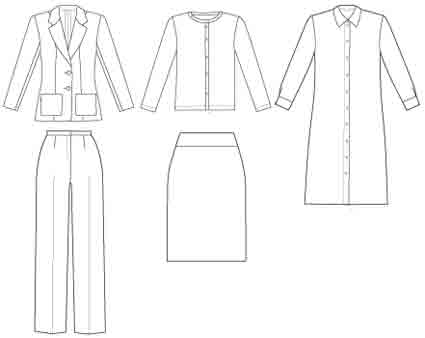
If you prefer more classic styles, new Butterick 5760 has two overlayers. A notched collar princess blazer, jewel neckband knit cardigan, and band collar shirt/ dress, as well as skirt and pants.

”b5760”

Wonder of wonders, rare in a wardrobe pattern – an underlayer with sleeves.
In their look book BMV add a shell in an accent colour, and jeans. 8 different items in all, a good basis for a short trip wardrobe. (Shirt, dress, shell, formal and casual jackets, skirt, pants, jeans.) Add a ‘dressy’ top if the trip includes a special occasion. More ideas on styling for a business trip at this wardrobe site.

Simplicity 1945 is a softer group for knits, this time with two underlayers. A raglan sleeve top with cowl neck, and a set in sleeve top with side drape front. Plus a simple jacket with cut on sleeve and cascade front. Pattern also has simple skirt and pants.

”s1945-2”

Add another jacket with a higher cascade collar, or a v-neck cardigan with banded neckline, for another group of looks. Or a light high-necked top to layer under those tops. . .

For a more ‘dramatic’ look there’s Vogue 8718 – with 2 very different underlayers (and a peplum jacket :D). The top with sleeves is a knit.

”v8718”

A version of the jacket with flat not ruched sleeves would add an ‘everyday’ look.

If you like ‘vintage’, Simplicity 2154 is another pattern with a choice of overlayers giving a good variety of looks, a 60s ‘Jackie O’ style.

”s2154”

Lengthen the top for a dress. Make another top without a bow.
Add pants with a slightly tapered leg, perhaps Colette patterns Clover pants. This style is from the days when people rarely wore jeans (and pants were’t allowed in good restaurants), but capris would be acceptable casual.

For the simplest of relaxed casuals, there’s Park Bench Central Park, which has three overlayers !

”central-park”

– – –

Finding a good pattern to start from isn’t the only question about building a wardrobe from a single pattern.

I have other posts planned, on how the shapes and ease of the styles in the McCall’s pattern work together as co-ordinates.

Then there are the very simplest strategies for adding items to make a minimum wardrobe.

Change fabrics : see my post on Kate Mathew’s wardrobe plans.

Change lengths : for inspiration look at patterns which include multiple sleeve and body lengths. See this post (also includes another 5-item wardrobe pattern). Or Butterick’s ‘The Cut Line’ patterns which work as tops, tunics, and dresses.

Change pockets or trims : see that post again.

Change necklines or remove collars : see my post.

Add basic patterns with minimum style elements : see my power of the boring post. (Also in that post, an example of building onto a 5-item cluster of separate patterns.)

These hugely expand the range of options you can get from one pattern starting point. As well as the sewing interest. And without needing to know anything fancy about pattern making 😀

– – –

Patterns and links available March 2012

= = =

Nine Body Shapes : research details

Posted February 25, 2012 by sewingplums
Categories: body shape

How many people have a waist ? How many people have upper body emphasis, lower body emphasis ? How many have a high hip shelf ? a dominant midriff ?

There was a flurry of interest in my previous post. Obviously many of you have difficulty finding yourself in a simple set of body shapes. This is because there are so many body shape features which can affect fit and flattery. Including them all is impossible in any simple system. I’m planning another post which lists them all – a bit daunting but it does show this isn’t easy. The same people who find simple fitting systems don’t work. . . aargh. . . it’s the people with the difficult shape combinations who need the most help !

Meanwhile here’s something rather more boring – more on the numbers of people with different shapes, that come out of the North Carolina research.

I love looking for patterns in numbers, but many people won’t find this at all interesting, so skip to the summary results.

– – –

Source of these results

The research was done at North Carolina State University. Reports are on-line here.

The numbers I use are in a table of results here.

All charts show percentage in each group.
Test group was over 500 people. Misses and Over 55s together included 6300 people. The study of Misses and Over 55s didn’t include the midriff measurements needed to identify Diamond and Oval shapes.

– – –

Waist or no waist ?

”waist-nowaist”

Yellow = test group.
Blue = Misses.
Red = Over 55s.

Although the different studies found somewhat different results, it’s obvious at least half of us have no clear waist.

And about three-quarters of the Over 55s (red) have no waist. No surprise there 😦

Of course the world doesn’t divide neatly into 2 groups of people, one group with tiny waists, the other group straight up and down. But if you choose a limiting number, you can say people with a bigger difference than this between waist and bust or hips look as if they have a waist. And people with a smaller waist difference than this don’t look as if they have a clear waist.

In more detail :

Body shapes with no waist

”no-waist”

Most of the people with no waist are :
Rectangle (straight up and down) : up to 2 out of 5 people.
Inverted Triangle (upper body dominant) : perhaps 1 in 7 of Misses (blue), 1 in 3 of Over 55s (red).
Looks as if the Over 55s who loose their waist may become Inverted Triangles.

About 1 in 45 are Triangle (lower body dominant).

Dominant midriff

Oval and Diamond shape people have midriff larger than, rather than similar to, other body measures. So it’s sad Oval and Diamond shapes were only identified in the test group (yellow).

Diamond and Oval shape people made up about 1 in 8 of the test group.

These results suggest the people identified as Oval in the test group (yellow) may have been classified as Inverted Triangle when midriff measures weren’t included (blue and red). Few Diamonds, but I guess they were classified as Rectangle in the big study.

Body shapes with a waist

”waist”

If you have a waist you’re defined as one of the Hourglass shapes, or a Spoon if you have both waist and noticeable high hips.

In the larger study (blue and red) : clearly the Spoon (with high hips) is the most frequent body shape with a noticeable waist. Perhaps 1 in 5 of people.

A lot of people in the test group (yellow) were classified as Hourglass or Bottom Hourglass, and these shapes have nearly disappeared in the bigger study (blue and red). Instead there are more people classified as Spoon. The big difference between Spoon and Bottom Hourglass is that Spoon people have a high hip shelf. Makes me wonder if the two studies used different criteria for identifying a high hip shelf.

The overall results showed fewer people Over 55 have a defined waist. These detailed results suggest this loss of waist happens for all shapes, not just for a particular shape of person. . .

– – –

Upper or lower body emphasis

”upper-lower”

About half the population are roughly equal in size above and below the waist. And roughly a quarter are larger above the waist, roughly a quarter larger below the waist.

Sadly the reports don’t say anywhere what is meant by larger and smaller here. We ‘pears’ usually have hips that are at least 1 pattern size bigger than our bust – 4 inches/ 10 cm. And standard upper body sizing is for a B cup. D cup needs about 2-1/4 inches / 6 cm added, DD about 5-1/4 inches/ 13cm larger.

In more detail :

Body shapes with upper body emphasis

”upper”

Fewer than 1 in 20 are Top Hourglass (with waist).

Most people with upper body emphasis were Oval (with midriff) in the small test group (yellow), and Inverted Triangle (no waist) in the bigger study (blue and red). Previously I suggested Ovals might have been classified as Inverted Triangle in the larger study.

About 1 in 7 of the Misses (blue) are Inverted Triangles.

Notice there’s about twice the number of Over 55s (red) who are Inverted Triangle shape. Nearly 1 in 3 of the Over 55s. Many people put on weight in the upper body as they get older.

Body shapes equal above and below waist

”equal”

Clearly most of these people who are about equal in size above and below the waist are Rectangle shape (no waist), about 2 out of 5 people.

Hourglass have a waist, less than 1 in 10 people.

Very few people are Diamond shape (with midriff). (Most of the people with prominent midriff were Oval shape – with bust larger than midriff.)

Body shapes with lower body emphasis

”lower”

The Spoon shape (waist and high hips) is the most frequent shape with lower body emphasis in the larger study – about 1 in 5 people. I commented before on the way Bottom Hourglass people (waist but not high hips) in the test group (yellow) have possibly been classified as Spoons in the larger study (blue and red).

The frequency of people who are Spoon shaped suggests it’s important to know about high hip measures when fitting the lower body.

In the larger study (blue and red), there were few people who had either no waist (Triangle) or a defined waist tapering smoothly out to hips (Bottom Hourglass).

– – –

Main results

Despite some large differences between the research groups, there are ball-park figures which are clear.

At least half have no obvious waist. And fewer older people have a clear waist.

Most people with no obvious waist are Rectangle or Inverted Triangle / Oval (upper body dominant) in shape.

Many don’t simply have no waist, but have a larger waist area. The test group results suggest about 1 in 8 have midriff larger than hips.

About half of people are about the same size above and below the waist. Most of these people also have no clear waist (Rectangle shape).

About a quarter are larger above the waist. Most of these people are either Inverted Triangle (without waist) or Oval (with dominant midriff) in shape. A big group of people get larger above the waist when they get older.

About a quarter are larger below the waist. And the predominant shape here may be the Spoon (with noticeable waist and high hip shelf).

These results are from the USA. The numbers of people who are each shape may be different in different areas of the world.

– – –

You may not recognise yourself in this body shapes scheme. But simplified body shapes are better than nothing. I added a note about some of them to my previous post. I don’t fit perfectly into any of the definitions, but I have learned something useful about myself from each.

I hope some of all this helps you with understanding your own fit and styling needs, or at least inspires you in thinking about them 😀

– – –

Links available February 2012

= = =