Ease levels

Posted October 12, 2013 by sewingplums
Categories: fit of clothes

After those voluminous architectural jackets, perhaps this is a good time to talk about ease levels !
Ease is the difference between the body measurement and the finished garment measurement at the point of interest. (Finished measures sometimes shown on the pattern envelope, usually on the tissue.)

For example, if your bust measures 36 in, and the finished garment measure at bust level is 38 in. then the bust level ease is :
38 – 36 = 2 in.

In practice the amount of ease is a surprisingly complex matter, as it depends on ease of movement, stretchiness of fabric, personal preferences, layering, and design.

This the Ease table (for non-stretch wovens) that used to be on the BMV site.
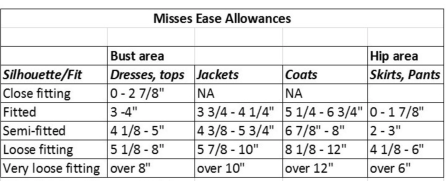
ease table

Some of us are not a RTW shape and have to buy garments which are huge in most places, just to be able to move without tearing the buttons off in our largest area. . .
Hopefully when we can make our own clothes, we can learn enough about fitting and pattern alteration to get round that problem.

– – –

Types of ease

Ease is not a simple matter of a few easy rules, as there are different types of ease for different purposes, as well as personal preferences to take into account.

There are 4 sorts of ease :

Negative ease

Garments made out of very stretchy fabrics, such as lycra leotards, may actually be made smaller than the body.
In these modern days of many stretch fabrics with different properties, pattern making books provide several different basic pattern blocks for fabrics with different amounts of stretch.

Movement ease

The minimum ease needed to be able to move.
For example, if you wore a skin tight garment in a non-stretch fabric, you wouldn’t be able to breathe.

The amount of movement ease needed depends on the amount of stretch in the fabric.
And people differ in their preferences.
Some people want to look sleek, and are happy to go without being able to move easily, to get the effect they want.
As in wearing a party dress which is too tight to sit down in. . .

In a close fitting jacket, with less than 2 inches of ease, you may not be able lift your arms easily above about 45 degrees.
So people who like freedom of movement often prefer 4 inches or more of ease in a jacket.
Most casual garments are made with more than minimum ease.

One of the problems with getting a good pants pattern is that they have both to look good while standing and feel comfortable when bending over or sitting.

There’s all sorts of specialist information available for particular sports, about the different areas of a garment where special ease is needed.

Layering ease

Here’s a diagram of the different levels of ease, adapted from the BMV table.

”ease-scale-sharpen”

This is an ease scale for non-stretch wovens.

CF . . . close fitting
F . . . . fitted
SF . . . semi-fitted
LF . . . loose fitted
VLF . . very loose fitting

Each level of ease assumes you want the garment to fit over the next one down : coat over jacket over blouse.
Though these days things are not quite so simple.

Jackets

The BMV ease table says jackets are not made close fitting.
But I know at least one pattern making book where the jackets are made from the same block as the dress.
Which means there’s not room for more than a camisole under, and minimum movement ease.
Say 2 in./ 5 cm. Perhaps less if the jacket is the focus of your outfit and always worn closed.

A jacket needs to be at least 1 inch larger than what it’s layered over, if it’s going to be worn as a layer over a blouse or shirt.
A lined jacket is often made 1 in. larger than an unlined one, for the same reason.
Then add at least 1 inch more, for each additional layer.

For layering a lined jacket over a sleeved shirt/ blouse, many people prefer at least 4 in / 10 cm. Especially in winter for more layering.

And also beware ease of sleeves. Fitted jacket pattern sleeves need to be checked. Many of them assume you’ll be wearing it over only a camisole or tank. So armhole and sleeve are not large enough to be worn comfortably over another garment with sleeves.

When you have a well-fitting jacket pattern, you may find you can wear a closer fit and still be comfortable. It’s a matter of personal preference and the usual clothes you wear a jacket over.
I need many layers for warmth, like to move easily, and am not close to a RTW shape, so most of my jackets are very loose fitting.

Coats

A bit bigger than jackets, as they’re usually designed to layer over a jacket.
The diagram has the coat ease levels BMV recommend for wearing over a jacket.

The BMV ease table says coats are not made close fitting.
But I have one coat pattern from them with ease of only 2 inches, obviously intended to be worn only over a top without a jacket.
So again, check finished measurements of a coat pattern to make sure you will be able to wear it in the way you expect.

Also the suggested ease levels assume the coat is worn over a jacket at the same level of fit.
For example, a fitted coat wouldn’t be comfortable over a very loose fitting jacket. There just wouldn’t be room inside the coat for all the extra fabric.

Design ease

The ease added by the designer to give the desired silhouette.
For example the 80s – 90s are famous for their huge shoulders and very loose fit.

For the last decade or so, fitted or close fitted has been the norm.
In recent seasons a ‘slouchy’ look has appeared – very loose fit has returned but without the huge shoulder pads supporting it.

– – –

Hip level ease

The main recommendations are for ease at bust level.

Hip level ease applies mainly for skirt, pants, shorts, culottes.
But also applies to the hip level of dresses, long jackets, coats.

On close fitted and fitted and semi-fitted styles, there’s often one inch less ease at hip level.
For example, if the bust level ease is 3 in. then the hip level ease is 2 in.

But allow for your personal needs.
For example, as my hips spread 4 inches when I sit down, I make sure there is at least that amount of ease at hip level.

On loose and very loose fitting styles, the finished garment measurements are often straight up-and-down. Hip level is often the same as the finished garment measure at the bust level.
But as the ease at bust level is more than 8 inches on these loose garments, that’s usually no great problem – unless your hips are 3 or more sizes larger than your bust.

– – –

This is all very dry. Ease is not a simple matter, but it is useful to understand how ease works and what your preferences are.

– – –

First written October 2013, link available September 2021

= = =

Turned up collar

Posted October 5, 2013 by sewingplums
Categories: current fashion, Eileen Fisher

There is a blazer detail that’s emphasised this season – many versions with turned up collar.
(I first mentioned it in a post on workwear suggestions from UK In Style magazine a couple of years ago.)

Gucci at Saks

”guccisaks”

Philosophy at Saks

”philosophysaks”

This one has a lovely change of texture by using a mesh overlay except in the collar and ‘lapel’ area.

Including Eileen Fisher’s featured jacket this season.

”efjkt”

Oddly there’s no photo on the Eileen Fisher site which shows the collar clearly.

(For a softer look, Eileen Fisher also has several jackets with a cascade/ waterfall front. Though in leather I think they look assertively edgy rather than soft. See my post on new patterns for soft and shapely jackets.).

A turned up collar is a possible style for both business and a more casual look.
Could work well in a setting which needs a more professional look but with a bit of fashion forward edge.

Easy to mimic using McCall’s 6711, which has a collar that can be made and worn either up or down.

”m6711jkt”

(Simplicity Sew Stylish 1542 View A is a softer style with a notched neckline, not like the RTW examples I’ve given photos of.)

On the McCall’s pattern, the princess seams give easy opportunities for this season’s colour blocking or texture blocking.
Or use leather just for the collar or for added trims, round the edges or in the princess seams.
The Eileen Fisher jacket has leather piping in a waist seam.

The McCall’s jacket is part of a wardrobe pattern, with a good variety for combining crisp and soft lines. Though as usual you have to check if the jacket will layer over other sleeves.

– – –

Collar details

Choose which way to make the jacket. If you press the collar and lapels to roll down and back, then turn up the collar, you may look just look as if you’re sheltering from a draft ! Make a version with collar pressed flat if you want to look sleek and in control with this turned up collar.
Though of course the conventional blazer collar turned up and worn with a scarf is a classic casual look.

Look closely and you’ll see this turned up collar may be made with a slightly wider neckline so the collar upper edge lies lower on the neck.

Also the notch in the McCall’s pattern is wider than the notches in the RTW versions. The pattern uses a collar which is easy to sew.

The RTW jackets have a collar inset into an angled corner, a much more advanced sewing technique. Not mentioned in my old Vogue Sewing Book which I thought was comprehensive. Surprisingly difficult to find guidance. These tutorials from the RTW tailoring sewalong at Paper, Scissors, Cloth show the method needed. They show the crucial techniques, which need accurate stitching :
– when attaching the under-collar to jacket and upper-collar to facings, sew only to the ‘match point’, not into the seam allowance beyond it (tutorial here – after first 2 steps).
– when joining body-under collar and upper collar-facing units, sew away from that match-point corner in both directions (tutorial here).

Not many patterns with an inset collar. Here’s a few (these are just examples which have that collar in a corner, they’re not patterns for turned up collars) : Vogue 8845 by Claire Shaeffer, Vogue Wardrobe 8887, Burda 03/2010 # 116.

– – –

Personally I wouldn’t look at all friendly with all those angles close to my face ! (though it would look better in light colours).

Is this a style element that would look good on you, or is the crispness and this collar shape not best for your personal lines and the attitude you like to convey ?

– – –

Pattern and links available September 2013

= = =

Jackets – architectural shapes

Posted September 28, 2013 by sewingplums
Categories: current fashion, personal style

I’ve been reviewing the new jacket patterns, with blazers here, and soft and shapely styles here.

But perhaps your taste in jackets is neither for crisp blazers or shapely softer styles.
There are several other options mentioned by YouLookFab in her review of jacket trends for the season (2013).
I may write on the more edgy looks – bomber, biker, military, though there aren’t many new patterns.

YouLookFab didn’t mention the soft and shapely styles in her review, but you obviously like them, as my post on them got more visitors in its first weekend than I’ve had for some time 😀

– – –

Avant garde

YouLookFab also picks out ‘avant garde’ as a key style for the season.

She says :

Avant-garde: A non-classic style that is arty, sometimes asymmetrical, architectural and boxy, usually quite dramatic, and full of interesting design elements that make it unique. Avant-garde styles have a long expiry date because they are pretty trend-immune, but don’t look classic either.

Well, that doesn’t place many limits on what we can wear 😀

I’ve picked two key themes out of that quote :
– architectural shapes
– interesting and unique design elements.
I have so many links and comments, I’ve divided this into 2 posts, this one on sources of ‘interesting’ shapes. Second post to come on links about adding ‘textile art’ details.

Not a listing of new patterns, just some of the more obvious links.

– – –

Architectural shapes

Inspiration

Ivey Abitz
Krista Larson
Terry Macey, Angelika Eisenbach

That is a just a small selection of studio designers who produce unusual clothes.

Eileen Fisher
Gudrun Sjoden
are more mainstream with multiple retail stores.

Many more links to styles of this type in the Lagenlook thread at Stitchers Guild.

Patterns (garments not prints)

Louise Cutting at Cutting Line Designs
Linda Lee of The Sewing Workshop
Shapes by Louise Cutting and Linda Lee
Diane Ericson (ReVisions)
Tina Givens has many interesting patterns. But do make a trial garment – many of the patterns and instructions need considerable adapting to get them to work.

Koos van den Akker at Vogue
Lynn Mizono at Vogue
Marcy Tilton at Vogue
Katherine Tilton at Vogue
Katherine Tilton at Butterick

There are also usually a few individual designer jackets at Vogue which are ‘architectural’ or strongly unusual, both hard-edged and softer styles. These are some of the current ones (2013, these links don’t work in 2016, do a search if you’re interested) :

Vogue 1264 by Anne Klein

”v1264”

Vogue 1211 by Guy Laroche

”v1211”

Vogue 1347 by Chado Ralph Rucci.

”v1347”

Vogue 1263 by Donna Karan

”v1263”

Vogue 1346 by Donna Karan

”v1346”

Vogue 1129 by Donna Karan

”v1129”

Some non-English language sources of more unusual shapes :
Lagenlook
Schnittquelle

For extreme shapes try the books by Tomoko Nakamichi:
Pattern Magic
Pattern Magic 2
Pattern Magic Stretch fabrics

or the series by Hisako Sato :
Drape Drape
Drape Drape 2
Drape Drape 3

– – –

What a lot of riches to explore ! Even if you don’t want to wear this style of garment yourself – if you’re fascinated by the shapes of clothes and how patterns work to achieve them, you’ll take pleasure in all this !

Or perhaps you’re more interested in jackets with unique details – jackets that are ‘textile art’, jackets that use fabric combining or are rich with embellishment. I have a second post planned with links on those topics.

Enjoy 😀

– – –

Originally published September 2013, links revised August 2016

= = =

Knit top sewalongs

Posted September 21, 2013 by sewingplums
Categories: learning to sew

(Hey, not sure I would have chosen this topic if I’d realised it was going to be my 200th post ! Amazing what starting a blog can turn into 😀 Thanks for all your interest over the years.)

Knit tops are so popular as a quick make, I thought there would be many sewalongs. There are several ‘let’s have fun together’ sewalongs, but not so many with detailed instructions for a specific pattern (at least, not ones that are easy to find !).

The skirt sewalongs in my previous posts included all sorts of pattern-sewalong combinations.
These knit sewalongs all come from the designer of the pattern.

Many of these assume you’re working with a conventional sewing machine rather than a serger/ overlocker. I’ve noted what’s used in some sewalongs, but I haven’t seen all of them so don’t know about the others !
Some are video and some written materials.

– – –

Written instructions with photos
(most of these are free)

Child’s cut-on sleeve top from KitschyCoo

”cut-on-sleeve-tee”

download pattern

Sewalong
scroll to bottom of page to get first post
Uses a serger/ overlocker.
Many ideas for variants – apply them to adult’s patterns too !

Fishsticks’s Designs Charlie Tee

A sew-along for a simple tee with separate sleeves.
The instructions show a children’s version, but of course the same instructions apply to the adult sizes !

”charlie-tee-sm”

Pattern for adult sizing, tissue or download

Intro to the sew-along
For later steps click the link at the bottom of each post.
Sewing machine, includes sewing a twin-needle hem.

Renfrew top from Sewaholic patterns

”renfrew”

Top with variants of sleeve length, neckline shape, cowl neck
The Number 1 best pattern for 2012 at Pattern Review.

tissue pattern

Sewalong intro
List of links
Final step
sewing machine

The Sewing Workshop Trio pattern Tee – raglan

”sw-trio-tee”

tissue pattern (includes woven sleeveless jacket and pants)

Sewalong for tee only, sewing machine (not free, 62 pages)

– – –

Video, on-line, free

Ttutorial from Hot Patterns on making a basic v-neck tee.

Video demos, on-line or on DVD
(not free)

Basic Tee from Meg McElwee of Sew Liberated patterns

”meg-tees”

Craftsy on-line video class – Sewing with knits
download pattern included
sewing machine

Fleece Hoodie from Meg McElwee of Sew Liberated patterns

”meg-hoodie”

Craftsy on-line video class – Sewing with Knits
download pattern included
sewing machine

(See above for basic tee in the same class. Class also has patterns and instructions for knit skirt, pants, dress)

Pamela’s Patterns 104 the Perfect T-shirt DVD

”pamelas-tee”

tissue pattern

sewalong in ‘The Perfect T-shirt‘ DVD

Vogue 8793 from Katherine Tilton

”v8793”

tissue pattern – class price includes pattern
complex collar with zipper trim

Craftsy on-line video class – The Ultimate T-shirt – from Marcy and Katherine Tilton
includes fitting, and making variations

– – –

P.S. useful links not related to a specific pattern :

Sewaholic’s big list of tips for sewing knits is itself a collection of useful links
Noodlehead’s self-made pattern for racer-back tank with detailed sewing instructions
Crafts class by Linda Lee on Sewing Fashion Knits.

– – –

Of course there are many other good sources of useful tips on sewing knits. Though you’re expected to pick out for yourself the information you need. My focus here is on thorough guidance from project-based instructions, which give more help than there is in specific pattern instructions. “If you follow these steps one-by-one you’ll make this. . .”

Again I haven’t read or used all these instructions, so no guarantee of quality !
But I hope you find something useful and helpful 😀

– – –

Patterns and links available September 2013

= = =