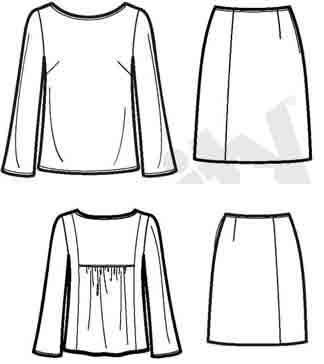
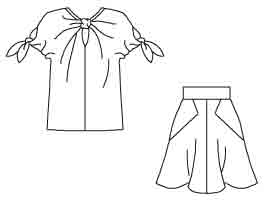
Archive for the ‘wardrobe planning’ category

A good wardrobe pattern for a core wardrobe ?

March 3, 2012

Wardrobe pattern books are inspirational, but once you know how to make very simple changes, you don’t need a book to get an easy group of co-ordinates. Just start with a wardrobe pattern.

Most wardrobe patterns are for a ‘Core 4’: top/dress, jacket, skirt, pants. All items with a closely similar look.

Wardrobe patterns which include patterns for more tops or layers are much more powerful as the starting point for a core wardrobe. Because they can give more variety of looks.

– – –

An example pattern

I often like McCall’s wardrobe patterns. They’re rare but stylish. I find the recent one particularly inspiring, McCall’s 6519.

This pattern doesn’t use the same style for both top and dress. It has two different underlayers.

My focus here is general issues about expanding to a wardrobe from a single pattern, with this pattern for the examples. I don’t mean to imply that everyone should use this pattern as their starting point ! These styles wouldn’t work well for all body shapes or personal styles. Do you think these styles would look good on a Rectangle ? an Inverted Triangle ? an Hourglass ? With my small bust and large hips, these aren’t the best style elements for me. I don’t look good in flat notched collars, or boxy jackets, or full pleated pants. Close fitting knits don’t flatter me. And I need tunics and vests in my basic wardrobe.

But this pattern makes a good foundation for thinking about wardrobe building.

Modern styling and some interesting style elements.

And hurrah, they’ve been generous : there’s a size 14 in the pattern envelopes for both larger and smaller sizes.
And hurrah again, they’ve put the finished garment measurements with the website pattern information. McCall’s used not to do this.

They made it in red, white and blue.
Fashionable colours this season. (Election in the US, Olympics in the UK.)
But not flattering for all of us.
So think of that as : accent colour, light neutral, and dark neutral.

– – –

The base items

For their examples McCall’s made :

Jacket : accent colour, solid, woven
(Unlined, edge-to-edge front. Shoulder dart under the collar, so it’s more shaped than the line diagram looks. Slight side-seam waist indent, not as much as suggested by the photo. 3/4 sleeve.)

”all-jackets”

Dress : 3 colours, large scale print, knit

”all-dresses”

Skirt : dark neutral, solid, knit

”all-skirts”

Top : 2 versions : one in dark and light neutrals, small scale print, woven; second in light neutral, solid, woven.

”all-tops”

Pants : 2 versions in the same 2 fabrics as the top.

”all-pants”

That makes 7 garments in all.
Which combined without the jacket make 7 different outfits.
Add the jacket to each, makes 14 outfits.

Could be a good basis for ejvc’s Spring Capsule at Stitchers’ Guild. Or her ‘Lucky Seven’ idea (see here page 20, Feb 25).

– – –

Other patterns

I think the key to the success of this McCall’s wardrobe pattern as a base for wardrobe building is that it includes 3 different tops. So different items in combination have different effects. Helped by accessories, you can go from business-like to casual with only a few garments.

Not many patterns like this, but I have found a few.
These ‘5 item’ patterns work well for Judith Rasband’s minimum ‘cluster’ of 5 garments (in ‘Wardrobe Strategies for Women’).

If you prefer more classic styles, new Butterick 5760 has two overlayers. A notched collar princess blazer, jewel neckband knit cardigan, and band collar shirt/ dress, as well as skirt and pants.
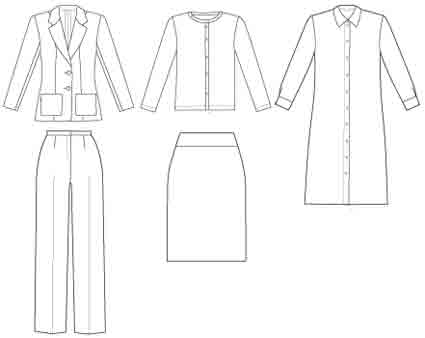
”b5760”

Wonder of wonders, rare in a wardrobe pattern – an underlayer with sleeves.
In their look book BMV add a shell in an accent colour, and jeans. 8 different items in all, a good basis for a short trip wardrobe. (Shirt, dress, shell, formal and casual jackets, skirt, pants, jeans.) Add a ‘dressy’ top if the trip includes a special occasion. More ideas on styling for a business trip at this wardrobe site.

Simplicity 1945 is a softer group for knits, this time with two underlayers. A raglan sleeve top with cowl neck, and a set in sleeve top with side drape front. Plus a simple jacket with cut on sleeve and cascade front. Pattern also has simple skirt and pants.

”s1945-2”

Add another jacket with a higher cascade collar, or a v-neck cardigan with banded neckline, for another group of looks. Or a light high-necked top to layer under those tops. . .

For a more ‘dramatic’ look there’s Vogue 8718 – with 2 very different underlayers (and a peplum jacket :D). The top with sleeves is a knit.

”v8718”

A version of the jacket with flat not ruched sleeves would add an ‘everyday’ look.

If you like ‘vintage’, Simplicity 2154 is another pattern with a choice of overlayers giving a good variety of looks, a 60s ‘Jackie O’ style.

”s2154”

Lengthen the top for a dress. Make another top without a bow.
Add pants with a slightly tapered leg, perhaps Colette patterns Clover pants. This style is from the days when people rarely wore jeans (and pants were’t allowed in good restaurants), but capris would be acceptable casual.

For the simplest of relaxed casuals, there’s Park Bench Central Park, which has three overlayers !

”central-park”

– – –

Finding a good pattern to start from isn’t the only question about building a wardrobe from a single pattern.

I have other posts planned, on how the shapes and ease of the styles in the McCall’s pattern work together as co-ordinates.

Then there are the very simplest strategies for adding items to make a minimum wardrobe.

Change fabrics : see my post on Kate Mathew’s wardrobe plans.

Change lengths : for inspiration look at patterns which include multiple sleeve and body lengths. See this post (also includes another 5-item wardrobe pattern). Or Butterick’s ‘The Cut Line’ patterns which work as tops, tunics, and dresses.

Change pockets or trims : see that post again.

Change necklines or remove collars : see my post.

Add basic patterns with minimum style elements : see my power of the boring post. (Also in that post, an example of building onto a 5-item cluster of separate patterns.)

These hugely expand the range of options you can get from one pattern starting point. As well as the sewing interest. And without needing to know anything fancy about pattern making 😀

– – –

Patterns and links available March 2012

= = =

Nancy Nix-Rice’s wardrobe plan : more thoughts

November 12, 2011

Nancy Nix-Rice gives us the simplest guide to a co-ordinated wardrobe. Of course when we know our own colour preferences, which garments we wear most of the time, and our personal style, we can make our own choices. And still take inspiration from Nancy’s ideas.

Here’s a summary of her 12-item basic wardrobe (making nearly 100 outfits). She uses three solid colours: darker and lighter neutrals plus an accent. And a print with all three colours.
– 4 under-layers, in each of the 3 solid colours and the print.
– 3 over-layers, in each of the 3 solid colours.
– 2 pants, in each of the solid neutrals.
– 3 skirts, in each of the neutrals and the print.

Nancy chooses simple classics, essentially only 6 styles with slight variations :
– knit sweater set.
– woven sleeveless shell.
– woven notched-collar jacket with short or long sleeves.
– woven pleated skirt and classic pants.
So to mimic her plan, we only need a small group of patterns.

If the details of Nancy’s plan are not right for you, what are the general principles ?

– – –

What are your core garment types ?

Are your core wardrobe needs a top, jacket, skirt, pants, as in Nancy’s examples ? Butterick 5333 is one of many possible wardrobe patterns.

”b5333”

Or perhaps you usually wear top, skirt, dress, jacket. Here’s one example, Butterick 5147.

”b5247”

I wear multiple layers : shirt/ blouse, tunic, vest, casual jacket, pants. Simple versions of my basics might be :

”my-five”

Textile Studio Mandarin shirt 1213,
Butterick 5390 tunic,
Simplicity 2285 vest (I picked this one because I’m working on it for Kenneth King’s faux-fur class at Pattern Review – recommended),
and Butterick 5429 jacket and pants.

I do own a couple of skirts, but they’re not part of my everyday wardrobe. I can remember my last dress, which went to the charity shop 15 years ago.

Perhaps you wear a simple threesome : knit top/ tee, jeans/ casual pants, cardigan/ casual jacket. Or white shirt, blue jeans, navy blazer.

What are your most frequently worn garments ? see my personal wardrobe plan post.

– – –

What are your go-to styles for your core garment types ?

How about Nancy’s core components but in a different style ? Eileen Fisher’s ‘system’ also consists of over- and under-layers, skirt, pants, but in ‘Easy Luxe’ casuals (see my posts on her capsules under Wardrobe Plan in the index).

”
Eileen Fisher winter 2010-11

Or perhaps you prefer a softer frillier ‘girly’ version of the dresses wardrobe.

I listed a few style options for tops, skirts, pants in my first of these posts about Nancy’s suggested wardrobe.

A blazer has been the key over-layer in recent seasons. There’s currently a good video on styling a blazer at Jones New York. But your favourite over-layer may not be a blazer. I always reach for a shirt-jacket. What is your go-to outer layer ? Here are some options :
Woven or knit ?
Fitted, loose, over-sized ? Length ?
Straight, flared ? curves, angles ?
Soft, crisp ? unstructured, structured ?
Lined, un-lined ?
Dropped shoulders, fitted armhole, raglan, cut-on sleeves ?
Front closure : buttons, snaps, zip, hidden placket opening, wrap ties, up to the neck or lower ?
Simple, or extra style elements such as a yoke, or princess seams, or jeans jacket seams, gathers, ruffles, twists ?
Collar or collarless ?
Collar : notched, mandarin, funnel, convertible, shirt band, shawl, hood ?
Pockets ? what style ? where ?
or perhaps you prefer a wrap, shawl, or cape ? (even though they’re not wearable without under-layer as Nancy’s scheme requires).

More ideas for variations on one of the cores ? see my recent personal styles post.

– – –

Possible co-ordinated patterns

Are there easy routes to co-ordinated patterns, if classics aren’t for you ?

The designers who produce a small set of basic patterns choose similar styles to Nancy’s group. See Nancy Erickson and Cecelia Podolak. Nancy Erickson has booklets on altering her basic patterns to make dozens of other styles.

Making the simplest versions of your core wardrobe could be a good starting point for your own pattern drafting. If you haven’t got many fit issues, simplify the fitting stage using a fitting aid – see my post on easier fitting shells.

Co-ordination may be easier if items come from the same designer. Many pattern designers include simple basics in their range. Such as Palmer-Pletsch and Nancy Zieman at McCall’s, or Connie Crawford at Butterick.

Among independents with a good group of basics, there’s Louise Cutting, Dana Marie, Loes Hinse (also recent patterns), Saf-T Pockets, Silhouette Patterns. And Jalie or Christine Jonson for knits.

There are more comments, plus descriptions of some wardrobe pattern books, in my post on reducing the number of shapes. Wardrobe patterns are the easiest way to co-ordinate. Among the Big4, Simplicity-New Look has the widest variety of styles.

– – –

Do you prefer more or less variety in colour, fabric, style ?

What are your most flattering colours ? I said a bit about colour in my first post of this group.

Nancy Nix-Rice’s wardrobe is based on neutrals. Here’s a video by Imogen Lamport on choosing neutrals. About 60 % of the clothes Nancy suggests are in neutral colours, about 40 % have accent colours. But of course you can choose your own proportions. Do you love or hate wearing neutrals ! Would you like no accent colour ? all colour 😀 I wear neutrals with occasional accent colours. You may instead want lots of bright colours.

Nancy has groups of garments all in exactly the same colour. I wouldn’t be comfortable with this. I prefer to wear a range of tonal variations around a main colour.

What are your favourite fabrics ? I usually wear textures for added interest (especially sweater knits), rather than prints. Sequins, shine, leather, fake fur are current for garments or trims. (P.S. There’s a fascinating new newsletter from Nancy on personal texture. There’s no way of getting my hair to look smooth and sleek 😀 )

Do you like many different styles, and a wide variety of looks ? Nancy Nix-Rice repeats very similar styles in her 23 garment selections. I may not have the same core wardrobe items as Nancy’s choice, but I do wear simple repeated styles. A big long scarf is an easy way of looking current. You may want much more variety or complexity!

– – –

Getting it all together

Despite all the differences, I’ve done so much wardrobe pondering before this that I found it quite easy to relate my own preferences to Nancy’s scheme. Hey, I already have most of them, or on a list of planned clothes purchases and fabric buys 😀

This season, getting a basic set of TNTs is the theme of the Stitcher’s Guild Sewing With A Plan for 2012. A core of neutrals plus a coloured twinset is the basis of the winter 6-PAC devised by ejvc for this year. We’re all working on getting our wardrobe basics right 😀

You Look Fab has an interesting modern take on the twin set – a woven blouse and knit cardigan in the same colour.

Sort out your TNTs or personal blocks, pick a few patterns from your favourite designer, or one wardrobe pattern for wovens and one for knits. Select your three colours and four or five fabrics. Whoosh around the accessory shops. And off you go into integrated wardrobe heaven 😀

Or for something completely different, how about a core wardrobe of just 1 item! Look at The Uniform Project :
1 dress 365 ways
(see View by Month for all the photos). Notice she chose a multi-function basic garment : it can be dress/ tunic/ under- or over-layer.
(Hint : you do need a lot of interesting extras 😀 )

– – –

Patterns and links available November 2011

– – –

Other posts on Nancy Nix-Rice’s wardrobe plan :
Neutral Cores, colours, personalising
Accent colour and print
Extras
Accessories
And related post :
Two-piece dresses

= = =

Nancy Nix-Rice : carefully chosen garments : extras

October 22, 2011

Nancy’s ‘core’ wardrobe consists of 12 mix-and-match items (4 under-layers, 3 over-layers, 5 bottoms). Of course she does’t expect us to live in just 12 garments ! Even though she shows so many variations we could wear a different outfit every day for a whole season.

Nancy also shows how to add items so they expand the wardrobe options. Instead of becoming orphans. She relaxes the rules : extras don’t have to co-ordinate with absolutely everything you already have ! Basics are clothes that mix-and-match without much thought, and can be worn on most occasions you find yourself in. Extras still need to make part of several outfits, but they can be more individual.

Nancy’s examples continue with the same classic shapes, and add some classic relaxed styles : jeans, shirt, and a drape front knit cardigan. Three new colours and another print !

– – –

First four extras : two more pairs of tops in accent colours
(end of Lesson 24)

Here’s something for people who long to have more colour 😀
Under- and over-layer in accent colour 2.
Under- and over-layer in accent colour 3.

The key point Nancy makes is you get better use from these added items if they’re :
– pairs of related under and over layers.
– colours which combine with the colours you already have.

Nancy chooses two more sweater sets. Sleeveless shell and over-layer that closes to the neck. Such as Silhouette Patterns 195 Sweater Set.

”sil-195”

Nancy chooses knits with texture, frills, and sleeve length variations for added interest.

You haven’t got to continue with the same styles as your original core. This could be the place where you add tops for different occasions – tee and hoodie for exercise, knit top and shirt-jacket for relaxed casual. Keep your blouse and jacket for looking competent or formal.

– – –

Fifth extra : print shirt
(Lesson 26)

Add a shirt which can be worn either as an under- or an over-layer. Gives a huge number of options. For this, the shirt needs to have unfitted waist – made from a casual-dartless block.

There are many many shirt patterns, from beginner’s camp shirt casual such as Kwik Sew 3475

”ks3475select”

to sublime elegance such as Chado Ralph Rucci Vogue 1215 (below) or Vogue 1054.

”v1215”

Male Pattern Boldness has had a shirt sew-along with many tips.

For fabric, Nancy uses another print that combines your first colours (darker and lighter neutrals and accent), for maximum co-ordination and interest.

– – –

Sixth extra : casual pants in your first darker or lighter neutral
(first paragraph of Lesson 27)

Nancy chooses corduroy jeans.

Jalie 2908 jeans was the top Pattern Review pattern for 2009.

”jalie

Pattern Review have 85 pages of tips in a jeans sew along for this pattern. Male Pattern Boldness has also had a jeans sew-along. There are tutorials on making the front pockets here. And Jennifer Sterns’ jeans pattern gets many good reviews for the instructions.

Judith Rasband in ‘Wardrobe Strategies for Women’ says jeans aren’t basic, because you can’t wear them at any time in any place without wondering if you’re appropriately dressed.

Your preference for casual pants might be chinos, such as Palmer-Pletsch McCall’s 6361. Or yoga pants, perhaps Palmer-Pletsch McCall’s 6082.

– – –

Seventh to tenth extras : a complete Core 4 in a second darker neutral
(Lesson 27).

Your second darker neutral does need to ‘go with’ the first, if you want maximum co-ordination possibilities. But it gives you the option to add a new frequently-worn colour.

For styles, Nancy repeats the basic classics. Her ‘Core 4” consists of under-layer, over-layer, skirt and pants, see first post in this group.

You might choose any wardrobe pattern which includes all your core items.

But you could use this opportunity to add a different style. All in denim ? all in a pretty print ? all in sweatshirt fleece ? Just :
– make all four items in a closely related colour group.
– link the colour and textures to what you already have.
– choose styles that make the look more casual or more professional, prettier or more edgy, but not so different that they look incongruous combined with the other clothes in your main ‘core’ wardrobe.

And take care with co-ordination. It may be dull to repeat shapes, but it does make everything interchangeable easily ! (Here are some thoughts on reducing the number of shapes.)

– – –

Eleventh extra : drape front cardigan
(Lesson 27, after the new Core 4)

Nancy’s final piece is a drape front knit cardigan. In a lighter colour related to your second dark neutral. This is a modern casual classic, with many patterns.

Jalie 2919 was one of Pattern Review’s top patterns for 2010.

”jalie2919”

Simplicity 2603 was one of Pattern Review’s top patterns for 2009.

”swaterfall”

These patterns both have a long front drape. A short cascade front looks better on me, see my post on cascade jackets.

– – –

Nancy ends Lesson 27 with a summary of the complete wardrobe. In Lesson 28 she makes some suggestions about choosing your group of clothes from your own closet or shopping.

– – –

Nancy has added 11 garments to her core 12. Making 23 garments total. All fit onto a short hanging rail ! And she stopped counting how many hundreds of different outfits she could make.

Nancy’s choices for these additions continue the same basic styles as the core wardrobe, but with added colour :
– two sweater sets in accent colours.
– another ‘Core 4’ in a second darker neutral or ‘basic’ colour.
That adds 8 items.

She also adds :
– casual pants (jeans) in your first darker neutral.
– ‘casual/ dartless block’ shirt, in a 3-colour print.
– drape front knit cardigan, in a lighter colour related to your new ‘Core 4’.
Well, don’t leave these ’til last if you need casual clothes !

As usual, all Nancy’s ideas for combinations and styling with accessories are thought provoking and inspiring.

If you follow Nancy exactly, you’ll have 7 shells, 8 over-layers, 4 skirts, 4 pants. In 3 neutral/ basic colours and 3 accents.

Want to go in another direction ?
There are several interesting suggestions for small groups of garments, ‘capsules’, in the Wardrobe Builder section of the Petite Plus patterns site. These ideas can be used by anyone, not just people who’re that shape.

Nancy hasn’t included ‘statement’ pieces. These are of course very individual. Instantly recognisable, not co-ordinates. But they still need to relate to your basics in colour and shape, so you can wear them !

23 Garments in Nancy’s scheme ? Why not make it two dozen ? What do you dearly miss ? What would you like for your special free-choice Bonus Item 😀

– – –

Patterns and links available October 2011

– – –

Other posts in this group :
Neutral Cores, colours, personalising
Accent colour and print
Accessories
More thoughts
And related post :
Two-piece dresses

= = =

Two piece dresses

October 8, 2011

The Japanese call a dress a “one-piece”. But many wardrobe planners suggest a two-piece dress, as it adds more options. Look at these pieces from Butterick 3037.

”b3037-1”

In a solid light wool or linen, they might be called a suit. In a pretty print, a dress. The print top with the linen skirt would be separates. I don’t think it’s helpful to worry about the words. Just think whether a top and bottom made from the same fabric, but too light and unstructured to be called a suit, would be useful in your wardrobe.

And what pattern to use ? Of course you could just make your favourite blouse/ top with a simple skirt in the same fabric. But what about specific patterns for 2-piece dresses ? Here are some pointers.

– – –

Classics

Butterick 3037 in full has a good range of choices. A top with 2 necklines and 3 sleeve lengths. Straight and A-line skirts in 3 lengths.

”b3037-2”

If you like classics you could base a whole wardrobe round this. Remember an over-layer needs to be larger. Add pants with the same waist style as the skirt, to increase the options. Learn how to change necklines and hem shape (see my post on pattern variations), and you’ll never need another pattern 😀

There are some similar patterns in the evening sections of the catalogues. Skirt and bodice options. Make a knee length skirt and they’re wearable for day too. Here’s an example : Butterick 3843

”b3843”

There are few two-piece patterns in the dress sections of the catalogues. The best source is wardrobe patterns. Many contain a top and skirt that can be made in the same fabric. Not all, often the top is knit and the skirt woven. I’m not listing these patterns because there are so many, especially at Simplicity and New Look.

Here’s one example, Butterick 5147.

”b5247”

Tuck that top into a big New Look skirt for a vintage 50s effect.

– – –

Trendy

The trendy version of a two-piece dress is a tunic top over a short skirt. Here are some examples.

McCall’s 6288 by Rebecca Turbow.

”v6288”

Simplicity 2305 by Cynthia Rowley

”s2305”

Simplicity 2059 by Lisette.

”s2059”

And what about this, which intrigues my pattern loving self 😀

Donna Karan Vogue 1259

”v1259”

– – –

Separates in different fabrics

Interesting, there are some patterns which include a top and skirt that the designer wants made in different fabrics. They are in the ‘separates’ sections of the catalogues.

Rachel Comey Vogue 1170.

”v1170”

Rachel Comey Vogue 1247

”v1247”

– – –

Other styles

Try the two-piece approach for other personal styles as well. It may be easier to combine favourite blouse and skirt patterns.

If you like ruffles and wraps, how about Kwik Sew 3474 for example, with a mock wrap skirt.

”ks3474web”

A casual person might prefer a tunic over a longer skirt in a knit fabric. Simplicity 3568 perhaps.

”s3568”

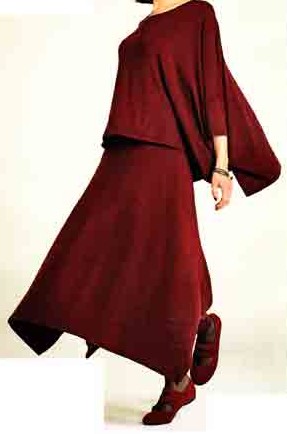
For lovers of the arty oversized : here’s a wide top combined with a long handkerchief skirt.

”walloslight”
from Wall London.

Perhaps copy this using the largest size of The Sewing Workshop Hudson top. And a DIY handkerchief skirt pattern. (or see this tutorial by Shams on her ‘tablecloth’ skirt.)

– – –

I used to think two-piece dresses are dowdy. But now realise I was looking in the wrong direction. This is just a sample of the interesting possibilities if you look beyond the dress sections of the catalogues. Check the separates. Or combine blouse and skirt patterns.

Two-piece dresses can also be good for someone like me, very different sizes above and below the waist. Easier to make two different size items than to try to join them together at the waist !

Judith Rasband has whole DVD, Look Changers, on the different ways you can wear a 2-piece dress. The particular styles may be dated, but the general styling ideas apply in any decade.

Doesn’t matter whether you call the two pieces a dress or separates made from the same fabric. Two items made from the same fabric have a stronger visual effect than the same two items made in different fabrics. Is that effect an option that you want to have available from your clothes ? If so, a top and skirt in the same fabric are garments you’ll want to have.

– – –

Patterns and links available October 2011

= = =