The ‘Classic’ style is well known and popular. Many basic wardrobe plans are based on classic styles.
Judith Rasband‘s simplest wardrobe cluster is a group of 5 items.
Her March 2012 newsletter makes the case for wardrobe basics very clearly, These simple clothes with very few added style elements are mainly what is called the ‘Classic’ style.
Buying into fashion lines that feature garments with simple design lines is the smart way to dress. These clothes are called “basics” because you can build most of your wardrobe with them. With simple design lines, basics don’t call a lot of attention to themselves. Basics don’t have design lines that fight with other garment’s design lines. Most basics don’t go out of style. You can find basics that are affordable. Some of my favorites are
basic blazer and bomber jackets,
basic V-neck tops,
basic sport [band collar] and camp shirts,
basic straight and flared skirts,
and basic straight-leg slacks.
With a wardrobe built on basics, you can afford a more complex or decorative garment once in awhile because it will go with most of your basics, adding a surprise element to your usual looks. Building your wardrobe on basics is the way to go!
Rasband counts a style ‘basic’ if it’s so simple that it will co-ordinate easily with pretty well any other style. So, for example, a ‘basic’ top co-ordinates with almost any skirt or pants style.
One of each of her basics would give you a ‘cluster’ of 5 items, perhaps as many as 10 different outfits.
Basics which include a blazer jacket also make good business wear for many people. Their simplicity means they don’t draw attention to themselves but do look efficient.
Perfectly Packed suggests a basic business wardrobe of 8 classic items :
suit fabric : blazer jacket, straight skirt, pants.
dressier fabric : zip-front jacket, sheath dress.
lighter fabric : sleeveless top, a-line skirt (together make a 2-piece dress).
shirting fabric : shirt.
I reckon you can make 21 different outfits out of these, enough for every day of a working month. Add another blouse or shirt and that adds 9 more combinations.
Similar classic styles make the basis of many other published wardrobe plans. Such as Nancy Nix-Rice’s basic wardrobe, newsletter issues 21 – 28.
– – –
Reproducing the basic classic wardrobe
You only need a couple of wardrobe patterns and 4 fabrics.

darkest neutral suit fabric : jacket, skirt, pants.
lightest neutral shirting : shirt (shorten dress).
(the knit cardigan gets mentioned later)
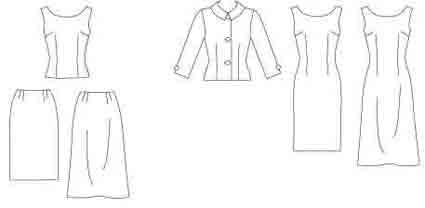
mid neutral dress weight : top, a-line skirt.
mid neutral dressy fabric : jacket (made without collar and with zip front), sheath dress.
– – –
‘Modern classics’
There are versions of the classic styles which look more ‘modern’ because they are crisp, close fitting, a little edgy.
The Vivienne Files frequently suggests basic minimum wardrobe groups in ‘modern classics’ style.
For instance some of her recent posts are on wardrobe groups consisting of neutrals plus one accent colour :
– 5 core dark neutral garments (for her that’s usually 2 tops, 2 bottoms, dress),
– a couple of white or light neutral tops,
– an accent jacket,
– 6 other garments in accent colour.
That’s 7 neutral garments and 7 accents.
Example here. And some of her other posts : one, two, three.
This modern take on classics includes many knits. Her basics include tees, knit classic cardigans, and leggings as essentials.
Tees, both fitted and looser and longer. Many tee patterns of course, one is McCall’s 6491.

Knit cardigan closing to neck, see Butterick 5760, first pattern mentioned in this post.
Slim pants pattern by Palmer-Pletsch, McCall’s 6440 (seams down back, 4 hem styles).

Leggings : McCall’s 6360 is one of many leggings patterns, 4 styles 4 lengths.

The ‘modern classic’ style is essentially sleek and close fitting, crisp in wovens. If you’d like to explore beyond Big 4 patterns, look to :
Burda Style downloads
styleARC
Notice I don’t call these ‘young classics’, as anyone can wear them if you’re the right shape 😀
– – –
Doesn’t mean of course that you have to wear these styles, or be limited to colours of black, white, grey, and denim blue. . . [aargh, eek]
As frequently happens, I find myself thinking about classics because many people write about them, even though I never wear them myself.
Does the classic style make you feel your best ? or make you feel constricted and constrained and unable to be your true self ? It’s very interesting this. The Vivienne Files recently posted on her everyday basics here. I actually shuddered. She loves these, but if I had to wear them I would find it completely soul destroying. Even if they weren’t all black, they’re the wrong shapes and fabrics for me. Fascinating that people can be so different.
For those of us who never wear classics ? We have to do a bit of thinking outside the box to work out how wardrobe plans like this match up with our own needs.
I have a whole lot of reactions to all this, some of which I’ve cycled through many times before. As usual I feel so strongly about this I found myself writing several hundred words, so it’s become a separate post (here).
There’s much to enjoy here. I’m fascinated by clothes and style, and I enjoy looking at and thinking about the classics. But it’s definitely not a style for me to wear myself !
– – –
Patterns and links available April 2012
= = =




 Sewingplums