Archive for the ‘style and planning’ category

Wardrobe pattern co-ordination : ease for layering

March 31, 2012

Yet more comments on how a pattern like McCall’s 6519 can be a good basis for building a core wardrobe.

”m6519wardrobe”

Two previous posts on this pattern :
– the interest and usefulness of wardrobe patterns with 5 rather than 4 items. And some other patterns with more items (post here).
– a few comments on how the shape elements of the different garments in this pattern work together (post here).

This post is about how shapes fit together for layering : is one layer large enough to be comfortable over another ? I’m not attempting to say everything there is to say about layering of all styles !

– – –

Movement ease

‘Ease’ is the amount the garment is bigger than the wearer’s body measurements.

The most basic is ‘movement ease’, the amount that needs to be added to be able to wear the garment at all. For wovens, this is usually either 2 inches/ 5 cm or 4 inches / 10 cm at bust level. Some people prefer a close fitting basic style. Other people like their basics a little looser.

Some personal pattern drafting instructions produce a basic block with 2 inches ease, some produce one with 4 inches. Check whether the drafting adds 1/2 inch or 1 inch to the quarter measure at bust level. If you’re going to draft your own pattern block from scratch, look for a method which produces the basic ease level you prefer.

As knit fabrics have stretch, they provide inherent movement ease. Even so, some people like loose knits, some people like no ease. Very close fitting garments made from very stretch fabrics (swimsuits, leotards) may even be designed with negative ease (cut smaller than the body).

So pattern making books have separate basic pattern blocks for knits and body fitting clothes. Different basic blocks for fabrics with different amounts of stretch.

Bending room

In the simplest fitting shell, ‘movement ease’ just means enough room to breathe. You may need more room for real movements.

For example, my sitting hip measure is about 4 inches larger than my standing hip measure. Many skirt and pants patterns have 2 inches ease at hip level. In those patterns, I need to go up a size, to add another 2 inches of ease. So I can wear that style without straining the fabric.

This isn’t a problem with the pants of McCall’s 6519 as they are very loose fitting, with hip ease of more than 9 inches.

It could cause problems with sitting down in that wrap skirt, and I would probably make a muslin to check.

If you are an active person, and like to be comfortable, you may find you need a larger armhole and more fabric at elbow and knee. And you probably know you only like some skirt styles, because you can walk and dance freely in them.

Design ease

Then add on ‘design ease’, the extra needed to give the garment the shape and style that’s wanted. This affects whether a garment is close fitting or very loose. The BMV ease table shows total ease, movement ease plus design ease.

There are modern jacket styles (not the one in McCall’s 6519) which are close fitting, with only movement ease. For example, Basic Patternmaking in Fashion by Lucia Mors uses the same block for making both jacket and dress. These close fitting jackets aren’t mentioned in the BMV ease table. They’re made in jacket fabrics with jacket styling, but not meant to be layered over anything more than a camisole. So it’s worth checking the ease level of your pattern. (Total ease = difference between finished garment measurement and your measurement.)

Layering ease

So ‘design ease’ includes ‘layering ease’ if need be. Make sure there’s enough room to put one garment on over another. Best to have at least 1 inch/ 2.5 cm extra ease for every additional layer something needs to be comfortable over, including a lining.

This applies to knits too, if you want them to be comfortable.

The ease levels in McCall’s 6519 at bust height are :
dress (knit) : 1-1/2 inches / 3 cm
top (woven) : 4-1/2 inches / 11 cm
jacket (woven, unlined) : 5-1/2 inches / 13 cm

So it might not look very good, but if you were cold you could wear all three 3 layers at the same time !

Armholes and sleeves

In this McCall’s 6519 pattern, dress and top are both sleeveless, so the problem of layering the jacket over another sleeve doesn’t arise.

If you want to layer one sleeve over another, then the outer armhole and sleeve need to be larger too.

It’s also easiest if all layers have the same style armhole : all fitted, all cut on, all raglan, all drop shoulder, etc. Most armhole shapes work over fitted, but not the other way round !

– – –

Now there are three posts inspired by McCall’s 6519. The first two were on :
5-item wardrobe patterns
co-ordination of shapes

In the first post I mentioned the easy ways of adding more items to a wardrobe pattern to make a core wardrobe : changing fabrics and lengths. Those easy ways may not add much to the sewing interest 😀

How to add more styles when starting from one pattern ? If you’re ready to try a little pattern altering, you don’t have to go straight to a full-scope professional-training pattern-making bible. There are many simpler sources of advice to use as a starting point. Am planning a post listing some of them.

Or if having ideas for capsules and small wardrobes is the point you get stuck at, look at The Vivienne Files or Polyvore. You may not share their ‘modern classics’ styling, but they’re full of ideas for combinations that make outfits and capsules.

Enjoy 😀

– – –

Patterns and links available March 2012

= = =

Wardrobe pattern co-ordination : shapes and lines

March 17, 2012

Continuing with comments on how a pattern like McCall’s 6519 can be a good basis for building a core wardrobe (see my previous past).

”m6519wardrobe”

It’s interesting to look at how a wardrobe pattern solves the problems of co-ordination. There are several.

One is the shapes visually, such as : does a loose fitting jacket look good with loose fitting pants, what necklines go together. . . I’ll say a bit about this pattern here. There could be many more points about co-ordinating shape and style elements once you add other patterns to supplement this one. A possible topic for another post.

Another issue is : do the shapes fit together for layering : is the jacket/ overlayer large enough to be comfortable over other garments ? Later post planned on this.

– – –

Visual shapes

Some wardrobe patterns co-ordinate shapes by using garments with few distinctive style elements.

The garments in this pattern have some style interest but still co-ordinate. They do that by having some common style elements.

Necklines and collars

Many people have difficulty co-ordinating neckline and collar shapes. What looks good, what is comfortable. . .

There are 3 necklines here :
– shawl collar with notch on edge-to-edge front (jacket).
– wide notched collar above wrap front (dress).
– simple scoop neck (top).

”m6519collars”

Notice that it’s quite easy to combine two notched collars if they differ in width, or how deep/ big the notch is, or how high the notch is on the body.

Here’s a photo from Kibbe’s “Metamorphosis” oop book showing some bravura notched collar co-ordinating. Two collars with notches of different shapes at different heights, plus a convertible collar. (A shirt collar would also work well – worn closed for a more ‘controlled’ look.)

”kibbe-collars”

(Notice also how this designer uses different textures in the nearly same shade. And the dramatic accessories give a very different impact to the classic clothes. Imagine these clothes more fitted – this outfit is from the 80s when clothes were big shouldered and loose fitting !)

Silhouettes

In McCall’s 6519, an edge-to-edge jacket works well over a wrap style, so long as the wrap doesn’t have a lot of fullness.
The simple top can be worn tucked in or out, for more or less formal effect.

The skirt and lower dress are the same pattern pieces.
Skirts and pants share a similar style element – pleats, which makes them good alternatives.

The pants are very loose fitting (9-1/2 inches ease at hip level). So they look best with a not too large jacket. This one has 5-1/2 inches ease at bust level, semi-fitted by BMV ease criteria.

I wrote a previous post on simplifying co-ordinates by using a limited number of shapes.

Type of line

Released pleats give a soft line (sewn down pleats have an more angular effect). Dress, skirt and pants all have these soft lines. The neckline of the top continues with the curves. Knits for dress and skirt also add softness.

Although the jacket and dress notch corners are angled in the pattern, they are softer in the line drawings. You could use slightly rounded corners on the bottom of the front openings and the patch pockets. Or of course you can have mixed curves and angles. Which goes best with your body shapes and lines, your personality ?

A pattern with curves and pleats like this might be better suited to someone who has soft lines in their face and body, or a gentler personality.

If you have straighter more angular lines to your face and body, or need to look crispy efficient, you might prefer Butterick 5760. Angular styling, except for a little softening in jacket silhouette and lapels.

”b5760”

– – –

These two posts have looked at one pattern in detail. There’s more to say on layering, in another post (here). And possibly more later on using this pattern to build a wardrobe. . . Very different from the way most of us usually sew – when we make a different pattern in a different fabric every time 😀

– – –

Patterns and links available March 2012

= = =

A good wardrobe pattern for a core wardrobe ?

March 3, 2012

Wardrobe pattern books are inspirational, but once you know how to make very simple changes, you don’t need a book to get an easy group of co-ordinates. Just start with a wardrobe pattern.

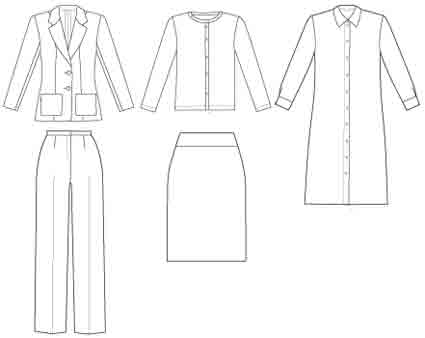
Most wardrobe patterns are for a ‘Core 4’: top/dress, jacket, skirt, pants. All items with a closely similar look.

Wardrobe patterns which include patterns for more tops or layers are much more powerful as the starting point for a core wardrobe. Because they can give more variety of looks.

– – –

An example pattern

I often like McCall’s wardrobe patterns. They’re rare but stylish. I find the recent one particularly inspiring, McCall’s 6519.

This pattern doesn’t use the same style for both top and dress. It has two different underlayers.

My focus here is general issues about expanding to a wardrobe from a single pattern, with this pattern for the examples. I don’t mean to imply that everyone should use this pattern as their starting point ! These styles wouldn’t work well for all body shapes or personal styles. Do you think these styles would look good on a Rectangle ? an Inverted Triangle ? an Hourglass ? With my small bust and large hips, these aren’t the best style elements for me. I don’t look good in flat notched collars, or boxy jackets, or full pleated pants. Close fitting knits don’t flatter me. And I need tunics and vests in my basic wardrobe.

But this pattern makes a good foundation for thinking about wardrobe building.

Modern styling and some interesting style elements.

And hurrah, they’ve been generous : there’s a size 14 in the pattern envelopes for both larger and smaller sizes.
And hurrah again, they’ve put the finished garment measurements with the website pattern information. McCall’s used not to do this.

They made it in red, white and blue.
Fashionable colours this season. (Election in the US, Olympics in the UK.)
But not flattering for all of us.
So think of that as : accent colour, light neutral, and dark neutral.

– – –

The base items

For their examples McCall’s made :

Jacket : accent colour, solid, woven
(Unlined, edge-to-edge front. Shoulder dart under the collar, so it’s more shaped than the line diagram looks. Slight side-seam waist indent, not as much as suggested by the photo. 3/4 sleeve.)

”all-jackets”

Dress : 3 colours, large scale print, knit

”all-dresses”

Skirt : dark neutral, solid, knit

”all-skirts”

Top : 2 versions : one in dark and light neutrals, small scale print, woven; second in light neutral, solid, woven.

”all-tops”

Pants : 2 versions in the same 2 fabrics as the top.

”all-pants”

That makes 7 garments in all.
Which combined without the jacket make 7 different outfits.
Add the jacket to each, makes 14 outfits.

Could be a good basis for ejvc’s Spring Capsule at Stitchers’ Guild. Or her ‘Lucky Seven’ idea (see here page 20, Feb 25).

– – –

Other patterns

I think the key to the success of this McCall’s wardrobe pattern as a base for wardrobe building is that it includes 3 different tops. So different items in combination have different effects. Helped by accessories, you can go from business-like to casual with only a few garments.

Not many patterns like this, but I have found a few.
These ‘5 item’ patterns work well for Judith Rasband’s minimum ‘cluster’ of 5 garments (in ‘Wardrobe Strategies for Women’).

If you prefer more classic styles, new Butterick 5760 has two overlayers. A notched collar princess blazer, jewel neckband knit cardigan, and band collar shirt/ dress, as well as skirt and pants.

”b5760”

Wonder of wonders, rare in a wardrobe pattern – an underlayer with sleeves.
In their look book BMV add a shell in an accent colour, and jeans. 8 different items in all, a good basis for a short trip wardrobe. (Shirt, dress, shell, formal and casual jackets, skirt, pants, jeans.) Add a ‘dressy’ top if the trip includes a special occasion. More ideas on styling for a business trip at this wardrobe site.

Simplicity 1945 is a softer group for knits, this time with two underlayers. A raglan sleeve top with cowl neck, and a set in sleeve top with side drape front. Plus a simple jacket with cut on sleeve and cascade front. Pattern also has simple skirt and pants.

”s1945-2”

Add another jacket with a higher cascade collar, or a v-neck cardigan with banded neckline, for another group of looks. Or a light high-necked top to layer under those tops. . .

For a more ‘dramatic’ look there’s Vogue 8718 – with 2 very different underlayers (and a peplum jacket :D). The top with sleeves is a knit.

”v8718”

A version of the jacket with flat not ruched sleeves would add an ‘everyday’ look.

If you like ‘vintage’, Simplicity 2154 is another pattern with a choice of overlayers giving a good variety of looks, a 60s ‘Jackie O’ style.

”s2154”

Lengthen the top for a dress. Make another top without a bow.
Add pants with a slightly tapered leg, perhaps Colette patterns Clover pants. This style is from the days when people rarely wore jeans (and pants were’t allowed in good restaurants), but capris would be acceptable casual.

For the simplest of relaxed casuals, there’s Park Bench Central Park, which has three overlayers !

”central-park”

– – –

Finding a good pattern to start from isn’t the only question about building a wardrobe from a single pattern.

I have other posts planned, on how the shapes and ease of the styles in the McCall’s pattern work together as co-ordinates.

Then there are the very simplest strategies for adding items to make a minimum wardrobe.

Change fabrics : see my post on Kate Mathew’s wardrobe plans.

Change lengths : for inspiration look at patterns which include multiple sleeve and body lengths. See this post (also includes another 5-item wardrobe pattern). Or Butterick’s ‘The Cut Line’ patterns which work as tops, tunics, and dresses.

Change pockets or trims : see that post again.

Change necklines or remove collars : see my post.

Add basic patterns with minimum style elements : see my power of the boring post. (Also in that post, an example of building onto a 5-item cluster of separate patterns.)

These hugely expand the range of options you can get from one pattern starting point. As well as the sewing interest. And without needing to know anything fancy about pattern making 😀

– – –

Patterns and links available March 2012

= = =
Wardrobe pattern books – other possibilities

February 4, 2012

More on wardrobe pattern books which claim to have all the styles and patterns you need in one book. Here are some books which are more of a challenge to find or use ! There are also brief notes on children’s patterns and learning to sew.

– – –

Out of print books

Rusty Bensussen. Making a Complete Wardrobe from 4 Basic Patterns (1987).

”rusty-diags”

Draft your own 80s oversized patterns for pullover top also used for dress/ jacket/ coat, plus dirndl and circular skirts, and pants, from simple instructions. Pullover up to about 50 inch hip, skirt up to about 45 inch hip. Easy to enlarge (every 1/2 inch added to width of front and back pattern pieces adds 2 inches to the size). With many simple suggestions for pattern alterations. Add ease to jacket and coat, or you get top/dress, jacket, coat all the same size ! Complete sewing instructions (mainly words) only for the most basic styles.

Sandra Betzina. No Time to Sew (1997).

”sb-rodale”

Patterns for slim and full pants (one-seam styles), skirt, tee, shirt, dress, vest, jacket, with suggestions for style alterations. All dartless. Simple advice on fit. Up to 43 inch bust, 46 inch hip. Melanie points out these are good for layering (in a comment on my layering wardrobe post). Sewing instructions have most steps illustrated. Conventional tissue paper patterns. Rare to find book and patterns together, as the pattern envelope isn’t part of the book. Easy to find the book, difficult to find the patterns. Search for the pattern pack as “Rodale Designer Collection” or “Sandra Betzina Rodale”. She now designs for Vogue Patterns.

– – –

Japanese pattern books and magazines

If you enjoy a challenge, there are 100s of Japanese pattern books and magazines. In a huge range of styles : casual-crafter, 60s dresses, arty, lolita, drapey, quick makes, fitted structured blazers and coats, mother-and-daughter, for children, multi-layers, young modern. . . See Simply Pretty.

One type of book (such as ‘Mrs Stylebook’) just tells you how to draft the pattern based on your personal block. So you can get a good fit, but you’re expected to know how to sew it together.

Other books have a traceable full size pattern sheet, though the sizes may be rather small (as in Extra Large with 38 inch hips :D). These books do have sewing instructions. In Japanese but with very good illustrations, so it’s usually quite easy to work out what to do. See sample instructions at end of Simply Pretty excerpts.

A couple of these books have been translated into English. As I already have several Japanese books in similar style, I haven’t looked at these. If they’re direct translations of the Japanese versions, they have sheets of full-size traceable patterns, and sizes may be small.

Simple Modern Sewing by Shufu To Seikatsu Sha

”simple-modern”

This book has 8 basic patterns : for 2 dress styles, 3 tops and shirts, 2 skirts, pants. With 3 versions of each pattern, including tunics, light jacket and coat. Some photos of the styles here.

Shape Shape

”shape-shape”

From the cover and description it looks as if the styles are more ‘arty’. See more information here.

For children and learners

There are also many pattern books for children’s clothes. Most of them by designers with children’s pattern companies. And most have a tissue pattern pack. Often also teach sewing. Find them using the links to other books provided by Amazon with :
Oliver & S Little Things to Sew

Bunkhouse books are written for children learning to sew, but of course can be used by adult learners too. All with full size traceable patterns : 27 – 38 inch bust, 28 – 40 inch hip, in girls and misses heights. Reviews at Amazon, but here are links to the parent company as you can scroll down the product page to photos of the styles. Also patterns for matching 18″ dolls clothes.
Stitches & Pins
Beginner sewing for girls. Patterns for simple skirt, vest, pants, top – also usable for nightwear, plus accessories. (Comments at Amazon that a complete beginner needs help.)
Buckles & Bobbins
Similar for boys.
Pins & Needles
Intermediate : patterns for vest, blouse, culottes, dress and jumper dress, shawl collar jacket, shorts, tee, sweatshirt, sweatpants, hoodie.
Pintucks & Lace
Advanced : heirloom sewing, mainly baby and home items. Also blouse (use pattern from previous book), half slip, 2 skirts, shrug.

– – –

Previous posts in this group :
Wardrobe pattern books – casuals
Wardrobe pattern books – mainly dresses

Pattern books are no longer unusual. They’re a growing type of sewing publishing, with many fascinating possibilities. Well worth looking out for. There’s a huge range of styles to explore, if you like the idea of easy co-ordination by just having one starting point for all your sewing.

But perhaps you prefer to sew every project completely different, rather than being sensible and wardrobe building 😀

– – –

Links and most books available February 2012

= = =