Archive for the ‘style and planning’ category

A summer capsule

May 19, 2012

Image consultant Judith Rasband has suggested a ‘casual classics’ summer capsule of 6 items (in an e-mail dated 30 April 2012).

”rasbandcapsule”

This capsule immediately caught my eye because each item has interesting style elements, rather than being the simplest possible basic. Because of that, I don’t think these tops and jacket could be worn in all possible layering combinations. But they do give style effects from formal to casual to dressy.

How about patterns for these ?

As often happens, I’ve found I’ve got so much to say on this, I’ve divided it in sections :
– this on patterns for the original capsule.
– a second post on variations in style (Variations on a summer capsule).

– – –

Drape front shell

”vwdrapetop”

The original is a Vivenne Westwood sleeveless top with ruched and pleated front, and side zip fastening.

Many patterns for a simpler version of this, with drape neckline but not so closely fitted it needs an opening. Here’s new Vogue 8816.

”v8816”

– – –

Smock top

”laceyokesmock”

Original was from Paul & Joe Sister, a top with lace yoke, gathered lower section, three-quarter puff sleeves, buttoned opening down back.

Again I would be more likely to wear a looser pullover version of this. I need layers even in summer, and I wear loose smock tunics.

There used to be several top patterns with yoke at mid-armhole height, now they’re more difficult to find. Try Butterick 5217 – gather the lower section instead of pleating. Or keep the pleats if you prefer a flatter effect. And lengthen the sleeves.

”b5217”

– – –

Big shirt

”bigshirt”

Madewell shirt. With ‘boyfriend sizing’ it can be worn alone or as a shirt-jacket layer.
So why not use a man’s shirt pattern. To get the over-sized effect, don’t choose a style which tapers to the hips.

Here’s one of several men’s shirts from Kwik Sew : Kwik Sew 2000.

”k2000shirt”

The drawing is tapered but the pattern isn’t.
Add large chest pockets if they look good on you.
I like rounded corners and some pretty trim. More difficult to sew, but a better look for me.

– – –

Pants

”pants”

Alberta Ferretti cropped pants with side buttoned opening.
Personally I look short legged in a cropped style. But ankles are a focus this season.
And the last thing I need is a row of buttons drawing attention to my high hips.
So use your favourite basic pants.

– – –

Long swirly skirt

”maxiskirt”

Target maxi knit.
I don’t wear knit skirts, they cling to every bump on my hips and thighs. And that waist swathe would be best avoided on my high hips. . . But I do love swirling around in a long skirt, even though it’s not practical for my everyday.

Look for something fitted over the hips then flaring out.
Many gored skirt patterns with this shape, but this is simpler. Simplicity 4881 for wovens – extend it to ankle or maxi length.

”s4881”

– – –

Safari jacket

”safarijkt”

Photo is the G-Star lined safari style blazer with interesting pocket detail.

”safaripockets2”

Basically a classic notched collar fitted lined blazer with added pockets.
So add bellows pockets and zips to your favourite blazer pattern.

Here are my blazer posts on style elements and sewing advice.

Personally, my favourite safari style jacket is more like a big shirt with convertible collar – perhaps Kwik Sew 3534. (I would leave out the epaulets and cuffs.)

”k3534”

– – –

Accessories

2 pairs of flat shoes – ballet flats and sandals.
Wedge heels would also work with this group.
Rasband has chosen leather, but the current rope trim and fabric upper sandals would also co-ordinate. Or fabric rather than leather ballet flats.
Scarves and jewellery need little space and can make a big difference to an outfit.

Big bangle and belt go well with safari styling. These are bigger and more aggressive than I would wear. (Never a big belt across my hips 😀 ) You could use softer or more ornate styling for jewellery and belts, especially if you don’t use a strictly blazer type jacket, and you round off the corners of style elements.

Rasband doesn’t show a bag, but this is a good group for wearing with a big fabric bag. Perhaps the new Marcy Tilton Vogue 8823.

”v8823”

– – –

There’s a second post (Variations on a summer capsule) on choosing a wider variety of styles for a similar capsule, and for making your look ‘this season’.

Enjoy your clothes choices for a mild summer 😀

– – –

Links and patterns available May 2012

= = =

😀 😀 😀 😀 😀

Hey, on Friday this blog passed 250,000 total visitors. Many thanks for all your interest

😀 😀 😀 😀 😀

= = =

April issue Vogue patterns – dresses

May 12, 2012

Some of the new season Vogues are a joy for people who’re fascinated by how patterns work.

The last few pattern issues have been mainly sheath and vintage dresses. I know those shapes are current but I don’t wear them myself and have difficulty working up any interest. Don’t see many people round here wearing them either, even though this is a young university suburb. Many short skirts, leggings and sweaters, but not dresses. Perhaps it’s different at corporate offices or parties in a big city.

I’m also becoming interested in flounces – though only in moderation.

Anyway, this set of Vogues has so much I want to mention this post got very long. So I’ve made 2 sections, this one on dresses, and another on separates, jackets and bags.

Yes these are dresses, but ‘interesting’ ones, not just sheaths (which are a very Classic style 😀 )

The most common current dress shapes are :
– close fitted sheath,
– vintage 50s – fitted bodice and big skirt,
– classic shirt-waist.

These patterns add :
– shift,
– tent-triangle,
– drapes, swathes, flounces.

– – –

Shift dresses, some with colour blocking

Very Easy Vogue 8805

”v8805”

Very Easy Vogue 8806 – similar but with set in sleeves, different yoke placement, and a hood. I can see myself in this as a top or tunic.

”8806”

Vogue 1300 – a simple elegant flounced shift from DKNY, another possibility for a top. And another I might wear myself.

”v1300”

Tent shape

Now this is more for me 😀

Vogue 1301 – fascinating options from Koos. Could be a thigh length tunic.

”v1301”

Very Easy Vogue 8807 – a simpler version swirling from a yoke. Another I think could make a good top or tunic.

”v8807”

Drapes and flounces from designers

Vogue 1304 – lots of shaping interest from Lialia. If you’ve got the right body to go inside it 😀

”v1304”

Vogue 1302 – close swathes from Kay Unger. Again lovely if you’ve got the shape for it, but not something I could wear myself.

”v1302”

Vogue 1305 – oh joy, something really interesting from Lialia. Not for me to wear, but understanding how it works as a pattern gives me great pleasure. Are the two versions actually the same dress with 2 different neck openings ?

”v1305”

Wow, a pattern that actually looks better on a body than in a line diagram.
But another style that leaves nowhere for a less than perfect shape to hide.

Vogue 8813 – drapes from Marcy Tilton.

”v8813”

Well, hiding bodies maybe, but Vogue recommends this for the pear shaped. Hmm, thanks but no thanks. I like crafters’ smocks, but wouldn’t feel flattered in this – though I can imagine people I know who have a different body shape and would love this.

Are these separates or a colour blocked dress ?

Vogue 1310 – more elegance, in bias lines from Chado Ralph Rucci.

”v1310”

– – –

Not much I would wear myself, but great pattern interest and pleasure.

My second post, about new patterns for separates, has styles I’ll be more likely to wear.

Which do you enjoy ?

– – –

Patterns available May 2012

= = =

My reactions to the Classic style

May 5, 2012

I have many reactions to wardrobe plans based on Classic styles (see my post on Classics). Some of my reactions I’ve gone on about many times before.

Personal style : Many people, me included, don’t wear the Classic style. Crispness and close fit don’t suit my body shape or my personality, though many people love them. I have rather a lot of posts on personal style.

Personal wardrobe plan : For many people, me included, that group of garment types – fitted jacket, top, pants, skirt, dress – doesn’t include the garment types we wear.
Here’s my post on finding your personal basic wardrobe plan.
The only wardrobe plan I’ve seen that represents what I wear is the Sewing Workshop layering wardrobe (my post).

Lifestyle has a big influence on your best wardrobe plan. Most published wardrobe plans are more useful for people who need to look efficient at work.

The word ‘classic’

So consider a much wider range of garment types and styles. And remember the word ‘classic’ has multiple meanings.
It can mean :
– a style with clear rules and little ornament, often considered a guide to what is good in design.
– a style which has endured, has stood the test of time.

In clothes I think the word ‘classic’ has two meanings :
The Classic style, as in my previous post.

The classics : these are garments which don’t have the simple clear Classic style but have been worn with pleasure for decades.
Such as Jeans.
Did you notice that none of the classic wardrobe plans I picked out mentions jeans ? Judith Rasband (“Wardrobe Strategies for Women” book) thinks they aren’t basic, as you can’t combine them with anything else and look good on any and every situation. What is acceptable has relaxed since she wrote her book 15 years ago, but that is still somewhat true. But jeans are one of the top selling garments of recent times. They are certainly an enduring style. So they are ‘classic’ in the sense of having been worn by many people over for a long period of time, even though they are not ‘classic’ in style. They’re classic casuals.

Think of the peasant blouse and tiered skirt, or the kaftan – instantly recognisable. They are enduring styles even though they are nothing like Classic style. Many of these styles are so well known they have their own names, and there are books on them for design students.

Perhaps I’m being nit-picky about this. It’s probably easier to call these enduring styles rather than classics.

My essential patterns

I know my personal wardrobe plan includes pullover layers, big shirts, vests, parkas.

As the next step on from knowing my personal wardrobe needs, I’ve been asking myself a focus question : what is the minimum number of patterns I could manage with ?

Several reasons for this, as a guide to :
– what I need as Tried ‘N True patterns for my own basic wardrobe.
– and even more fundamentally, what blocks I need as a basis for developing my own patterns, or morphing style elements onto from commercial patterns, so they fit me well.
– what are the sewing techniques and fabrics it’s most important for me to be relaxed about.

This has made me think, not just what garment types I wear, but also how they vary during the seasons, and what specific style elements I usually wear. To cover the whole year, I’ve managed to get the number of patterns down, not to a ‘Core 4’ but to a ‘Basic Eight’ or, including outerwear, a ‘Top Ten’. My summer/ winter clothes need different patterns as they have :
– different fabrications,
– different amounts of ease to allow for layering. As I wear many layers, I need more ease in my winter clothes than many patterns provide.

My essential Top Ten are :
– summer and winter blouse/ shirts with collars (summer one worn alone needs to cover my hips, winter one worn under other layers is best fitted and shorter),
– summer and winter pullover layers,
– summer and winter front opening big shirt/ jacket layers,
– winter vest,
– pants,
– summer and winter hooded parkas.

These layers are not alternatives to give different style effects, they may all be worn at the same time 😀

My essentials are fashionable

Although several of my Top Ten don’t appear in most wardrobe plans, they’re easy styles to buy, so obviously not unfashionable.

Here are some current examples from Polyvore.

summer weight layering pullover

”pvtunics”

Even UK Elle has a spread on these this month (June 2012).

winter pullover
winter layering jacket

”pvlayers”

winter vest (I’m looking at Polyvore in the spring, and didn’t find a picture of a padded vest, which I wear all the time in winter)

”pvvests”

summer and winter parka (only summer ones shown)

”pvparkas”

I don’t wear a fitted jacket often enough for one to make it to my list of essentials, but here are some examples. Just to show you aren’t limited to blazer, shawl collar, cascade !

”fitjackets”

Hundreds of choices at Polyvore, so obviously I haven’t got unusual tastes, even if these garments don’t appear in wardrobe plans from the experts 😀

These layering pullovers, big shirts or loose jackets and vests are ‘basics’ for me, as I wear them all the time. The Polyvore ones I’ve picked don’t all co-ordinate beautifully, but it’s possible to co-ordinate a smaller selection. As usual, it’s easier to get them to co-ordinate if they have few individual style elements.

My essential sewing techniques

The Classics can involve tailoring and intricate couture, the epitome of high class sewing. But those techniques are not part of my clothing style, so not something I need beat myself up about not being able to do. Many people enjoy that sort of sewing as a skill to take pleasure in for it’s own sake. My favourite sewing skills are more in the direction of embellishment, quilting, embroidery and heirloom sewing. That may fit with my preference for softer lines.

Key techniques also include familiarity with fabrics. Do you need to be able to sew with gabardine and fine silks ? I need to know about sewing cotton, linen, fleece, velvet, crepe, brocade, fake fur. People with a more romantic style may want to know how to handle charmeuse, satin, chiffon, lace. People with a more casual style may want to know how to sew a variety of knits, or ‘performance’ protective fabrics, as their priorities.

Oh I do feel so much happier looking at my own style choices rather than all that crisp tailoring and skin tight knits 😀

How about Krista Larson Clothing to remind you there are possibilities which are nothing like the formal Classics 😀

Which styles warm your heart ?

– – –

Links available April 2012

= = =

The Classic Style

April 20, 2012

The ‘Classic’ style is well known and popular. Many basic wardrobe plans are based on classic styles.

Judith Rasband‘s simplest wardrobe cluster is a group of 5 items.

Her March 2012 newsletter makes the case for wardrobe basics very clearly, These simple clothes with very few added style elements are mainly what is called the ‘Classic’ style.

Buying into fashion lines that feature garments with simple design lines is the smart way to dress.  These clothes are called “basics” because you can build most of your wardrobe with them.  With simple design lines, basics don’t call a lot of attention to themselves.  Basics don’t have design lines that fight with other garment’s design lines.  Most basics don’t go out of style.  You can find basics that are affordable.  Some of my favorites are
basic blazer and bomber jackets,
basic V-neck tops,
basic sport [band collar] and camp shirts,
basic straight and flared skirts,
and basic straight-leg slacks. 
With a wardrobe built on basics, you can afford a more complex or decorative garment once in awhile because it will go with most of your basics, adding a surprise element to your usual looks.  Building your wardrobe on basics is the way to go! 

Rasband counts a style ‘basic’ if it’s so simple that it will co-ordinate easily with pretty well any other style. So, for example, a ‘basic’ top co-ordinates with almost any skirt or pants style.

One of each of her basics would give you a ‘cluster’ of 5 items, perhaps as many as 10 different outfits.

Basics which include a blazer jacket also make good business wear for many people. Their simplicity means they don’t draw attention to themselves but do look efficient.

Perfectly Packed suggests a basic business wardrobe of 8 classic items :
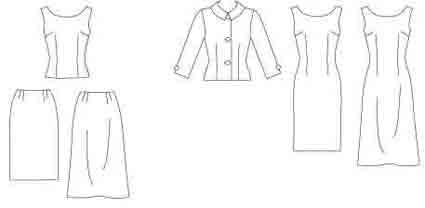
suit fabric : blazer jacket, straight skirt, pants.
dressier fabric : zip-front jacket, sheath dress.
lighter fabric : sleeveless top, a-line skirt (together make a 2-piece dress).
shirting fabric : shirt.

I reckon you can make 21 different outfits out of these, enough for every day of a working month. Add another blouse or shirt and that adds 9 more combinations.

Similar classic styles make the basis of many other published wardrobe plans. Such as Nancy Nix-Rice’s basic wardrobe, newsletter issues 21 – 28.

– – –

Reproducing the basic classic wardrobe

You only need a couple of wardrobe patterns and 4 fabrics.

Butterick 5760

”b5760-2”

darkest neutral suit fabric : jacket, skirt, pants.
lightest neutral shirting : shirt (shorten dress).
(the knit cardigan gets mentioned later)

Butterick 5147

”b5147”

mid neutral dress weight : top, a-line skirt.
mid neutral dressy fabric : jacket (made without collar and with zip front), sheath dress.

– – –

‘Modern classics’

There are versions of the classic styles which look more ‘modern’ because they are crisp, close fitting, a little edgy.

The Vivienne Files frequently suggests basic minimum wardrobe groups in ‘modern classics’ style.
For instance some of her recent posts are on wardrobe groups consisting of neutrals plus one accent colour :
– 5 core dark neutral garments (for her that’s usually 2 tops, 2 bottoms, dress),
– a couple of white or light neutral tops,
– an accent jacket,
– 6 other garments in accent colour.
That’s 7 neutral garments and 7 accents.

Example here. And some of her other posts : one, two, three.

This modern take on classics includes many knits. Her basics include tees, knit classic cardigans, and leggings as essentials.

Tees, both fitted and looser and longer. Many tee patterns of course, one is McCall’s 6491.

”m6491”

Knit cardigan closing to neck, see Butterick 5760, first pattern mentioned in this post.

Slim pants pattern by Palmer-Pletsch, McCall’s 6440 (seams down back, 4 hem styles).

”m6440”

Leggings : McCall’s 6360 is one of many leggings patterns, 4 styles 4 lengths.

”m6360”

The ‘modern classic’ style is essentially sleek and close fitting, crisp in wovens. If you’d like to explore beyond Big 4 patterns, look to :
Burda Style downloads
styleARC

Notice I don’t call these ‘young classics’, as anyone can wear them if you’re the right shape 😀

– – –

Doesn’t mean of course that you have to wear these styles, or be limited to colours of black, white, grey, and denim blue. . . [aargh, eek]

As frequently happens, I find myself thinking about classics because many people write about them, even though I never wear them myself.

Does the classic style make you feel your best ? or make you feel constricted and constrained and unable to be your true self ? It’s very interesting this. The Vivienne Files recently posted on her everyday basics here. I actually shuddered. She loves these, but if I had to wear them I would find it completely soul destroying. Even if they weren’t all black, they’re the wrong shapes and fabrics for me. Fascinating that people can be so different.

For those of us who never wear classics ? We have to do a bit of thinking outside the box to work out how wardrobe plans like this match up with our own needs.

I have a whole lot of reactions to all this, some of which I’ve cycled through many times before. As usual I feel so strongly about this I found myself writing several hundred words, so it’s become a separate post (here).

There’s much to enjoy here. I’m fascinated by clothes and style, and I enjoy looking at and thinking about the classics. But it’s definitely not a style for me to wear myself !

– – –

Patterns and links available April 2012

= = =