Archive for the ‘sewing’ category

Classic wardrobe for work, winter 2010 : waistcoat, blazer, coat

September 18, 2010

The UK ‘In Style’ October piece about clothes for work this winter includes mainly current versions of classic shapes. I’ve already suggested patterns for the skirt, dress, pants, and shirt.

This is about the waistcoat (vest), blazer and coat, which may need more advanced sewing skills.

– – –

Waistcoat (US vest)

A classic mannish style, v-necked and fitted. Worn a bit longer than usual, half way down the hips, if that length works for you. Fitted and over a soft blouse it doesn’t look masculine.

(There’s an excellent discussion about best proportions at Stitchers Guild.)

McCall’s 5186, View C for length.

”m5186”

This pattern has a lining.

– – –

Blazer

Not necessary to wear wide loose ‘boy friend’ shoulders if they aren’t for you, but the look is longer, just below the hips. Check which length is good on you. And make sure the jacket has enough ease to fit over your waistcoat or jumper dress plus blouse or thin sweater, if you need warmth.

Making a jacket which is an extra layer for warmth or more coverage needn’t involve any special sewing skills. Most jacket patterns are not for blazers but for soft ‘dressmaker’ styles which involve less, or at least no more, skill than making a shirt. And there are several patterns for jackets that can be sewn in a couple of hours (see speedy layers post).

Even making a blazer needn’t be a major investment in time. The Butterick 4138 2-hour sewing time jacket has no lining and no more interfacing than the usual blouse.

”b4138-2”

But a ‘proper’ structured blazer keeps it’s shape well, by using special support for lapels, collar, and sleeve heads, with 2-piece sleeves. And added layers, not only a lining but perhaps multiple interfacings and underlining. Making one of these does involve more skill. Sigrid has a whole section of jacket making tutorials.

There are 3 levels of difficulty for home sewers trying some tailoring, according to the book ‘Tailoring : a step-by-step guide’.

Start at the easiest level, using fusible interfacing, with the new version of the Palmer-Pletsch jacket, McCall’s 6172 which they claim takes 8 hours sewing time (after practice !). This has 3 lengths, if the longer length is not a good proportion for you.

”m6172”

Then if you want to, you can work through the levels of difficulty, using more complex support structures plus welt pockets and bound buttonholes, special pressing, and much hand sewing.

Your blazer fabric doesn’t need to match the skirt or pants, unless you have a very conservative work environment. Current jacket fabrics can have a low contrast woven pattern – check/ plaid or herringbone.

Substitute a long (thigh length) deep-V neck classic knit cardigan, or a high-hip length classic Chanel jacket (with a touch of waist shaping), if blazers aren’t for you.

Again, making a true-to-style Chanel jacket with all the quilting and weighting chains involves special couture skills. But there are easier patterns with the basic Chanel shape. Here’s one with waist shaping, Vogue 7975.

”v7975chanel”

– – –

Soft Classics

When you have the skills, you can make a major investment in time and beautiful hand stitching to construct one of Claire Shaeffer’s Couture jackets, perhaps Vogue 8333.

”v8333”

There are many subtle variants of the basic blazer shape. And many patterns. Here are some lovely designer patterns which need advanced sewing.

A skirt suit by Tracey Reese, Vogue 1126.

”v1126treese”

And pant suits by
Badgley Mischka, Vogue 1040

”v1040bm”

and Anne Klein, Vogue 1063.

”v1063klein”

There are a couple of issues with these patterns and some of the other blazer variants, which mean they may not fit in with the ‘In Style’ wardrobe.

One problem is they’re designed to look good when close fitting, worn perhaps over a camisole. They aren’t best suited to being expanded so they have enough ease to wear over several warm layers.

They also have little sign of the current edgey sharp cornered androgynous ‘boy friend’ shape of the ‘In Style’ wardrobe.

This doesn’t mean these styles are out of date. It’s just there are different versions of a ‘classic’ look. In his book ‘Metamorphosis”, David Kibbe separates traditional Classic from Dramatic Classic and Soft Classic, as 3 different personal styles. I would say the blazers in this section have the soft rounded curves of the Soft Classic look, while the ‘In Style’ blazer is crisper and more angular, a Dramatic Classic.

If you like more traditional Classic styles, look at Fashion Sewing Group patterns by Nancy Erickson. Or “The Classics” by Cecelia Podolak (on-line from Haberman Fabrics, more information at her site).

And also, ‘In Style’ is only giving one opinion about what to wear to look competent. In most types of work you don’t need to wear a blazer if you don’t like them. Cascade collar jackets and double breasted military style jacket are also current, if you do need a jacket.

– – –

Wool coat

‘In Style’ suggests a classic single breasted notched collar coat, a double breasted trench, or a double breasted pea-coat style with funnel collar. All are current. And all with a suggestion of waist shaping.

There are coat patterns which are quick and easy, especially casual coats made of thick fleece. But making a classic warm coat expected to keep its shape and looks throughout daily wear for several years is more of a commitment. There’s much guidance in a past coat sew along.

For a classic single breasted notched collar shape, there’s Vogue 1266.

”v2166coat”

Or for a double breasted trench, McCall’s 5525.

”m5525”

And a double breasted pea-coat style with funnel collar, such as Simplicity 2508 Project Runway pattern.

”s2508peacoat”

If you’re not comfortable in the formality of a classic coat, the more informal current outerwear styles are a parka or a duffle coat.

– – –

A good group of clothes for signalling that you’re both competent and current ! (in your sewing as well as your work :D)

Make a complete working wardrobe :
– several blouses/ shirts : plain, with frills, with a bow.
– pants, skirt, jumper dress.
– vest, blazer, Chanel jacket.
– coat.
Add a camisole, a couple of tees, some jeans, some fine classic sweater knits, perhaps a hoodie or jeans style jacket, and you’ll be covered for a lot more than just work.

What if you’re not by nature a ‘Classic’ ? Ignore fashion and use your favourite jewellery, scarves and laptop case. Adapt the classic style in current ways that are more ‘you’ :
– If you’re really a romantic, add frills or bows, embroidered embellishment, lace trim, or soft fabrics for the blouses, with kitten heels and textured bags.
– For greater comfort, make everything large enough to layer and move in easily, use plaids or herringbone weaves, wear quality classic fine knits instead of woven shirts, leather flat brogues or knee high boots (not real hiking boots !) and biker bags.
– For added edge, wear a leather garment, leather or metal trims and buttons, a shirt with asymmetric opening, or studs, buckles and grommets on bags and shoes.
– For more drama, go for this season’s high fashion thick soled shoes and big bags, or bigger shoulders, a statement necklace, and what can you do to liven up the linings of vests, jackets, coats !

Any non-extreme current style is worth investing time and effort in. Look at my post on the autumn/winter trends for 2009. The first 4 looks are still current. It’s only the extreme styles, aggressively pointed shoulders and tight corsets, that are not wearable any more. And happily there are now current softer ‘romantic’ styles.

Jill Martin, writer of ‘Fashion for Dummies’, says everything in your closet should score 10 / 10 for being right for you (oh dear, I wouldn’t have any pants to wear – someday soon I’ll get the ideal fit. . .) Personally I can give high scores to a classic skirt, classic pants, blouse, vest, trench, possibly a sheath dress, but I have a complete no-no about blazers and classic coats – anything with a flat notched collar. Would any of these styles score 10 / 10 for you ? Would they all score zero 😀

– – –

Patterns and links available September 2010

Classic wardrobe for work, winter 2010 : skirt, dress, pants, shirt

September 11, 2010

Despite the huge range of styles on offer in shows and magazines, this is a good season if you like classics.

UK ‘In Style’ October issue suggests mainly current classics for a wardrobe for work.

Classic styles look best if they’re impeccable. And when fitted shapes are fashionable that means good fit. So I mention several Palmer-Pletsch patterns. (I’m not a fan of tissue-fitting, but their instructions are also good for fitting a muslin.)

It’s surprising how good fit can make someone look as if they have no figure ‘faults’. While a bad fit – well, I live in an area of lawyers and bankers and, oh dear, the shoddy sights that appear during the lunch hour. . . somehow their clothes don’t leave me trusting their integrity or ability to care about detail. . .

Classic also implies long lasting ‘investment’ quality. Though the In Style styles have ‘current’ proportions and detail, most of them are likely to be around for some time.

In home sewing, quality means good fabric. And good sewing technique, not just the easy skills for sewing simple casuals.
I’ve divided this in two :
This is about the skirt, dress, pants, and shirt : intermediate dressmaking and fitting skills.
Next week for the waistcoat (vest), jacket, and coat, which in classic styles usually involve more advanced sewing

– – –

Camel skirt

UK In Style suggests a skirt can be pencil, A-line, or mini (not micro) style, so use your favourite silhouette and length.

Many people get better fit with a waistband or waist facing, rather than elastic. And that means sewing darts and in-seam zips. A quality skirt also has a lining.

These are basic patterns for the main shapes :
McCall’s 3830 straight.

”m3830”

Taper a longer skirt in a couple of inches (5 cm), for the ‘pencil’ look.

McCall’s 3341 A-line.

”m3341”

(Tip : if you have high hips plus an indented waist, to fit the waist use 2 or 3 small shorter darts each side, not one big one.)

The ‘current’ emphasis here is on the camel colour. But though camel is the season’s key colour, not to worry if it doesn’t look good on you. Grey is another major colour, and likely to be more flattering if your colouring is cool. More interesting combined with other greys, such as charcoal, dove and slate, rather than with black.

– – –

Black dress

No need to be put off by the focus on black – the key current look here is the shape, a sleeveless sheath, fitted, but loose enough to wear over a blouse in US ‘jumper’ style. In your best dark neutral.

”jumperdress”

Designers are looking for more ways of keeping warm than just putting on a sweater.

Skills : fitting challenges, facings, and perhaps a lining (so it will keep its looks longer).

For the most general fitting help, you might use the fitting pattern Butterick 5746, because it includes a sheath dress. Though the dress doesn’t have sleeveless or scoop neck versions, and would need adapting to fit over a blouse.

There are many sheath dress patterns in the catalogues. For fitting help you could use Palmer-Pletsch McCall’s 6028. Though with that upper body seam shaping, this is not the easiest of starting points for learning to fit. And not easy to sew those curved seams so both sides are the same shape. There’s an easier sheath dress in Palmer-Pletsch wardrobe pattern McCall’s 5818.

”m6028”

McCall’s 5927 is one of several sheath patterns with front pattern pieces for 3 or 4 cup sizes. It also has 3 sleeve styles, but not much other fitting help.

”m5927”

Many wardrobe patterns include a sleeveless sheath. Check if you need a larger size so it will layer comfortably over a blouse. Many of these styles have high scoop necks, so would not be good with a frilly front shirt.

If you’d like more ideas about this look, see the Cynthia Steffe show, which has many of these jumper dresses worn over shirts and sweaters. You haven’t got to wear a dress that short !

– – –

Peg top pants

These are pants that are loose on the hips and tapered at the ankle – specially for showing off the season’s amazing shoes. (YouLookFab calls these slouch pants.)

Add pant fitting, trouser pockets, and a fly zip to the sewing skills.

Here’s a designer pattern from Donna Karan, Vogue 1201.

”v1201pant”

Or Burda 7438 . . . . .Burda 7463. . . . Burda 7439.

”burdapegpants”

(Click on the PR image for a larger view. The only Burda site that works in my elderly browsers is in French :D)

– – –

Classic pants, current proportions

Obviously, the pants ‘In Style’ have chosen aren’t classics. So what can you do if peg top pants don’t suit your body shape, or you’re not comfortable wearing a high fashion style.

Follow UK Vogue’s pant suggestions for this year, as both are classic styles with current proportions.

The trouser style has an ‘easy’ loose fit over the hips, but falling to straight legged trouser shape. As in Palmer-Pletsch McCall’s 5239 View C.

”m5239”

This pattern gives advice about pant fit. It also works through a sequence of sewing skills as you make the 3 pant styles.

Often these looser pants appear in the shows with only a blouse, or a neat vest plus blouse. Jackets with them tend to be slim and long, either more structured with some waist shaping and perhaps a narrow belt, or soft and unstructured.

Skinny pants are another of UK Vogue’s choices – again classic style elements but this time with very slim proportions. I listed several patterns in my pant shapes post.

More possibilities : UK Elle is going for flares and bootcuts as pant shape themes for the season.

If you prefer classic shoes, rather than the current dramatic styles that peg top pants put on display, this season you can wear ballet flats, brogues, court shoes, or boots up to the knee.

– – –

White shirt

Blouses are a special item this season. Fitted and with a classic shirt collar. The key to being current is the added elements, perhaps some front frills, or back interest. Lots of bow collars.

To sew these does mean being able to fit sleeves and make buttonholes. Preferably also a shirt collar and cuffs. Sigrid has many links to tutorials on band collars and sleeve plackets. Though of course you can wear an easier to make convertible collar with a simple straight sleeve hem.

Butterick 5284 is just the thing.

”b5284-2”

If you need advice on fitting a basic style, try Palmer-Pletsch McCall’s 5630 (which includes a strip for an added bow).

”m5630”

For an attached floppy bow collar., here’s a attractive sleeveless designer top by Badgley Mischka Vogue 1127.

”v1127”

I haven’t found a current pattern for the classic big floppy bow collar on an otherwise basic blouse pattern.

Simplicity 2501 has a neat tie neck as seen in several collections.

”s2501”

Here’s a lovely version of a full bow collar from the early 80s, Simplicity 9581, to inspire us.

”simplicity-9581”

Perhaps I like the bows and frills because I’m small busted and best with upper body emphasis. Other body shapes may not feel the same enthusiasm for big additions 😀

The easiest bow – just tie a ribbon under the collar, in a different though neutral colour. The simplest matching bow is a strip of self fabric to tie under the collar (as in the Palmer-Pletsch pattern). Try different widths of strip and lengths of bow loops and ends, to find what looks best on you. Experiment with how long the bands need to be to get a bow you like.

With a little more effort, devise an attached bow collar from a pattern with band collar (there’s one in the Palmer-Pletsch pattern). Simply widen and extend the band (use only the softest fusible interfacing if any).

If white doesn’t flatter you, don’t despair. Cream, nude shades, and muted pastels are all current. Or a darker shade is another current look. A touch lighter than what’s layered over it.

”darkblouse”

In this outfit, the vest fabric is a 2-tone weave and the blouse is a 2-tone print. A sophisticated idea.

– – –

Next week I’ll be finding patterns for the classic waistcoat, jacket and coat styles suggested by UK ‘In Style’ for a work wardrobe.
UK Elle also says it’s a season for classics and tailoring.

And don’t forget this is only one possible take on the many trends this season – good if you like classic styles, but you haven’t got to wear them if you
don’t 😀

– – –

Patterns and links available September 2010
Photos from oldpatterns.com and UK In Style.

Sew a Wardrobe in a Weekend : layers and capsules

June 19, 2010
At last, the super quick layers needed to complete a speedy wardrobe.

I’ve already posted about time-limited patterns for wardrobes, dresses, tops, and bottoms. Here’s the next step, some time-limited patterns for vests, jackets, and coats. A good range of styles from casual to classic. There are also some jackets in the speedy wardrobe patterns posted earlier.

Interesting, these jackets suit a wide range of body shapes. Not just for rectangles, there are shaped waists for people who have them, and flared styles for the pear shaped.

Pick a jacket, top, and bottom from these super quick patterns to make a ‘capsule’. For most of us that would be a considerable achievement in one weekend. Can we leave aside for the moment the aim of making a whole wardrobe in a weekend 😀

– – –

Vests

McCall’s 2260 has several unlined classic vests which take 1 hour of sewing time.

”m.vests”

Butterick 5888 is for similar vests in 2 hours. In the extra hour you can make a faced notched collar or an edge-to-edge lining.

”b.vests”

What about my favourite layer – tunics ? I haven’t found any timed patterns specifically for tunics. But several of the super quick dress patterns include a tunic length version, or could easily be cut to that length. Check if you need to make a larger size so it will layer comfortably over tops (see ease post).

– – –

Soft Jackets

Butterick 5394 is for 2 hour knit cardigans.

”b.5394”

Butterick 5224 has more 2 hour knit styles.

”b.5224”

McCall’s 5241 1 hour knit cascade style jacket has 3 front lengths all with the same back (the only 1-hour jacket pattern I found).

”m.5241”

Butterick 4989 has an interesting choice of 2 hour cascade/ waterfall jackets – this time for wovens.

”b.4989”

– – –

Blazers

The pattern companies also think it’s possible for us to make more formal styles in a short time.

Butterick 4138 even has a classic unlined blazer pattern they say can be made in 2 hours ! There’s a choice of pocket styles and long or short sleeves.

”b.4138”

You could also round the corners of collar and hem. Or leave off the collar and use your favourite neckline (see neckline post).

At the ultimate, on their website Palmer-Pletsch claim their tailored lined blazer McCall’s 4598 takes only 8 hours to make. (This will be replaced by McCall’s 6172, available July 1.)

”m.4598”

These two patterns show you can add some shaping even if you’re sewing quickly.

– – –

Outerwear

oop Butterick 5089 is a 2 hour pattern for an unlined cropped jacket with cut-on sleeves. Lengthen it for a bit more warmth, and to be more flattering for some of us. Waist length jackets (or just above it) are ‘in’ for the coming winter season.

”b.5089”

McCall’s 9576 is a ‘relaxed classic’ 2 hour reversible shawl collar jacket.

”m9576”

McCall’s 5988 is a 2 hour reversible coat in 2 lengths.

”m5988”

McCall’s 3448, the easiest, is for 1 hour ponchos.

”m3448”

– – –

Some Speedy Capsules

Evidently you can include making your winter coat in your speed sewing weekend 😀

And you could make a blazer along with your winter coat, right. . .

If you prefer more formal styles, make the Palmer-Pletsch McCall’s 4598 8-hour blazer, one of their 3-hour shirts (McCall’s 4079), and a pair of their oop McCall’s 4459 3-hour pants. All in one weekend of course 😀

”pp.capsule”

I think Sue Neall, the expert whose wardrobe-in-a-weekend inspired these posts, could manage to sew those in a weekend, if it was her style. She chose a softer pattern which would not be quick and easy for many of us (Adri oop Vogue 2910). She was making a wardrobe for a week when she needed to look competent but friendly rather than authoritative and powerful.

We slower sewers might pick three 1-hour patterns so we could cut and sew a capsule in a day. . . er. . .

A ‘classic’ capsule from the super quick patterns could include the Butterick 4138 2 hour blazer, one of the Butterick 5948 2 hour tops, and a pair of Butterick 5044 1 hour straight legged pants. Oh dear, that gets it up to 5 hours of sewing time 😀

”classic.capsule”

There’s a good choice of jackets for a softer look. Perhaps a Butterick 4989 2 hour jacket, a camisole from the same pattern, and a pair of McCall’s 5889 1 hour pants.

”soft.capsule”

Or the timed wardrobe patterns are supposed to take less than 6 hours to sew a basic capsule.

It would certainly be pressurised to sew one of these capsules in a day. Me, I prefer to stay calm. . . but it’s interesting and fun to think about the possibilities !

You could use 2 days of a holiday weekend to make two capsules. And spend the third day making a coat, dress, and skirt. In 3 speedy days, you’d have a proper ‘wardrobe’ of 9 items to cover most eventualities 😀

Kate Mathews in ‘Sewing a Travel Wardrobe’ suggests you make jacket, pants, dress and skirt from the same fabric, for easy co-ordination. She calls this a ‘Six yard wardrobe”. That would speed up cutting and sewing a bit more.

Goodness, you might even have enough time to make one of the oop Butterick 5055 2 hour bags. . .

– – –

Patterns and links available June 2010
Sew a wardrobe in a weekend : skirts and pants

June 6, 2010
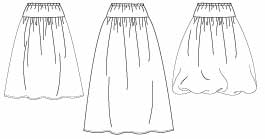
Sewing a wardrobe in a weekend ? Here are some skirts (a surprising number of skirts) and pants which the pattern companies think we can sew in 1 or 2 hours.

From plain to frivolous. Even the fanciest of these skirts will go with most of the tops in my previous post. Though it wouldn’t be to everyone’s taste to wear them with all the speedy jackets in my planned post on layering pieces.

There are also several super quick skirt and pants patterns in the wardrobe patterns I listed earlier.

– – –

A Skirt in One hour

Many people start their dressmaking career with a dirndl skirt – cut a strip across the width of fabric, sew it into a tube, and turn over top and bottom for elastic waist casing and hem. If I was really under pressure I think even I could do that in less than an hour. If you’d like some helpful guidance with this, there’s Kwik Sew Kwik Start 3765.

Simplicity 2368 is a 1 hour of sewing time skirt pattern including dirndl and 4 gore styles.

”s2368”

There are some interesting possibilities that take 1 hour of sewing time, though they do need more sewing skills.

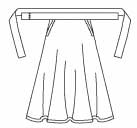
McCall’s 5430 is a 1 hour wrap skirt with ties.
”m5430”

oop McCall’s 3145 is a 1 hour sarong style wrap skirt.

”m3145”

Silhouette 2050 is a wrap skirt with darts and button closure but no vertical seams, which they say takes 1 hour.

”sil2050”

Simplicity 2611 is a 1 hour pattern for skirts and pants.

”s2611”

– – –

A Skirt in Two hours

There are several oop skirt patterns which show what the pattern companies think you can achieve if you can spend twice the time on your sewing.

There’s even a classic skirt with a fitted waist. oop McCall’s 2029 thinks we can sew darts, zip and waistband in 2 hours.

”m2029”

There’s also a skirt with a side opening : oop McCall’s 4875 flared skirt.

”m4875”

The other 2 hour skirts all have elastic waists. They use the extra sewing time on more complex pattern pieces.

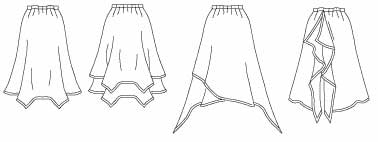
oop Butterick 5043 is for 2 hour tiered skirts.

”b5043”

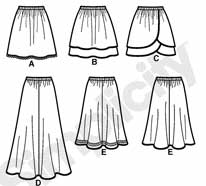
oop McCall’s 5140 has lots of 2 hour flared skirts.

”m5140”

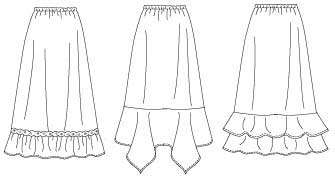
oop Butterick 4993 has 2 hour skirts with added frills and flounces.

”b4993”

– – –

Pants

The super quick and easy pants all have elastic waists.

McCall’s 5889 pattern for 1 hour tapered leg pants includes several lengths. Leave off the lower casing if that doesn’t suit you. If you’re not using a soft drapey fabric, you may find you need to cut a smaller size at the side seam, as there is a lot of fabric over the hips.

”m5889”

If you prefer a straight leg, there are many possibilities. It must be difficult to have a pattern stash without acquiring several elastic waist pants patterns.

Butterick 5044 are one-seam straight legged pants said to be very easy.

”b5044”

I know many people love one-seam pants. I’ve made these and they are very quick. But I have a curved hip silhouette, and one-seam elastic waist pants really are not flattering on me. I need a side-seam to echo my shape. What’s best for me is a properly fitted waist with zip, but I’m yet not up to making them in a couple of hours !

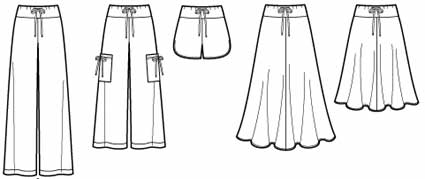
Butterick 5153 has similar 1 hour drawstring pyjama style pants and shorts, sized for all the family. McCall’s 6129 is for 1 hour shorts, again for all the family. McCall’s 6082 is a 1 hour pull-on pant pattern for knits from Palmer-Pletsch.

For ‘proper’ pants, there’s even oop McCall’s 4459, a Palmer-Pletsch pattern for 3 hour classic pants.

”m4459”

– – –

The super quick patterns are not to everyone’s taste. And elastic waists are not the most flattering fit for anyone with an indented waist. All those bumps over your curves (and in my case adding to my high hip lumps. . .) If you have an indented waist and want to make quick bottoms, you pretty well have to wear elastic waists under a loose fitting top. Or use very soft fabric with no body, so the gathers lie flat instead of bubbling up. But these patterns do show the sort of processes you can use if you want to finish speedily.

oop McCall’s 2029 is a pattern for a skirt with darts, zip, and waistband, in 2 hours of sewing. Obviously they think those processes will only take you one extra hour of sewing. Is this actually possible ?

I’ve been timing myself, and think I take at least twice as long to sew than these patterns suggest. Also I’m very slow at cutting out. So I think I would allow myself at least one day to make something the pattern companies say takes one hour. But I’m ultra slow. No doubt many people could do it without difficulty in half a day 😀

– – –

Patterns and links available June 2010