Archive for the ‘fit + patterns’ category

Getting to know my sizes

November 26, 2011

Many surprises when I started exploring pattern blocks earlier in the year. One was that many methods of drafting patterns to individual measurements assign half your bust/ waist/ hip measure to front and half to back. Surely not, I thought. And indeed it isn’t true for me.

Some pattern making books do include front-back differences. I’m using :
Knowles. Pattern making for fashion designers : juniors, misses, and women.
Allemong. European cut.
Liechty, Rasband, Pottberg-Steineckert. Fitting and pattern alteration (hurrah, my birthday present this year).

– – –

Taking my measurements from waist to thigh

Wearing leggings and tank, I rigged myself up with :
– horizontal velcro tapes at waist, high hip, hip.
– vertical tapes at CF, side seam, and CB.

Needed to adjust the position of the side tapes so they :
– looked from the front as if they were at the edge of my body.
– looked from the side as if they roughy divided the area of the body in half.

No photos – I haven’t got a leotard, so it was all rather untidy !

I don’t attempt to measure to an accuracy of 1/16 inch or 1 mm, as BML tells you to. Impossible accuracy with a soft flexible body. It’s easy to change the measure much more by a slight change in tension of the tape measure or posture of the person being measured.

I know 1/8 inch can make a difference to the quality of fit. But that’s in fabric being tried on. I aim for measures to the nearest 1/4 inch/ 0.5 cm. Details to be adjusted on the ‘muslin’.

– – –

The results

My total waist measure is 33-1/2 in., total hip 43-1/2 in.
Both Big4 pattern size 18.
Apparently no problem there then.

But look at the details and a very different picture emerges :
. . . . . . . . . front . . . . back . . . . total (inches)
waist . . . . 19 . . . . . . . 14-1/2 . . 33-1/2
high hip. . 20-1/2 . . . 21 . . . . . . 41-1/2
hip . . . . . . 20-1/2 . . . 23 . . . . . .43-1/2

(Sitting hip 46 in., important to know for ease allowance.)

Interesting, I still have a waist at the back, but there’s all that stomach sticking out in front. Yes, it does go in and out daily.
And my high hips are important, so :
– darts below waist need to be short, and mainly at the back.
– below high hip there’s little change.
My high hips are about 3-4 inches below my waist. But as I have a tilted waist (higher at back due to high hip pads), a level high hip is not the same distance below my natural waist all the way round.

Double those measures – so these are just imaginary numbers, assuming my back and front are the same :
. . . . . . . . front . . . back (inches)
waist . . . . . 38 . . . 29
high hip . . . 41 . . . 42
hip. . . . . . . . 41 . . . 46

Comparing those numbers with the BMV size table, that means my pattern size is/ are. . . (I’ve added bust here, I knew this before.)

. . . . . front . . . . back
bust . . . . 14 . . . . 16
waist . . . 24 . . . . 14
hip . . . . . 16 . . . . 22

Eeek ! no wonder I’ve never been able to wear a sheath dress or a leotard 😀

I’ve still got an indented waist in silhouette from the front, but have difficulty fitting it. Easiest with a waist seam, which isn’t usual in a blouse. I’m sure it is possible to get princess seams to fit me well at the back, but I haven’t got round to it.

Here’s my personal waist-to-hip pattern which shows the different front (right) and back shapes.
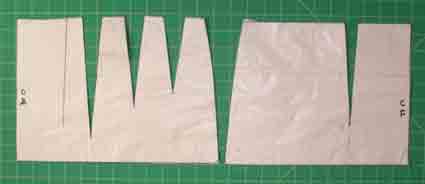
”hip-templates-web”

These measures helped me understand much, but they don’t give the complete picture. My front waist and hip measures may be similar, but I’m not the same shape all the way down – forward spreading waist becomes hips spreading sideways. Visually, my widest hip is lower in my silhouette from the front than it is in my silhouette from the side. And unlike my stomach, that large back is just generally large, not protruding.

Don’t even try to imagine what I look like in a RTW fitted jacket !
Though I do promise I have never bought one 😀

Some people need front bigger than back below the waist. Sandra Betzina ‘No Time to Sew’ p.15 says she cuts a size 14 pants front and size 10 back.

Above the waist, I have small bust and wide back. Many people have larger upper front than back. FBAs need to be adjusted for personal shape and ease preference. See my post on the FBA for some comments.

– – –

Other special features of my shape

Here are some other features of my body, as described by Liechty et al.

Short lower rib cage/ high waist.
short between armhole and waist

High neck base.
similar to sloping shoulders but I think this is more ‘me’.

Forward head.
raise back neckline, lower front neckline

Shallow chest.

Low bust position.

Rounded upper back.
Shoulder darts essential

Cylindrical upper torso.
Scoop out armholes sideways. I haven’t got large biceps but do need a large armhole. I’ve learned to check cut-on sleeves to make sure they’re not tight.

Larger elbows.
Don’t know if my bones are large, but I do like to be comfortable when I bend my arms.

Longer lower torso.

Cylindrical lower torso.
long crotch shelf/ extensions on pants

Here’s some things which affect style rather than fit :
– I’ve recently realised my forward head has made my neck go visually from long to short.
– lumpy knees (hereditary) and thick ankles.
I have got good features too 😀

– – –

Implications

No I don’t look like a freak.
But RTW doesn’t look good !

And, with so many non-average features, no wonder I find it easier to get good fit by starting from my personal pattern block and adding style elements to it. Rather than starting from a commercial pattern and making all these changes.

I don’t think all this self awareness gets you out of making a trial garment. Even when you’ve gone through the pattern-muslin-pattern-muslin cycle several times and have a good fit, it’s best to check that length, ease, and style elements such as collar shape, pocket placement, etc. are flattering.

Also best fitting method depends on personal preference. I don’t at all enjoy tissue fitting. I prefer working direct with a muslin, ‘reading the wrinkles’. Rather than trying to get all the adjustments done accurately to the pattern before ever trying something on.

But many people love ‘Fit for Real People’, and tissue fitting, and not having to make a muslin. So try different methods to find what you prefer. Every little step is an improvement 😀

– – –

P.S. There have been so many comments about this, perhaps I’d better add some more :

I’d like to to encourage people who have unusual fitting challenges. Of course it’s marvellous if you find commercial patterns which are close to your body shape, or a fitting aid which works for you. But there are people who have too many features away from average for that to be possible. And many of those special features aren’t dealt with in the pattern making books which claim to tell you how to draft a personalised pattern.

I’m not so analytic about all this when I do the actual fitting. I fit by ‘reading the wrinkles’ on a muslin. I make no attempt to resolve all my fitting issues one by one on the pattern before cutting out.

Though there are many fitting issues which need a rough change to the pattern before cutting the fabric, or there won’t be enough fabric available to make the detailed adjustments. (Though if you make a muslin, you can slash and spread on the body to add the wedges of fabric needed.) Such as a long body, or square shoulders, or a large bust cup, or protruding front and rear when fitting pants. Or different sizes front and back, above and below.

And I am the sort of person who likes to understand what I’m doing. For example, I need a personalised armhole to be comfortable. Liechty et al is the only book I know which explains what it is about my body which makes this necessary, and what to do about it.

– – –

Patterns and links available November 2011

= = =

‘Multi-block’ patterns

November 19, 2011

Most patterns with different styles make variations on the same main pattern pieces, such as changing length, collar, trim, perhaps sleeve shape in the same armhole. There are many examples in my posts on new patterns this autumn, in businesslike and casual styles.

What I’m talking about here is styles so different in shape that they need different main pattern pieces. These basic pattern pieces are called ‘blocks’.

I’m not talking about wardrobe patterns – obviously those include top/ jacket/ pants blocks, etc.

What features would you like in your collection of basic patterns ?
– armhole : fitted, drop shoulder, raglan, cut on sleeve.
– body shaping : darted, shoulder princess, armhole princess, side panel, wrap, casual-dartless either straight or flared.
– knits, wovens.
– amount of ease : close fitted, fitted, semi-fitted, loose fitting, very loose fitting.

– – –

Jackets and coats

Simplicity 1943 boleros are all dartless, but have different sleeves and body shapes. One (right) has cut on sleeves. The others have set in sleeves with different bodies : one with flared body and flared sleeves, one with straight body and gathered sleeve cap. Simply lengthen these to get many more styles.

”s1943”

Simplicity 2154 has two dartless block jackets with different sleeves. One is set in, the other has a cut-on upper sleeve with side panel below.

”s2154”

Simplicity 2208 is for fleece jackets. A dartless flared jacket with slightly dropped shoulder sleeve and either a drape front or big collar. And a raglan princess hoodie.

”s2208”

Simplicity 2150 is for jackets and coats. Two jackets based on the same princess block with different centre front panels. And two dartless styles – jacket size with set in sleeve, or coat size with cut on sleeve.

”s2150”

Simplicity 2285 has two raglan sleeve styles, a jacket and cape. Also a princess jacket with set in sleeves, and a dartless vest.

”s2285”

– – –

Tops

There are many top patterns with ingenious variations in collars, cuffs, lengths, trims etc. But few include different blocks.

Butterick 3030 is for easy dartless tops with raglan, cut-on, and dropped shoulder sleeves.

”b3030”

Butterick 5526 is for classic shirts, with dartless and fitted princess bodies.

”b5526”

Simplicity 1945 is a wardrobe for knits by Khaliah Ali. A raglan sleeve top with cowl neck, and a set in sleeve top with side drape front. Plus a simple jacket with cut on sleeve and cascade front. (Pattern also has simple soft skirt and pants.)

”s1945-2”

– – –

Skirts

There are several skirt patterns which include both straight and a-line skirts. And 4, 6 and 8 gore skirts. Those may be the first things you learn if you take a pattern making course.

McCall’s 6402 is more interesting, with shaped seam, pleated, and drape front styles. Girly at this length. Make it longer if you prefer !

”m6402”

– – –

Pants

There are several pant patterns with both loose and close fitting styles, which have a different cut. A couple of examples :

Butterick 5502 has both leggings and elastic waist pants.

”b5502”

McCall’s 6403 has both straight and fuller leg styles.

”m6403”

– – –

Sorry I haven’t found any dresses ! Doesn’t mean there aren’t any, but they do have much bigger pattern pieces so perhaps are less likely.

Do any of these block collections meet all your styling needs 😀

– – –

Patterns and links available December 2011

= = =

‘Fit to Flatter’ by Amy Herzog

November 5, 2011

October 2016. Amy Hertzog’s on-line tutorials are no longer available. She now has a book, Knit to Flatter, and a Craftsy class, also Knit to Flatter. She gives much detail about hand knitting, but the general ideas apply to all garments. This post has some comments on applying the ideas to dressmaking patterns.

Amy Herzog’s tutorials are a marvellous series about the style elements that flatter and don’t flatter different body shapes. And how to make fit changes.

It’s for knitters, but most is relevant to dressmakers. We have similar basic problems :

– We can’t try something on until it’s partly finished. So how do we know beforehand that we aren’t wasting our time, effort, money, and beautiful materials on making something that looks marvellous on the model and dreadful on us ?

– Most of us have body features that are not ‘average’. How can we alter an ‘average’ pattern so it fits us better ? This is actually easier for dressmakers – we just have to alter the paper pattern. We don’t have to calculate the details of stitches and rows.

In this series there are excellent photos of real people wearing right and wrong shapes (generous of them to show that). Especially tops and casual jackets. The examples are hand knits, but the advice about styling and shaping applies to any clothing, made or bought.
So read “dressmaker” instead of ‘knitter’ and “top” instead of ’sweater’.

Full of ideas and inspiration 😀

– – –

1. Introduction

2. Shapes
Types of body shape and suggestions about what flatters them.

3. Mindful project choice
Starting from body shape and showing what styles do and don’t look good.
Also starting from patterns and suggesting body shapes they look good on.

4. Sweaters [tops] and you
Use photos to identify your body shape.
Take interesting measurements.
Some comments on easier and more difficult pattern changes.

5. Necklines
Advice on necklines that flatter different body shapes.
Instructions for changing width and depth of neckline in knitting patterns.

(Knit stitches are not square, which adds complications. This is why she mentions ’knitters graph paper’. There are web sites where you can enter the number of stitches and rows to the inch/ 10 cm for your knitting yarn. The site produces graph paper with those proportions. You draw your required shape, with the natural proportions, on the graph paper. And use that to count how many stitches and rows you need to knit the shape.)

For suggestions about changing necklines in dressmaking patterns, see my necklines post.

6. Sleeves
Flattering length, width, and shape of sleeves.
Again the instructions section is about knitting.

For dressmaking patterns, it’s usually easy to change sleeve length.
To change sleeve width or shape which involves changing the armhole, it’s easiest to substitute the sleeve from another pattern. Match up the centre lines and shoulder seams of the 2 patterns and trace the armhole across. If you use the correct armhole for it, you won’t need to change the new sleeve.
If you want a wider sleeve without changing the armhole, most fit books tell you how to alter sleeve biceps width without altering the sleeve cap length. Or simply use a larger size sleeve from the same pattern, with the armhole to match.
Brensan Studios Shirt Club are patterns you can swop sleeve styles between as they have the same armhole.

7. Length
Where best to put the horizontal lines on your body.
When she says to use ’short rows’ if you have a tummy, she means add a downward curve to the centre front hem.
The section on pattern modifications uses measurements of the lengths of your body sections (taken in Section 4). So it applies to dressmakers as well as knitters. Guidance about where you need shaping darts.
For me it’s important to know about my high hips (circumference, and distance below waist) as well.

8. Shaping
Where you need darts, and how large to make them. Advice that’s the same for dressmakers. Good on shaping for the back – I recognise myself here.

When she tells a knitter to use short rows, it’s a way of adding length at the centre of a garment piece without changing the length of the side seams. Dressmakers achieve the same result by adding horizontal darts from the side seams.
Do you know how to add darts to a dressmaking pattern? It’s often easier than in knitting. Perhaps easiest to learn by experimenting with a trial garment to find what works for you.

She thinks we all look best with waist shaping in our clothes. Yes, in an ideal world. But in winter I wear so many layers that looking more shapely than a box really isn’t an option 😀

9. Implementation
Making your custom styled top pattern.
Choosing the best style elements for you from all the previous sections : this is the same process whatever the source of your clothes – knitting, sewing, RTW.
The measurements section is also relevant to dressmakers. Though do add bigger ease levels if your pattern is for woven rather than knit fabrics.

There’s a section for knitters on doing the pattern calculations. This is the only section in the whole series where there’s not much for dressmakers.
For dressmakers it’s the usual strategy :
– develop well fitting personal basic pattern blocks, or learn what changes you need to make to commercial patterns.
– learn how to transfer style elements from one pattern onto another.

10. Conclusions
Review, plus ideas on how to use favourite style elements from any pattern in a way that’s best for you.

(Ravelry is a huge site for knitters. Somewhat akin to Pattern Review.)

– – –

Amy mentions light/ dark colours but otherwise says little about colour, which for me is very important in getting a flattering result. But there are many interesting tips and helpful comments in all this. You do sometimes have to make an effort not to be distracted by details about knitting. But the general principles are the same for all clothes makers. Recommended 😀

All the recent wardrobe planning reminded me how much I like sweater knits. But the simplest sweater patterns are basic rectangles, which are not good on my pear shape. So this Fit to Flatter series is just what I need.

It is very relevant to choosing flattering style elements for anyone. And for making appropriate pattern alterations in dressmaking as well.

– – –

Links available November 2011

= = =

North American independent pattern designers update

July 23, 2011

There’s a modern list of independent pattern companies here :
A-H
I-P
R-Z

Diary of a Chain Stitcher is a blog which publishes a monthly post on new indie pattern releases.

– – –

Here’s an update of the list of North American ‘independent’ pattern companies. This is now updated with new companies whenever I come across them. (P.S. late 2016 – I long ago gave up trying to keep track of all the US indie pattern companies, which come and go daily, though I do make note of European ones whenever I come across them – see right menu.)

I haven’t included companies which only have 1 or 2 patterns. Or aprons, or bags, or for children, or all the patterns for historic specialists or lingerie.  Or people who re-design sweat shirts. I had to stop somewhere ! I don’t think it’s humanly possible to make a complete list – companies are always coming and going.

The European and Australian pattern companies I know of are listed in this blog right hand menu (click on red header to get to main blog if the menu isn’t showing – though you’ll loose this post if you do that !).

There are many exciting pattern discoveries 😀

– – –

Akasha – Andrea Steele
akashaclothing.com

Alternatives – Shirley Adams
sewingconnection.com

Amy Butler
amybutlerdesign.com

Anna Maria Horner
annamariahorner.com

Back Porch Press
backporchfabrics.com

Barb Originals
barboriginals.com

Birch Street Clothing
birchstreetclothing.com

Bootstrap Fashion – download patterns up to 34W with some size customisation, can be altered in Adobe Illustrator
bootstrapfashion.com

Boutique Chic – see Serendipity Studio

Brensan Studios
brensan.com

Brown Paper Patterns – Barbara Allen
brownpaperpatterns.com

Carol Lane-Saber designs
saberdesigns.cc

Christine Jonson Patterns
cjpatterns.com

Classics, The – Cecelia Podolak
ceceliapodolak.com

CNT Pattern Co.
cntpattern.com

Colette Patterns
colettepatterns.com

Controlled Exposure – outdoor gear
controlledexposure.com

Country in the City
161.58.115.112/wearable_patterns.htm

Cutting Line Designs – Louise Cutting
fabriccollections.com

Cynthia Guffey
cynthiaguffey.com

Dana Marie Design Co. (was Purrfection) – Dana Bontrager
danamarie.com

Darlene Miller
darlenemillercloz4u.com

Dawn Anderson Designs
dawnandersondesigns.com

Decades of Style
decadesofstyle.com

Design and Planning Concepts – Nancy Mirman
designandplanningconcepts.com

Disparate Disciplines
disparatedisciplines.com

Elements – Linda Kubik, especially for handwoven fabrics
lindakubik.com

Encore Designs – Debbie Walkowski
voguefabricsstore.com

EvaDress
evadress.com

Fashion in Harmony – bias cut designs from Julianne Bramson
fashioninharmony.com

Fashion Patterns by Connie Crawford
fashionpatterns.com

Fashion Sewing Group – Nancy Erickson
fashionsewing.com

Favorite Things
favoritethings.net

Fehr Trade – workout wear
fehrtrade.com

Fit for Art Patterns
shop.fitforartpatterns.com

Folkwear Patterns
folkwear.com

Four Corners
fourcornersdesigns.com

Gail Patrice Design
gailpatrice.com

Grainline Gear – Lorraine Torrence
lorrainetorrence.danamcoweb.com

Great Copy
greatcopy.com

Green Pepper – active outdoor wear
thegreenpepper.com

Hot Patterns
hotpatterns.com

Indygo Junction
indygojunctioninc.com

Islander – mainly men’s shirts
stores.intuitwebsites.com

Jalie
jalie.com

Jamie Christina
jamiechristina.com

Jean Hardy – equestrian
jeanhardypatterns.com

J.Stern Designs – Jennifer Stern
cinematicweddingstory.com

Kayla Kennington
kaylakennington.com

Kosher Patterns
kosherpatterns.com

La Fred – Fred Bloebaum
lafred.com

Laughing Moon – JoAnn Peterson
lafnmoon.com

Liesl & Co. – easy download patterns from Liesl Gibson
oliverands.com

Lila Tueller Designs
lilatuellerdesigns.blogspot.com
see lower right menu

Lingerie Secrets – Jan Bones
sewinglingerie.com

LJ Designs – Lyla Messenger
ljdesignsonline.com

Loes Hinse Design
loeshinsedesign.com

Loes Hinse Studio– recent patterns
casualelegancefabric.com

Lorraine Torrence Designs
lorrainetorrence.danamcoweb.com

MacPhee Workshop – Linda MacPhee
macpheeworkshop.com

Maggie Walker Design
maggiewalkerdesign.com

Mary’s Patterns
maryspatterns.com

Material Things – Cecelia Podolak
ceceliapodolak.com

Megan Nielsen – including maternity
megannielsen.com/

My Sister’s Patterns
mysisterspatterns.com

Paisley Pincushion
paisleypincushion.com

Pamela’s Patterns
pamelaspatterns.com

Paradiso Designs – Cheryl Kuczek
paradisodesigns.com

Park Bench Patterns – Mary Lou Rankin
parkbenchpatterns.com

Past Patterns – historic
pastpatterns.com

Pattern Studio – hats and gloves
patternstudio.com

Pavelka Design
pavelkadesign.com

Petite Plus – Kathleen Cheetham
petitepluspatterns.com

Quilted Closet, The – Elaine Waldschmitt
quilterswarehouse.com

Rag Merchant – Jill Mead
shiboridragon.com

Rainshed – camping gear
therainshed.com

RDKC – Rachel Clark
rdkc.com

ReVisions  – Diane Ericson
dianeericson.com

Round Earth Publishing – martial arts and cosplay
round-earth.com

Saf-T-Pockets – Marsha McClintock
saf-t-pockets.com

Skinny Bitch Curvy Chick – petite patterns, paper or download
sbccpatterns.com

Seamster
seamsterpatterns.com

Serendipity Studio – Kay Whitt
sewserendipity.com

Sewaholic patterns pear-shape sizing, sew-alongs. Best pattern company at Pattern Review in 2012.
sewaholic.net

Sew Chic – retro
sewchicpatterns.com

Sewgrand
sewgrand.com

Sewing Workshop, The – Linda Lee
sewingworkshop.com

Sewn Square One Patterns
sewnsquareone.com

Shapes – Louise Cutting and Linda Lee
sewingworkshop.com

Silhouette Patterns – Peggy Sagers
silhouettepatterns.com

Sisboom – downloadable pdf patterns
sisboom.com

Storm Mountain Designs – active outdoor gear
therainshed.com

Stretch and Sew
gmidesign.com

Suitability – equestrian
suitability.com

Taylor Made Designs – Cindy Taylor Oates
taylormadedesigns.typepad.com
pattern books listed in menu at right

Textile Studio Designs
textilestudiopatterns.com

The King’s Daughters – Modest Sewing Patterns
modestsewingpatterns.com

Thread Theory – download patterns for men
threadtheory.ca

Tina Givens – paper and download
tinagivens.com

Trudy Jansen Design
trudyjansendesign.com

Tu-RIGHTS – for special needs
tu-rights.com

Unique Patterns – drafted to customer’s measurements
uniquepatterns.com

Victoria Jones Collection – Hawaiian
victoriajonescollection.com

Victory Patterns – Kristiann
victorypatterns.com

Wearing History – 30s and 40s
wearinghistorypatterns.com

– – –

Have fun finding designers who share your personal style 😀

With special thanks to other people who have made pattern link lists. One was from the ASG, another I saved 3 years ago has no name or source with it. And thanks to all who post at Pattern Review.

I’ve written some previous posts on independent pattern designers.
The first suggests European sources for North American patterns, plus a little about pattern magazines.
The second focusses on new generation designers.

If you want patterns for historic re-enactment or cosplay, here is a place to start : Great Pattern Review (reviews only – recommendations and warnings), or their earlier sources of patterns (links).

For a list of software companies, see my pattern making software post.

Enjoy !

– – –

Big Companies – in case you don’t know where to find them 😀

Burda (Germany)
Burda Style (US)
Butterick
Kwik Sew
McCall’s
Neue Mode
Simplicity – New Look
Vogue

– – –

Links available July 2011

To get to the main blog, click on the red header.