Archive for the ‘fit + patterns’ category

Pattern making – easier fitting shell

June 4, 2011

An updated version of this post is in my free .pdf
e-Book on Personal basic pattern making blocks.

P.S. 2020. This post is about all the different types of methods for getting a well fitting bodice block. I did eventually get my own a couple of years ago from Brookes Ann Camper’s Top Class, which uses a combination of drafting and draping.

– – –

I’ve already described (here) the textbook approach to pattern making : draft the pattern for a closely fitting shell, then use that as the basis for pattern alterations.

This post is about ways of getting a good-fit starting point. The ‘official’ method is to take your measurements, then draft a pattern from scratch on a blank piece of paper. But the aim is to get a well fitting basic. And there are much easier ways of achieving that.

You can :
– use simpler methods for measuring and drafting.
– take the measurements and let someone else do the drafting.
– get a fitting shell without drafting, and no more measurements than you normally take when choosing a pattern size.

Reminder : I’m using these word meanings :
‘fitting shell’ : a basic closely fitting pattern. The same shape as the person it’s for, with little movement ease and no design features. Not usable directly as a garment pattern.
‘block’ : basic starting pattern for a type of garment, with the usual ease and style elements. Such as a basic fitted blouse or casual jacket.

Yet another note :
All these simplifications make some assumptions.
Some of these methods make very simplified patterns.
All of them include some wearing ease. So they make assumptions about the clothes you want to make.

Many people, especially custom dressmakers, like to make a fitting shell which is a ‘second skin’. Enough ease to breathe, but no assumptions about how loose the garments made from it should be, how much stretch there will be in the fabric used, or how easy it should be to make various movements.

If you want a ‘second skin’ you will have to use a drafting method with no allowance for ease. Or do draping. Not one of these easier methods.

As amateurs and hobbyists, we only have to fit ourselves and our families, and please ourselves with the methods we use and the clothes we make. So we can do things in a much easier way than professional designers and dressmakers, if we want to !

– – –

Fewer measures, easier drafting : the Casual Block

There are several books which give very simple instructions for drafting a personal fit. Thcy can do this because the modern ‘casual’ or ‘dartless’ block is simple :
– no darts.
– front and back patterns the same except for the neck line.
– as the front and back pattern armholes are the same, the sleeve cap is symmetrical.

Much easier and cheaper to manufacture. And much easier to make a basic pattern for.

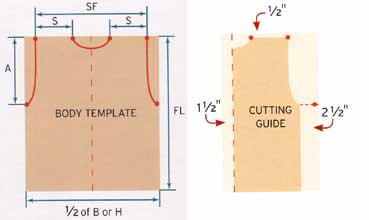
Simplest of all is ‘Sew What ! – Fleece’ by Jessop and Sekora. They use 7 measurements to draw their ‘body template’. Then they add extra width to front opening, shoulders and side seams, to make tops and jackets. Easy pull-on pants from 5 measures and a similar approach. Book leads you through a sequence of projects so you learn both simple pattern making and sewing. All in fleece, so no need to neaten edges and prevent fraying.
”sewhatfleece”
Sew What ! Fleece pp.76-7
(the seventh measurement is sleeve length.)

For a less easy starting point, there’s Cal Patch’s Design-it-yourself Clothes. This simplifies block making and pattern altering. Few darts, so not for large cup sizes. Problem : the instructions are mainly in paragraphs of words. Not good for a visual person. Also the focus is on pattern making, it’s not for beginners to sewing.

She uses 24 measurements in all. For a wide range of clothes : skirt, tee, shirt/ light jacket, dress, pants. Modern styles.

I don’t know how well these methods work for larger sizes.

The simple Casual Block doesn’t fit me well. I now have my own ‘casual block’ with personal neckline and shoulder slope, back shoulder darts, and personal armholes and sleeve cap – very different front and back (post on that here). Many people with a full front look better if they add a bust dart to the casual block. Now I can apply the simple style changes which people suggest for the casual block, to my own version of it.

– – –

You measure, someone else makes the shape : physical tools

I’ve tried several physical methods for making a basic starting point from your own measurements.

Plastic templates

Bonfit Patterners use plastic slot-together templates to get different size bodies (see my review). Probably good for a Casual Block if you don’t need an FBA. I don’t think the Bonfit book about pattern making which is with my old kit is good. Small dim print and few illustrations

There are also a couple of interesting block drafting rulers which I haven’t tried.

The Point and Pivot Pattern Ruler is from Eileen in South Africa.

”southafricanruler”

This covers personal measurements for bust, bust point and cup size, waist, hip, waist length, and could be adapted for shoulder length.
The video shows how to draft a bodice.

There are several similar rulers from Australia :
DKEMEL ruler
Pattern Drafter
Sitam square

Tracing multi-size patterns

The Sure-Fit system is a join-the-dots tracing method. She claims it can be used for any size body.

”surefit”

The Sure-Fit dress kit allows for bust, cup size, bust point position, waist, waist length, high hip and hips, shoulder and arm length.

These are all schemes for making basic blocks (simple usable patterns). Sure-Fit calls this your ‘body blueprint’. You then use standard pattern making methods to get other styles. I think the Sure-Fit booklets, more visual, are very good. And the instructions can be used to make new styles whatever your source of basic blocks.

Sadly, none of these include all my challenges in getting neckline, shoulders, high round back, armhole, to fit. I need to do those fit alterations myself.

For people with a longer back crotch measure, the Sure-Fit pants don’t discriminate between those who need more vertical length and more angle, to accommodate a large rear, compared to people who need more horizontal crotch extensions, to accommodate a deep torso (see my note on pants wedges).

There are many helpful SFD videos about improving the fit at the SFD Learning Center.
These apply to fitting any personal blocks, not just the Sure-Fit Designs derived ones.

And you only have to make alterations once on the basic pattern. Then all patterns you make from your adjusted personal block ‘blueprint’ will include those changes ready made.

With the re-issue of Sure-Fit there has been a lot of interest, see Stitchers Guild discussion thread.

In the FitNice System you trace very simple basic shapes for knit casual-block top and elastic waist pants. Many simple ideas for pattern alterations to make new styles. Up to finished measurement at bust level of 48-1/2 inches/ 123 cm.
The conversion for wovens doesn’t work well for my body shape, as the simple unadjusted casual block isn’t good on me.
I had a lot of problems with the discs on my elderly Mac, but she did give me a quick complete refund without me asking.

– – –

You measure, someone else makes the shape : software

What if you want a basic which allows for more of your personal measurements ?

The idea of pattern making software is that you put in your measurements, and it produces the patterns for you. All the software brands use different measurements and different ways of calculating the patterns.

In Pattern Master Boutique you enter your measurements and test fit a set of basic fitting shell patterns : bodice, skirt, pants, and sheath dress. If the fit isn’t right, you enter slightly changed measurements, print out another pattern, try that, and so on. Once you’ve got the fitting shell right, then you can choose from a huge variety of style elements to make your designs.

”pmbmeasures”
Example measurements (inches) in Pattern Master Boutique

Bernina My Label doesn’t make the two stages (fitting and styling) clearly separate. You enter your measurements (many more than for PMB), and try out simple tunic and pants styles to refine the fit, by changing the measurements again. Then there’s a range of about 25 classic styles. You’re expected to use your own pattern making knowledge to adapt these to other styles. There’s a good range of guidance about doing this on the website. Many of their pdfs give advice about pattern making which you can use with any starting point, not just BML.

Basically, the aim of BML is to produce a set of good classic blocks which you can alter to make other styles.

The fun attraction of BML is the simulation of your body shape, with the clothes on it. So you can try out different lengths, levels of ease, etc. and get an idea of what’s most flattering.

Those are the only pattern making software I have personal experience with. There are many other software companies (see list in my software post). I found this sort of fitting process is not one I enjoy at all. And I’m too far from average in too many ways for it to be very successful for me.

It’s a good idea to start small and find if using pattern software is a way of working you enjoy. And best to start by expecting ‘better’ rather than ‘ideal’ for the fit. It may take several tries to get the best fit you can. It’s not an approach which works well for me.

Wild Ginger (who produce Pattern Master Boutique) also sell Click & Sew software for fitting shells.

Pattern.stringcodes.com is an on-line company that produces personal fitting shells.

Unique Patterns provides personally fitted versions of some Simplicity and New Look designs. There are some interesting pdfs in their Education section.

As with pattern making software, both these products are more successful if you send them good measurements !

– – –

Minimum measuring, no drafting : commercial fitting shells

Most ways of making a personal fitting shell use many measurements. And it’s difficult to take those accurately, especially on yourself. But there isn’t actually any need to do detailed measuring to get a fitting shell – if your size is within the usual pattern ranges. Well, no more than the measuring needed to choose a pattern size.

There are several bodice-skirt fitting shell patterns :
Butterick 5627 for sizes 6 to 22.
Butterick 5628 for sizes 16W to 32W.
(Connie Crawford’s patterns are a different shape.)

McCall’s 2718 (below) This has bodice fronts for 5 cup sizes. Individual patterns for sizes 6 to 22.

”m27182”

and Vogue 1004, individual patterns for sizes 6 to 22.
(Sandra Betzina’s patterns are a different shape).

These patterns include guidance about how to get them to fit well. You may get a better fit for your shoulders if you choose the pattern size by high bust/ chest, rather than full bust measurement (see my post on the FBA).

There’s also a pants fitting shell, Vogue 1003, individual patterns for sizes 6 to 22. Probably best for people who don’t protrude front or rear (see my post on pant fit).

Starting from one of these commercial patterns gives you a double payoff.
You get a fitting shell which you can use for your own pattern making.
You also know how your body differs from the average Big 4 pattern. So you know what changes you need to make, and how big, every time you use one of their patterns.

This would be my preferred method. Except they none of them say much about how to get a comfortable armhole and sleeve cap, which I really do want to do something about. And now I have a good fit pattern, it differs so much from the commercial shapes, I find it a huge hassle to do all the changes. Easier (I think at the moment !) to start from my own basic shapes and add the style elements from patterns I like.

Using a commercial fitting shell pattern, you just need to use standard fitting techniques to get a good fit.

But if you know about fitting techniques, you don’t need the extra instructions in the commercial fitting shells. You could use those fitting techniques on any simple pattern. Then you can use that well fitting pattern as a basis for simple style changes. Like TNT (tried ‘n true) patterns, but ones delibrately chosen to be good starting points for redesign. After trying a whole lot of other possibilites, that is what I find myself doing. At least with all my lengthy struggles to get software to fit, I did learn a lot about fitting myself !

– – –

No measuring or drafting : draping a fitting shell

If you drape your fitting shell directly on your body, you only need measure enough to cut a fabric rectangle big enough to cover the area. And do the rest by draping.

Connie Crawford has a DVD on this, called the Custom Bodice DVD. There’s an interesting sample clip at the site.

There’s one review at Pattern Review from someone who managed to do it on herself. From comments added to this review, it sounds as if this method is good if different parts of you are different sizes. Or if the 2 sides of your body are different shapes. I haven’t tried draping myself.

The price of this DVD is above the customs limit here in the UK, so expensive. There is a similar sounding DVD available here, The Art of Dress Modelling by Lisa Silberberg from Shoben Fashion Media. But that’s all I know about it.

There are written instructions and photos about draping a fitting shell in ‘Patternmaking for Fashion Designers’ womenswear by Lori Knowles.

(P.S. There’s a new class at Craftsy on this, but I haven’t tried it – Fashion draping. Not for sewing beginners.)

Draping gives you a ‘second skin’ sort of fitting shell. You will need to add ease to most measurements to get a wearable pattern.

– – –

P.S. See the comments for some more very good suggestions about getting a well fitting starting point for pattern making.

So which do you enjoy – taking accurate measurements, doing the drafting, or fitting, or draping ?

You need to decide whether you want to work towards a personal fitting shell which is a close fit ‘second skin’ with no movement ease. Or personal blocks, which can be used as patterns for simple garments. Or the TNT equivalent. But this was getting too long, so I’ve put all that in a separate post.

There’s a wealth of methods for getting a well fitting starting point for making new styles. Obviously it’s something people have difficulty with. And have been inspired to think of solutions for. Developing a fitting shell or basic blocks may not be something we have to do often. But if we find the right method for us, it can be something we enjoy rather than keep putting off.

I am planning a post on simple style changes you can make without cutting up a fitting shell. But I’m finding I have more and more to say about the starting point for doing this, so there are several more posts to come ! Personally I find it much easier to get a personal set of basic patterns rather than blocks. But there are many other possibilities if that doesn’t suit you 😀

These easy methods can be good for people who need few fit adjustments, but not for people who are far from average. None of the simplified methods do – and I spent years trying them !
Many don’t deal with different cup sizes. Let alone sloping/ square shoulders, round backs, etc. My post on Getting to know my sizes lists my differences !

– – –

Links available June 2011

= = =

To get to the main blog, click on the red header.

Pattern Making – the formal route

May 14, 2011

An updated version of this post is in my free .pdf
e-Book on Personal basic pattern making blocks.

– – –

Books on pattern making talk about two different processes :
– drafting a fitting shell pattern from measurements, to make something that covers the body closely and hopefully accurately,
– altering this basic fitting shell pattern to make garment patterns for different styles.
The idea is : if the starting point fits well and the pattern changes are made using the right methods, then the garment patterns made from it will fit well too.

Three main groups of people use pattern making skills, and they have very different needs :
– RTW designers and pattern makers use standard body shapes and sizes, and may want the quickest way of making patterns. From designers of huge production runs for supermarkets to studio designers of small runs for boutiques. I put them together here because none of them need be concerned about the shape of specific individuals.
– professional dressmakers and costume makers : make one-off versions of any style for any body shape, hopefully with minimum effort. The most challenging group of needs.
– amateur dressmakers : work with one person or a small group of people. And we can choose to work fast or slow, simple or complex, depending on what we enjoy.

This “draft a fitting shell, design by altering that” approach is the way designers are taught to understand basic principles. But underlying these, the general aims are :
– get a good fit,
– make a garment pattern for the style you want
And you can often achieve these more easily by other methods.
So what’s done in practice may be rather different.

I’m going to talk a bit about the ‘first principles’ methods here. But not to worry if you find yourself grimacing and saying “I don’t want to do that”. There are much easier methods, which I plan to talk about later. (P.S. My post on easier ways of making personal basic blocks is here.)

Note on terms : the words ‘block’ and ‘sloper’ are used with many different meanings. So I don’t use the word ‘sloper’. I’m using these meanings :
‘fitting shell’ : a basic closely fitting pattern. Follows the shape of the person it’s for, with no design features. Little movement ease, so not usable directly as a garment pattern.
‘block’ : basic starting pattern for a type of garment, with the usual ease and style elements for this. Such as a simple fitted blouse or casual jacket.

– – –

Ready To Wear standard fitting shells and blocks

RTW designers make patterns based on a generic industry/ company standard body shape. Though there isn’t one industry standard. Different companies use different ones. So we find some RTW companies fit us better than others, and some use more flattering size numbers.

The big pattern companies also use slightly different basic fitting shells. oop book ‘Every Sewer’s Guide to the Perfect Fit’ by Morris and McCann compares them. And there are designers within the large pattern companies who use their own idea of an average body shape, like Sandra Betzina and Connie Crawford. The independent pattern companies have their own body shapes too, presumably related to the shape of the designer. So if we use independent patterns, we learn which companies have patterns which fit us easily with small changes, and which ones don’t.

Shoben Fashion Media publish full size basic blocks for use in design schools (sources in UK, US).

Here’s their block for a women’s dress (Big4 pattern sizes 12 – 24, underarm ease about 4 inches/ 10 cm) :

”lfs-women”

and for a men’s jacket :

”lfsmenjkt”

They also publish women’s blocks for jacket, pants, casual top, stretch body.

Notice they publish blocks for a few basic garment types, with different amounts of ease and common style elements. They don’t expect students to start their designs from the more basic fitting shell. Though they do expect students to devise more complex blocks for themselves, such as a dress/ blouse without waist seam. I’ve found myself working this way too, making some basic types of garment that fit well. Then, for very simple garments, all you have to do is change style elements on the basic block. More on that in later posts.

Here’s an interesting story and advice from someone who taught herself how to make patterns and now sells them on-line.

– – –

Fit and then pattern making for individuals

If we use this formal approach to make clothes for individuals, we need to learn both drafting a fitting shell from measurements, and then making styles from that.

There are books for professionals. These are just some of the many available. It’s a good idea to read the comments at Amazon and Pattern Review. None of them get 100% approval, especially from beginners.

Winifred Aldrich : Metric Pattern Cutting. [I’ve seen a copy of this and like the style, but haven’t yet got one of my own.]

Connie Amaden-Crawford : Pattern Making made easy.
Review by Kathleen Fasanella.

Helen Armstrong : Pattern making for fashion design

Kenneth King : e-books on CD
Separate CDs on each ‘moulage’ for bodice, sleeve, and pants, and for making other styles from them.

I haven’t seen any of these, which come at college textbook prices.

All of these books are ‘bibles’. They try to cover all possible styles, which you pick and choose from to make your own design.

I prefer a ‘project based’ style of learning. For this there’s Lori Knowles’ ‘Practical Guide to Pattern Making’ for women and for menswear. I haven’t tried this but plan to. (P.S. I now have this and find it is my main go-to book on pattern making.)

There are also many more modest books for amateurs who want a relatively painless introduction.

Some sources are good on how to get a fitting shell that fits.
Others are good as a simple guide to making patterns from these, for non-professionals.
Again I’ve nowhere near tried all of them. But I have now looked at enough to have some I keep returning to. I no longer feel that if only I buy another book I’ll understand it all at last. I feel I’ve got reference material I understand, and it’s just up to me to get on with it.

So here are my choices. The trouble is we all have different thinking and learning styles, so my choices won’t suit everyone. There was a recent strand at Stitchers Guild on learning pattern making, which suggests other possibilities.

– – –

First step : Drafting the pattern for a well fitting basic starting point

Each textbook uses a different method for drafting a basic fitting shell – that is, starting with some measurements and a blank piece of paper, and ending with a pattern for a garment which is a good close fit.

Here’s an image of part way through the drafting process :

”bodicedraft”

That is from a free pdf about bodice drafting which is here.

(P.S. here are some free pdfs about drafting, from Burda Style : skirt, dress, sleeve.)

As they’re all different, it’s likely that some drafting methods are more successful with some body types than others. Sadly no one has done an analysis of that !
And I’ve given up on the search for one that fits me well first go on the basis of measurements, and only needs small adjustments to get a good fit.

I like Donald McCunn How to Make Sewing Patterns for getting a basic fitting shell. (Search at Pattern Review for McGunn not McCunn) (In the UK, it’s cheapest to import through Amazon.com.)
This starts from basic measurements to make the pattern for a preliminary muslin, and then uses draping to finesse the fit.
Lots of ingenious ideas on measuring and fitting yourself without help.
And on-line classes which include demo videos for all the pattern drafting and muslin fitting steps, and cover all he’s found out since writing the book. Apparently the bodice draft in the book doesn’t work well for larger cup sizes. He now has a different method. There’s a pdf on it which you can access without taking the class, if you join the yahoo group.

But some people don’t like his approach because they want to get a good fit first go, from measurements. I haven’t got the sort of body shape that seems to be possible for, but it’s much easier if you have ! And certainly a professional dressmaker or costume maker can save a lot of time if they don’t have to do much altering to get a good fit.

If you like to watch video demos, another source for drafting is eSewing Workshop. Here’s a short YouTube intro. I haven’t seen them, but understand they cover drafting but not correcting any problems with the fit of the muslin made from the drafted pattern.

Different people prefer different fitting methods. There are recent Stitchers Guild discussions with many comments on fit issues, at :
Jacket a month fitting.
Spring 6PAC page 4.

– – –

Second step : Making patterns for different styles from your basic well fitting starting point

An example : working out how to copy a favourite flared jacket with no side seams and revers neckline.

”red-jacket-patt”

Rotate out the darts in the quarter scale fitting shell (white), add length (pale green), slash and spread (red).

I like Peggy Sagers ‘Basic Pattern Making‘ DVD for a good intro to understanding the basics of altering a basic starting point to make patterns for different styles.
Though it’s very difficult to re-view as it has no menu or headings, or listing of what’s covered. I’ve made extensive notes on what happens when. (And it is expensive, luckily I got it on special offer.)

So I definitely need to be supported by Adele P. Margolis ‘Make Your own Dress Patterns‘ as a simple book for reference, so I don’t have to remember it all. (Nothing in this book on making a personal fitting shell.)

No substitute for actually doing some, to learn how to do pattern making.

It’s fun to use quarter size blocks and play with different pattern making techniques. There are often quarter size blocks in pattern making books, but I haven’t found any copyright free ones.

Quarter size patterns fit 16 inch ‘fashion dolls’ with relatively correct adult body proportions (not like children’s dolls and Barbie, however much fun they may be to make clothes for !). Here are a couple of on-line sources for buying these small patterns as downloads : Don McCunn and a doll pattern site. (Tyler Wentworth is a 16” fashion doll.)

And then there’s no substitute for making the patterns up in fabric, to see the real-life 3-D result of making the pattern changes.
Easiest in quarter or half scale again.

And then make up the design full size in ‘muslin’. To be sure the pattern pieces go together properly. And to check the overall silhouette and size/ shape/ placement of style elements flatter your body shape. Good to make this trial garment in a fabric you can write and draw on, and just baste it together so you can change things easily.

Getting the right length and breadth of each pattern piece to achieve the effect you want is a matter of judgement, an art not a science. So can only be refined by practice, experimenting to find out what has what effect. Which is why many of us find we prefer to adapt commercial patterns rather than trying to make our own.

Professional high-end designers and dressmakers don’t expect to get things right first time !

– – –

Are there easier ways ?

This post describes the stereotype of what pattern making involves.
But, as Kathleen Fasanella so passionately and frequently points out, that is just how RTW designers are taught the principles. Not what they actually do. In practice they make things easier for themselves by starting from an existing design which is similar to what they want.

I knew a commercial designer who had pictures of style elements on her studio wall. She’d say – we’ll have that body, that collar, that sleeve – and the pattern maker would go off and combine them. This is also how you work if you use some types of pattern making software, such as Pattern Master Boutique.

So it can be much simpler. Understanding first principles is helpful and interesting. And useful in some but not all contexts. But it just isn’t always necessary.

After all, the aim of ‘pattern making’ is to get a well-fitting pattern for the style you want. And you don’t have to go through all the processes described in this post to get that.

We amateurs are free to make many choices :
– there are many ways we can get a well fitting starting point without drafting a fitting shell pattern from scratch based on our measurements.
– there are many ways we can get patterns for the garment styles we want without starting from a basic fitting shell.
We are lucky to have the choice. We can use whichever method we like and works best at the time.

So not to worry if you find the processes described here all much too daunting. Happily there are much easier methods 😀 which I’m planning to talk about later.

(P.S. My post on easier ways of making personal basic blocks is here.)

– – –

Links available May 2011

= = =

To get to the main blog, click on the red header.

North American independent pattern designers

April 22, 2011

Here’s a fun way to spend a Happy Holiday Easter Weekend 😀

A list of all the North American ‘independent’ pattern companies I’ve found. Except I haven’t included ones which only have 1 or 2 patterns. Or aprons, or bags, or for children, or all the patterns for historic specialists or lingerie.  Or people who re-design sweat shirts. I had to stop somewhere ! I don’t think it’s humanly possible to make a complete list – companies are always coming and going. At least one has changed URL recently. And there’s one I can’t remember the name of. So if you know any I’ve left out, please tell me.

The smaller European pattern companies I know of are listed in this blog right hand menu.

Discover new delights 😀

– – –

Akasha – Andrea Steele                        
akashaclothing.com

Alternatives – Shirley Adams
sewingconnection.com

Amy Butler
amybutlerdesign.com

Anna Maria Horner
annamariahorner.com

Back Porch Press
backporchfabrics.com

Batik Butik – the Bali collection                  
batikbutik.com

Birch Street Clothing
birchstreetclothing.com

Brensan Studios
brensan.com

Brown Paper Patterns – Barbara Allen  
brownpaperpatterns.com

Carol Lane-Saber designs
saberdesigns.cc

Christine Jonson Patterns
cjpatterns.com

Classics, The – Cecelia Podolak                        
ceceliapodolak.com

CNT Pattern Co.
cntpattern.com

Colette Patterns
colettepatterns.com

Country in the City
161.58.115.112/wearable_patterns.htm

Cutting Line Designs – Louise Cutting     
fabriccollections.com

Cynthia Guffey
cynthiaguffey.com

Dana Marie Design Co. (was Purrfection) – Dana Bontrager   
danamarie.com

Darlene Miller
darlenemillercloz4u.com

Dawn Anderson Designs
dawnandersondesigns.com

Decades of Style
decadesofstyle.com

Design and Planning Concepts – Nancy Mirman             
designandplanningconcepts.com

Dos de Tejos
dosdetejas.com

Elements – Linda Kubik
lindakubik.com

EvaDress                                                
evadress.com

Fashion Patterns by Connie Crawford
fashionpatterns.com

Fashion Sewing Group – Nancy Erickson
fashionsewing.com

Favorite Things
favoritethings.net

Folkwear Patterns
folkwear.com

Four Corners
fourcornersdesigns.com

Gail Patrice Design
gailpatrice.com

Grainline Gear – Lorraine Torrence     
lorrainetorrence.com

Great Copy                                                            
greatcopy.com

Green Pepper                                                       
thegreenpepper.com

Hot Patterns
hotpatterns.com

Indygo Junction
indygojunctioninc.com

Islander – men’s shirts
stores.intuitwebsites.com

Jalie
jalie.com

Jean Hardy – equestrian
jeanhardypatterns.com

J.Stern Designs – Jennifer Stern
cinematicweddingstory.com

June Colburn Designs
junecolburn.com

Kayla Kennington
kaylakennington.com

La Fred – Fred Bloebaum     
lafred.com

Laughing Moon – JoAnn Peterson       
lafnmoon.com

Lila Tueller Designs
lilatuellerdesigns.blogspot.com
see lower right menu

Lingerie Secrets – Jan Bones
sewinglingerie.com

LJ Designs – Lyla Messenger                   
ljdesignsonline.com

Loes Hinse Design        
loeshinsedesign.com

Lorraine Torrence Designs
lorrainetorrence.com

MacPhee Workshop – Linda MacPhee 
macpheeworkshop.com

Maggie Walker Design
maggiewalkerdesign.com

Mary’s Patterns
maryspatterns.com

My Sister’s Patterns
mysisterspatterns.com

Paisley Pincushion
paisleypincushion.com

Pamela’s Patterns
pamelaspatterns.com

Park Bench Patterns – Mary Lou Rankin 
parkbenchpatterns.com

Past Patterns – historic
pastpatterns.com

Pattern Studio – hats and gloves
patternstudio.com

Pavelka Design                       
pavelkadesign.com

Petite Plus – Kathleen Cheetham 
petitepluspatterns.com

Quilted Closet, The – Elaine Waldschmitt 
thequiltedcloset.com

Rag Merchant – Jill Mead                                  
shiboridragon.com

Ragstock – Deborah Brunner
deborahbrunner.com

RDKC – Rachel Clark     
rdkc.com
                                    
ReVisions  – Diane Ericson                     
dianeericson.com

Round Earth Publishing – martial arts and cosplay
round-earth.com

Saf-T-Pockets – Marsha McClintock                 
saf-t-pockets.com

Serendipity Studio – Kay Whitt
sewserendipity.com

Sewgrand
sewgrand.com

Sewing Workshop, The – Linda Lee     
sewingworkshop.com

Shapes – Louise Cutting and Linda Lee
sewingworkshop.com

Silhouette Patterns – Peggy Sagers  
silhouettepatterns.com
                
Stretch and Sew – Ann Person
gmidesign.com

Suitability – equestrian
suitability.com

Taylor Made Designs – Cindy Taylor Oates
taylormadedesigns.typepad.com
pattern books listed in menu at right

Textile Studio Designs
textilestudiopatterns.com
                                        
The King’s Daughters – Modest Sewing Patterns
modestsewingpatterns.com

Threadbare Patterns – for shaggy plush felt
threadbarepatterns.com

Trudy Jansen Design
trudyjansendesign.com

Tu-RIGHTS – for special needs
tu-rights.com

Unique Patterns – drafted to customer’s measurements
uniquepatterns.com

Victoria Jones Collection – Hawaiian
victoriajonescollection.com

– – –

Have fun finding designers who share your personal style 😀

With special thanks to other people who have made pattern link lists. One was from the ASG, another I saved 3 years ago has no name or source with it.

I’ve written two previous posts on independent pattern designers.
The first suggests European sources for North American patterns, plus a little about pattern magazines.
The second focusses on new generation designers.

If you want patterns for historic re-enactment or cosplay, here is a place to start : Great Pattern Review, or their earlier sources of patterns.

For a list of software companies, see my pattern making software post.

Enjoy !

– – –

Big Companies – in case you don’t know where to find them 😀

Burda (Germany)
Butterick
Kwik Sew
McCall’s
Neue Mode
Simplicity – New Look
Vogue

– – –

Links available Easter 2011

Jackets of the season – notched collar blazer

March 26, 2011

The key jacket for this Spring/ Summer 2011 is a notched collar blazer.

Eileen Fisher has picked out 3 versions.

”3-notched”

The most obvious difference is length : mid hip, low hip, or mid thigh. Which is the best length proportion for you ? (Notice the under layers are all about the same length.)

All have collar notch at front neck level. Good if you want to draw attention up to your face.

All have similar shape and angle of notch. In some seasons there can be big changes in these, but a simple notch is popular this year.

And lapels that are 1/3 to 1/2 the width along the shoulders to the armhole.

All of them are loose enough to layer. While many jacket patterns are more fitted and meant to be worn closed, with perhaps only a camisole under.

As I never wear a blazer myself, I used to think a blazer is a blazer is a blazer. Notched lapel collar, fitted sleeves, single breasted, boxy shape. Well, that’s in women’s clothing. In men’s clothing it’s a similar shape but usually navy fabric with brass buttons and patch pockets. Or in sports club or school colours. But in women’s fashion, there’s actually a wide variety of style details.

– – –

Round or square corners ?
Two of these jackets have square and one has rounded corners, so choose which is best for you.
Are your body lines straight or curved ? Is it your style to be crisp or soft ?
And some stylists say square corners make you look slimmer. . .

Width of lapels and collar
A wide variety of lapel widths are fashionable at the moment. Though Eileen Fisher hasn’t featured one, shoulder-width lapels are also current if that looks good on you.
For me it’s not a simple choice.
Wide lapels give me upper body emphasis, which I need as I’m small busted and wide hipped. And they visually strengthen my sloping shoulders.
But a slim lapel adds a vertical line, which I need as I’m short waisted.
Which looks best on you ?

These styles all have collar and lapels the same width. This is classic style, but it isn’t essential, it’s a design decision.

Also the edges of collar and lapel are straight. That’s another style feature which is current classic, though there are many patterns with curved lapels.

X or Y neckline ?
In these examples, the 3 button style has a front edge Y shape, and the 1-button styles have a front opening X shape, which I talked about in my shawl collar blazer post.
Would you look better with the front cut away below the lowest button ?

Soft roll or firmly pressed edge to the collar fold ?
Which is more to your personal taste ? Which flatters your body shape ?
Do you want to look more formal or more casual ?

Style, location, angle of pockets ?
Men’s blazers have patch pockets. Women can use nearly every pocket style on a blazer : patch, in-seam (perhaps with hidden zip), flap, single welt, double welt. (An exposed zip is more edgey than classic. And pleated or bellows pockets are more safari/ artisan.) It’s possible to go on at length about pockets. There’s a lovely old book, ‘Just Pockets’ by Patricia Moyes. Start from the simplest jacket pattern and make multiple versions which look different because of the pockets.

Added back interest
Do you do the sort of work where you have your back to onlookers, so jackets with back interest would be a good idea ?
Or do you usually sit down, so need a plain back that doesn’t crush easily ?
One of these Eileen Fisher jackets emphasises the curved shaping of multiple princess seams at the back. Another has an inverted pleat at centre back.

People round here are wearing jackets with multiple seams or inverted pleats at the back, often below a yoke, and with a 2-button tab at waist level.

Perhaps Project Runway Simplicity 2810.

”s2810”

Lined – unlined ?
It’s relatively easy to leave out the lining of a lined jacket – unless there’s a lot of inner structure to hide.
Adding a lining to an unlined pattern is not difficult once you know how. See oop book ‘Easy Guide to sewing linings’ by Connie Long.

Notch height and shape
There are some style elements which it’s best to leave as they are on a pattern, as they’re difficult to change unless you know what you’re doing.

The notch shape and height and the break point of the collar are all best left alone. (Though they can be changed in pattern making software like Pattern Master Boutique. Not in Bernina My Label. Those are the only software I have personal experience with.)

These 3 jackets all have the notch at front neck level.
But it has recently been fashionable to have notches much lower, even at bust or waist level. Particularly on ‘boyfriend’ jackets.

Being closely analytic, there are 3 angles at the notch – the collar corner, the notch, and the lapel corner. And all 3 are design decisions. The Eileen Fisher jackets have the corner angles close to square. This is the classic choice.
This is a fashion thing, other angles and shapes have not been so fashionable recently. (And they’re not so easy to manufacture.)

The origin where the lapel fold line starts – the ‘break point’
On these jackets, you have a choice of folding back the collar from bust level or waist level.
Which is more flattering on you ?
I’m best with a lapel down to waist level. That gives me a vertical line on my short waisted upper body. And a lapel folding out from bust level draws attention to the fact that I haven’t got one.
Does one of these break points make you look or feel older/ younger ? slimmer/ wider ? larger/ smaller cup size ?

In the example jackets, the lapel from bust level goes with the shortest length jacket, but that isn’t necessary.

Number and position of buttons
On these jackets the button positions are simple and classic : a single button at waist level, or three buttons spaced from bust to waist level.

It’s easy to change the number and position of the buttons within the space available. This is the strip where the centre fronts overlap. The top of the strip available for closures is just below the break point where the collar turns out. The bottom of the strip depends on whether or not the lower jacket is cut away.
Once these are set it’s relatively easy to change how high or low the top and bottom button are, and how widely spaced they are.
No doubt if you’re generous busted you’re already know it’s best to have a button level with the bust point, if that area is buttoned over.

Choice of 3 buttons or 1 (or 2 ?). Which is best for you ?
This depends on details of your body shape (and how fitted the style is, just to complicate things).
Perhaps do some snoop shopping of jackets. Which button layouts make you look longer/ shorter waisted ? Which make you look larger/ smaller busted ? Which make you look more efficient/ more relaxed ?

One button needn’t be a waist level. There are several Simplicity jacket patterns with 1 button at bust level.

– – –

Just for contrast, here’s a design with very different style decisions, Vogue 8638. (The pattern has a choice of notch shapes.)

”v8638”

– – –

This was all getting a bit much. So I’ve put some comments about notched collar blazer patterns and sewing advice in another post.

And not to worry if notched collar blazers are not your style. Some people love them, but they’re not for me.

I remember wearing a few RTW notched collar jackets, but never one that could be described as a blazer. I did once own a shawl collar structured blazer. Bought it because a stylist said “Every woman should own a blazer”, and that was in the days when I didn’t know better about such opinions. I only wore it one time. A colleague said “You look very. . . um. . . straight” – and I never wore it again 😀

I do wear trenchcoat styles, which are also current. Not at all the same as a blazer. Double breasted, wide lapels, closing up to the neck, wide collar based on a band, added yokes for shoulder emphasis.

There are three other key jacket styles picked out by Eileen Fisher for this season (cascade, collarless, and biker/aviator). I’m planning a post on them too.

– – –

Patterns and links available March 2011