What size do you need a top ? I made a mock-up to test how big a pullover needs to be for me to get into it. Then I realised I could also find out how big a layering top needs to be so it doesn’t look strained.
– – –
Size for layering tops
I made a mock-up from a couple of large non-stretch fabric rectangles. I gradually moved the side seams in until it was just too small, when the fabric looked a little strained and lumpy.
Here’s my suggestion for the size of fabric to cut :

Use your largest measurement to choose the width.
If you need an FBA or have a large abdomen, cut the front piece 4 – 5 inches wider than the back. Align the side edges to sew the seams.
Sew the initial seams as marked. Use contrasting thread.
The largest I want a layering garment to be is over a thick sweater. So I started by trying my mock-up over that.
I’m larger below the waist than above, and my hips are my largest part, so I started by checking fit over my hips.
I basted the side seams further in, 1/4 inch or presser foot width at a time. Until the first time when the fabric was a little distorted at hip level. So I knew the previous size was the smallest I can wear a layering top over a thick sweater and look good. And I measured between those seams.
Then I tried the mock-up over a thin layering top, and moved the seams in again.
Then I tried it over a loose shirt and camisole.
(It’s getting cold here and I forgot to test for best basic layer looseness. I could unpick some of my mock-up seams, but I think anyway it’s better to try close fit using a test garment with darts.)
So I knew about layering tops for my hips. Then I moved on to testing fit without strain at the underarm. For this, I just sewed short seams above the waist.
Here’s a scan of part of my final seams (looks better in real life !) :

Arrow points to size to measure for the underarm.
If you’re larger above the waist, start by testing your underarm. Then you could check how much narrower you can go at hip level and still wriggle through it.
From this I found that for me a successful layering garment (tunic, vest, jacket, etc.) needs to measure at the underarm :
over a thick sweater : at least 45-1/2 inches
over a thin layering top : at least 44 inches
over a loose shirt : at least 42 inches.
Don’t use my numbers for yourself. I think people with different styles, shapes, and favourite fabrics will get different results. I used a medium muslin with a bit of body for my tests and I don’t wear close fitting clothes.
You could also use this mock-up to try out different neck opening sizes.
– – –
‘Wriggle into’ room – getting the garment over your shoulders :
You’re making a pullover top. Using a pattern you’ve made from a blouse/shirt or jacket pattern by closing the opening, can you get into it ?
You may need to remove waist shaping (see later) :
– Don’t sew any waist darts.
– Straighten out the side seam from bust to hip.
Also check the neckline opening is bigger than your head.
Then, if your bust is larger than your shoulders, you should have no problem getting the garment on.
If, like me, your shoulders are bigger than your bust, you need to check this. With a knit fabric this may not be a problem, With a woven fabric with no stretch, it may be. I found my results interesting.

(black diagram from Fit For Real People p.66)
My shoulders at rest measure 41 inches, and my bust is 36 inches. So I assumed I would need something bigger than my bust to be able to get into it.
I tried my mock-up over minimum clothes to find what is the smallest I can wriggle in to.
I found I can get into something that is several inches smaller than my top : 32-1/2 inches. Not that I’d actually ever wear anything that measurement ! It was very uncomfortable, but certainly endurable for the short time of getting a garment on.
I don’t know if there’s something odd about my shoulders, or if this is true for other people. But at least for me, getting something over my shoulders is less of a problem than I thought it would be. It looks as if I don’t need to remove all the waist shaping in a pullover pattern just so I can get it on.
– – –
How do you compare your findings with the pattern ?
The finished garment measurement is usually printed on the pattern, somewhere near the bust and hip points. Or it may be in a table near the beginning of the instructions. If it’s not supplied, measure the pattern (allow for seam allowances).

On the McCall’s 5664 pattern I based my pattern alterations on, the finished garment in my size is 43-1/2 inches at underarm. For a layering top over a loose shirt I need 42 inches. Over a thin sweater I need 44 inches. So I could wear this top over a loose shirt, but it might not look good over a thin sweater. If I wanted a top to wear for that, it could be best to alter this pattern a little.
The Nancy Zieman oop McCall’s 5526 jacket (left below) has 40 inches at underarm. Obviously designed to be worn over something light, a camisole or perhaps a fitted blouse. The Marcy Tilton Vogue 8454 jacket (right) has 45-1/2 inches at underarm. So I could easily wear that over a thin sweater, possibly over something thicker.

If you want a layering item to wear over a thick sweater or a big jacket, also measure your biceps. Check the pattern sleeve width is at least a couple of inches larger.
I’m surprised how much I’m using this information. It makes it easy to check I can use a pattern for what I want without changing the size. I’ve also used this to buy mail order from companies that say what the actual measurements of their garments are.
– – –
Enlarging the underarm size
What to do if your pattern is too small ?
If you need 1 inch (2.5 cm) larger, add 1/4 inch / 6 mm to the pattern at side and sleeve seams, as in the diagram.
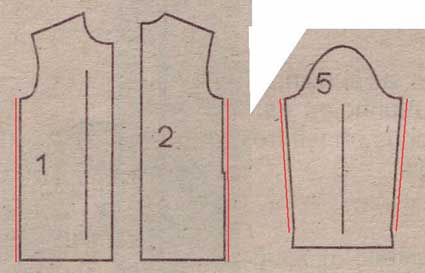
(Butterick oop 5803)
If you need 2 inches (5 cm) larger, add 1/2 in. / 13 mm at each of the marked places.
If you need more than 2 in. (5 cm) added at the underarm, sorry this size is not a good starting point for you to make a pullover or layering top with minimal changes.
If you go up a size, you don’t only increase the underarm. You also lower the neckline, lengthen the shoulder seam, and enlarge the armhole. These are usually good for a layering top anyway. But it’s worth checking if the changes are flattering on you.
Or start from a pattern that is more loose fitting.
– – –
Ease
You don’t need to know about ‘fitting ease’ to assess patterns for layering, but it’s related. And it’s useful to know when buying patterns.
The difference between actual garment measurement and body measurement is called the ‘ease’.
For example, the McCall’s 5526 jacket size 14 measures 40 inches at underarm. My bust is 36 inches. So the underarm ease of this pattern is :
40 – 36 = 4 inches.
Here is a general post on ease levels.
And here’s a simplification of the Ease table in the Vogue print catalogue :
top :
fitted : 3 – 4 inches
semi fitted : 4 – 5
loose fitting : 5 – 8
very loose fitting : more than 8
jacket :
fitted : 4 – 5 inches
semi-fitted : 5 – 6
loose fitting : 6 – 10
very loose fitting : more than 10
The finished underarm measurement of a pattern isn’t usually given on the envelope. So you have to use the fit description when choosing a pattern.
For example, for a garment to wear over a thin sweater, I like at least 44 inches at underarm. So I need 44 – 36 = 8 inches of ease. The table tells me I can get this from a top pattern described as very loose fitting, or a larger jacket described as loose fitting, without having to make underarm changes.
– – –
A long top
While you’re experimenting, why not try out lengths as well. To make a fashionable thigh length top, most people need to add about 10 in./ 25 cm to a low hip length pattern, and add about 20 in./ 50 cm to a high hip length one.
Some people look better with a long top at mid thigh. Others look better with a top an inch or so above the knee. If you look good in several widths of pant leg, you may find you look best in different lengths of top, depending on how tight your pants are.
Robin has some good posts on body length proportions.
body quarters
body eighths
more on proportions
Detailed written instructions are in Fit For Real People pp. 62-73 or Looking Good pp. 31-33 ,(Palmer-Pletsch books).
Robin has the good idea of using a square to make the marks – much easier to do it without help. You don’t need a drawing instrument square. Any firm corner will do – a piece of cardboard, even a full pattern envelope !
– – –
Getting this information is like making a fitting sloper, but a lot less work. When you’ve done this once, you know your head size (previous post), the size you can get your shoulders through, and the sizes you need for layering items. Then changing a pattern from open to closed can be relatively simple.
And pattern making is an art not a science. So long as you can get the garment on, you can of course change anything in any way you like 😀
– – –
Patterns and links available November 2009.
= = = = =




 Sewingplums