Archive for the ‘designers, trends’ category

Jackets of the season – shawl collar

March 19, 2011

Eileen Fisher’s jackets are current classics, so we can wear them for several years. But each season she picks out one style to emphasise. And this season it has a shawl collar.

”shawl-collar”

Style details : long lapels down to a single button, and lapels about 1/3 the width of the shoulders. The turn of the collar is softly rolled, not pressed flat. Cut away fronts below the button. Slightly angled welt pockets. But otherwise this looks an easy fit classic boxy blazer shape.

I’ve found surprisingly few classic jacket patterns with shawl collars. Most shawl collar patterns are for outerwear with wide picture collars.

Here’s a possibility, Burda.8201.

”burda8201”

– – –

Understanding the shawl collar pattern

Shawl collars are cut differently from most jackets, the collar is cut in one with the front.
There’s an explanation of the difference between shawl and notched collars in Threads magazine.

Here’s the characteristic corner joining body and collar, from Vogue 8605 (which happens to be the only current pattern with a full shawl collar that I’ve got !).

”v8605shawl”

The corner needs to be stay stitched and clipped, so one side of the angle makes the front shoulder seam, and the other side goes along the back neck.
Not a trick for sewing beginners (see later).

And for pattern making, it’s not a trivial enterprise to add one of these to the neckline of a favourite jacket pattern.

Here’s an on-line lesson on how to draft the shawl collar.

If you really need convincing that drafting a shawl collar is no simple process, here’s a YouTube video on how to draft a shawl collar pattern using OptiTex CAD software !

– – –

Types of shawl collar

It’s a bit difficult to tell from a design drawing how an integral shawl collar is cut. There are two ways of doing it.

One has both the upper and under collars cut on. So there’s a front-under collar pattern piece (see previous diagram) and facing-upper collar pattern piece. The front-under collar in one piece makes the under collar look neat and tidy, if you want to turn the collar up. Good for outerwear, but less needed on an indoor jacket.
Both the sewing videos (see later) are about that type of collar.

The other approach is to cut the front and under collar separately, and the front facing with the collar cut on.

Palmer-Pletsch oop McCall’s 4598 is an example. Here are the front and under collar pattern shapes (left), with the front facing for a notched collar (centre) and a shawl collar (right).

”m4598collars”

It helps to be able to look at the pattern to see how the collar is cut.

But if that isn’t possible, one clue that patterns must have a separate notchless collar, rather than an integral shawl collar, is if there’s a curved neckline. So the neckline can’t be on a fold, and upper and under collar must be added pieces. This happens in many current jacket patterns, which have an open soft curved V neckline and a ‘picture’ collar. Such as Butterick 5570.

”b5570”

And here’s another reason to make a separate collar. One Eileen Fisher jacket uses a different fabric for the collar.

”sheer-notch”

Difficult to see in black, but the collar is layers of transparent fabric.
So of course that has to be cut separately.
And patterns with the collar/ lapel cut separately are much easier to change the neckline shape and depth if you want to.

Nancy Zieman’s McCall’s 6293 could be a starting point.

”m6293”

– – –

Sewing a shawl collar

I haven’t found any good on-line written tutorials for sewing that tricky corner on shawl collars.

There are a couple of YouTube training videos for industrial sewing machinists.
The videos use different methods for sewing front-plus-collar to back.

In this first one, you start stitching from centre back, and back neck and shoulder seam are sewn in one continuous step. Two machining steps. This is also the method used in the book ‘Professional Sewing Techniques for Designers’.
Shawl collar sewing

In this second one, shoulder seams are sewn first, then across the back neck. Three machining steps. This demo includes adding the facing. Much of the commentary is not in English, but if you’re not a beginner sewer it’s not too difficult to understand what is going on.
Shawl collar part 1
Shawl collar part 2

There are several other methods. Some people avoid getting kinks in the fabric by hand sewing the corner. I prefer to machine sew each corner in 2 separate steps, starting from the corner each time. Four machining steps, so not used in industry ! Make samples and see which technique you like.

– – –

Style elements

What about the details of these shawl collar jackets.

Single button. Try out the best height for you. Should it be where your body bends, higher, or lower ? I’m short waisted so look best with a single button below waist level.

With my high round back and forward neck, I always have to change necklines and collars to get a good fit. I would need to check there’s no gapping on that long V-neck.

What about the soft roll of the colar. Is this right for you, or is a firmly pressed flat collar more to your personal style ? Which would give the best emphasis to your body shape ?

And notice how the fronts are cut away from the centre line below the button. This adds vertical lines below the waist, even when the jacket is buttoned. Flattering for some of us.

Also means that, when buttoned, the edges of the front opening make an X shape (look at the photos) rather than a Y. Which shape might be more flattering on you ?

Try out how much (if any) cut away of the lower fronts would be good. Perhaps by folding existing jacket fronts away at the front edge to see what looks best.

And the placing and angle of the pocket welts ? On me, emphasis at high hip level is best avoided, so I would make these nearer vertical.

So, if I made one of these jackets, there are several good reasons to start with a test muslin to try out the details.

Some stylists say a shawl collar looks matronly. Others think it’s flattering as it frames your face and adds vertical lengthening lines. I certainly think they can look good if you get the details right for your own body shape and style.

– – –

Easiest continuous neckline

The easiest way of getting the long lines of a notchless collar look, though not the same effect as an integral shawl collar, is simply to add a neckband wide enough to fold over. There are several patterns for this, such as Christine Jonson’s 511 Boyfriend jacket (left), or the Shawl jacket from Loes Hinse (right).

”cjboyfriend” ”lh-shawl-collar”

– – –

Well, obviously when I’m let loose I can go on for rather a long time about a single garment 😀

Classic notched collar blazers are the main fashion jacket this season. And there are several in the group of jackets picked out by Eileen Fisher, see next post. Plus some other jacket styles. More jacket posts planned !

– – –

Patterns and links available March 2011

Oriental style – Cheongsam

March 12, 2011

Oriental styles are fashionably ‘ethnic’ this season (2011). My previous post was on the Japanese kimono, rather a long post as it’s a popular shape. The second trendy oriental shape is the Chinese cheongsam (qi pao), which I’ve found less about.

And (mid 2020) the number of patterns available has been getting smaller and smaller. The big pattern companies have been sadly over-rationalising their pattern collections. Many slightly different versions of some costume possibilities, and none of others.

The cheongsam is a western influenced version of traditional Chinese dress, a sheath dress with mandarin collar and side angled neck opening.

Many different style details in the designs here : whether the opening goes into or below the armhole, the darting, whether and where there’s a zip, and the sleeves.

Here are a couple of dress patterns. Burda 8438 (left) and New Look 6812 are both now out of print. (The Burda dress has a centre back zip, the New Look dress has no zip.)

”burda-nl”

Here’s a pattern for a vintage style cheongsam : Simplicity 8244, also now discontinued. It has short cut-on sleeves, opening to below armhole, vertical waist darts only, and side seam zipper.

New Look 6203 was a pattern for a top (no zip) with skirt and pants. Oh dear, that went to being available only as a download pattern, and now is also discontinued.

”nl6203”

The Great British Sewing Bee book – From Stitch to Style includes a pattern for sleeveless qi pao inspired top, with opening to below armhole, angled darts, and side seam zip.

Folkwear has patterns for a cheongsam, Folkwear 122 (left) (no zip) and for a jacket with similar side opening Folkwear 114 (right).

”fw-cheongsam”

There is a free download sleeveless cheongsam pattern here (side seam zip). Swap the right and left front pattern pieces to get the opening towards the left side, as in the other patterns.

”freecheongsam”

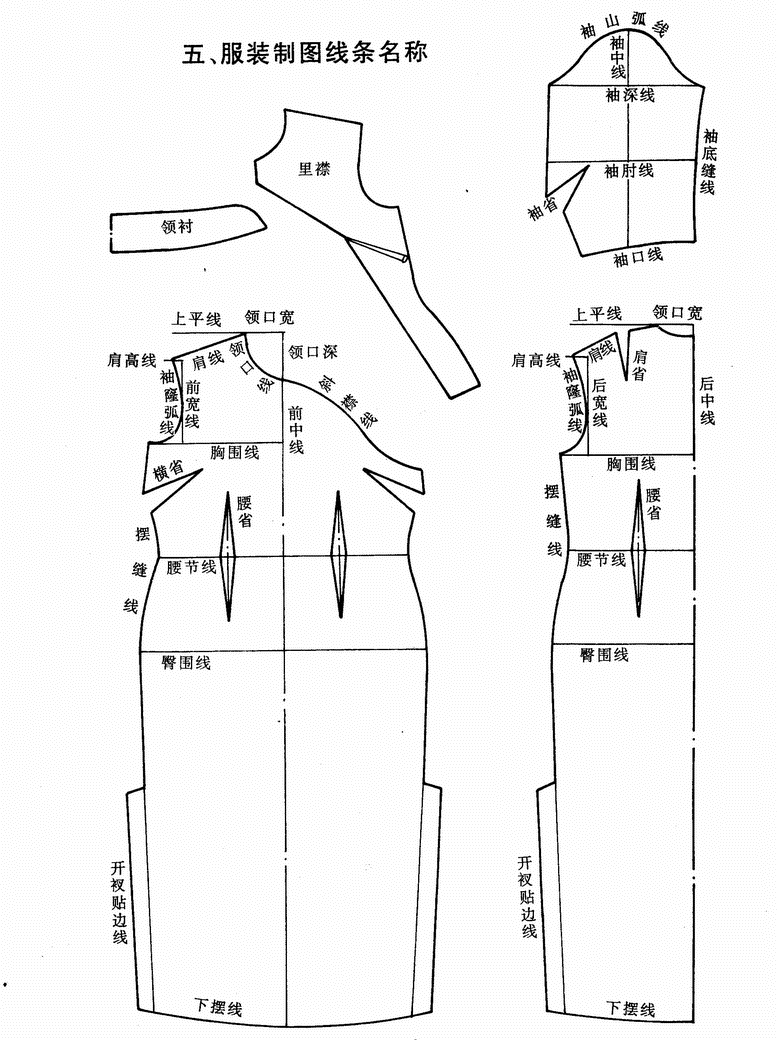
The cheongsam is not a wrap style. Here’s a Chinese diagram of the pattern piece shapes. Could you use that as a guide to adapting your favourite sheath dress pattern ?

Notice the Chinese diagram of the pattern pieces has the opening to below the armhole, and angled darts (‘french’ darts up from below bust level). Some of the other patterns have the opening into the armhole, and horizontal bust darts. I suspect the free non-Chinese pattern, with opening to below armhole and no dart that side, may be difficult to get to lay neatly against the body.

For a beautiful book, there’s Cheongsam by Pepin van Roojen, which includes a CD of dress and fabric images.

Japanese company Clover had templates to make the traditional Asian Knot buttons from cord or bias rouleaux, but even those seem to be discontinued.

If you look good in a more fitted shape, this may be a much better oriental style for you than the straight kimono. Use a border print or a brocade. It’s a challenge to find a pattern, but have fun making something exotic 😀

– – –

Originally written February 2011.
Patterns and links revised September 2020.

– – –

To get to main blog, click on red header.

= = =

Tweak your capsule for Spring 2011

March 5, 2011

Eileen Fisher’s designs for the coming season have appeared.

As usual there’s a ‘Dress in 5 minutes‘ section. Much the same as before. Some repeated shapes in the main catalogue, so I’m commenting on them. And as usual, the biggest style changes are the focus jackets. I’m writing a separate post on them this time. (This turned into several posts, starting here.)

– – –

‘Dress in 5 minutes’ basics

The ‘system’ for ‘dress in 5 minutes’ is very similar to last year, when I wrote several posts on it. So renew your basics.

Tops

Mostly low hip length sleeveless tops with wide or narrow straps (see previous ‘dress in 5 minutes’ tops post).

One new style element – a ‘racer-back’, see McCall’s 6288 by Rebecca Turbow.

”m6268-2”

A few thigh length tunics, one with sleeves (see winter capsule post for pattern suggestions).

Bottoms

And slim pants – though there is a choice of straight and wide legged pants in the main catalogue.

Just-above-knee length slim straight skirts. Eileen Fisher hasn’t chosen to go for this season’s trendy longer looser skirts.

See previous ‘dress in 5 minutes’ bottoms post for slim pant and skirt patterns.

– – –

Adding more interest

There aren’t any layering pieces in the ‘dress in 5 minutes’ section this time. But there are plenty of possibilities elsewhere in the catalogue. Several main shapes keep appearing (jackets I’m putting in a separate post).

Cardigans

Many knit cardigans. Similar styles to previous layering tops.

– short straight little tops, as last summer.

”shortjkts” Eileen Fisher

Easiest to find find patterns for these little jackets/ shrugs in the evening wear pattern sections, perhaps McCall’s 6245 below (or Butterick 5529 View C.).

”m6245”

There are some comments on wearing these short layering pieces in my previous post on ‘dress in 5 minutes’ layers.

– longer cascade or drape front knits

”cascadecardis” Eileen Fisher

Many Eileen Fisher versions of these, in different fibres and with slightly different fronts. Also many patterns. A typical one is McCall’s 6084.

”m6084”

Some other patterns in my winter capsule post.

Sweaters

Knit sweaters, mainly with mid chest or bust level v-necks,

”v-necks” Eileen Fisher

Add one of these wide curved V-necks to a favourite easy fit knit top pattern.

Or try these Hot Patterns Plain & Simple Relaxed Tees

”hot-tees2”

or Hot Patterns Metropolitan Sweaters

”metrosweater”

As well as open V-necks, you can add cowl and drape necklines.

”cowldrape” Eileen Fisher

Eileen Fisher call styles with an added fabric piece ‘cowls’, and styles with an integral dropped front ‘draped’ – perhaps cut on the bias.

There are several patterns for these in the catalogues, though not many with long sleeves. Try Vogue 8597, which has both cowl and drape neck versions.

”v8597”

Vests

Drapey front styles

”cascadevests” Eileen Fisher

Some pattern suggestions in my ‘current vests’ post.

Dresses and shirts

As usual, most of the Eileen Fisher dresses are simply longer versions of the sleeveless tops. There is one shirt dress, the only dress with sleeves.
And there are a couple of classic shirts in the Tops section.

Several patterns for classic shirts. Palmer-Pletsch McCall’s 5433 has fitting help.

”m5433”

This pattern combines a classic band shirt collar with 4 sleeves and 3 lengths, and could easily be lengthened to a dress.

You may be going for shirts because you prefer wovens to knits. Or if you can’t find knit fabrics you like. You can of course make all these top, cardigan, ‘sweater’ and vest shapes in wovens. Possible patterns in the other posts I’ve linked to.

Accessories

Big slouchy leather bags (Vogue 8680).

”v8680”

Classic leather belts,
Long wide textured scarves.

There’s currently a good video on ways of wearing scarves, in the videos section of the Eileen Fisher site.

– – –

Many continuing styles. So if you stocked up in previous seasons, on sleeveless tops, simple slim bottoms, and knit loose layers, you can continue to wear them.

It’s interesting fabrics and surface textures plus subtle details which give variety to the main shapes. There’s a good video showing some of the details and looks, a Spring Preview currently on the Eileen Fisher site.

There are several focus jacket shapes, so I’m planning more posts on those.

Eileen Fisher mainly uses black and greys. There are many other current colours and prints if you prefer them, see my post on looks for the coming summer.

– – –

The top runway designers tempt the big spenders by changing the fashion shapes every season. Pants seem to be the current most rapidly changing high fashion shape. But you haven’t got to change your clothes so much to look good (which is rather different from looking fashionable 😀 ).

Here’s a quote from top film costume designer Jenny Beavan :
“I was watching a catwalk show the other day and I found it fascinating because it’s obviously all drawn, made and then put on a model who is completely bland. They all look the same, walk the same, have the same hair, the same body shape – it’s all about the clothes. What I do is the absolute opposite. For me, it is all about the characters – the clothes are a useful tool.”
(BBC Radio Times, 26 Feb)
Some of the top designers even sketch models with tiny heads, while most real people need designs which draw attention to their face.

Wearing simple unfitted separates with few style elements, like these from Eileen Fisher, is not the right choice for everyone. We can choose our own favourite shapes, textures and trims. We can choose the colours and prints we most love. Dress to express your character 😀

– – –

Patterns and links available March 2011

Oriental style – Kimono

February 26, 2011

The ethnic style for the coming season (summer 2011) is ‘oriental’, according to the UK Elle magazine March issue.

Meaning the Japanese kimono and obi belt, and the Chinese cheongsam. This all got a bit long, so I’ve put the cheongsam in a later post.

Make from a border print or a chinese brocade. Also many oriental style prints available in quilting cottons. The Japanese use luxurious silks to make kimonos for special occasions.

– – –

Kimono

The classic kimono has a straight neck band, straight armhole, straight side seams perhaps with long slits, and big deep sleeves. So they’re simple to make, and often used as a beginners pattern. The simple shape also means they’re a popular starting point for embellishment.

Cut-on sleeves are sometimes called kimono sleeves, but that isn’t what is meant here.

If you prefer a Big 4 pattern, there are several from Simplicity.
Simplicity 4080 is a pattern for a geisha costume.

”s4080geisha1”

Simplicity 4134 (left) and Simplicity 2940 (right) are more fashion oriented versions.

”skimonos”

Japanese kimonos are traditionally cut in rectangles, using every scrap of what may be very expensive fabric.

For authenticity, try a Japanese pattern book. In Japanese, but the instructions have many illustrations. This book includes photos of how to wear kimonos, and how to tie the obi belt – simplified for modern wear.

There are two main western books in English. For focus on the clothes, try Make your own japanese clothes by John Marshall. Or Jenni Dobson’s book for kimonos used as the background for embellishment and art-quilting.

Do a book search for ‘kimono’ as there are some stunning books with photos of historic garments as works of art. And everything I’m saying is very simplified, as in Japan there are different styles of kimono for different purposes and with different names. Here’s a summary.

– – –

Independent patterns

There are many kimono styles from independent pattern designers. Here are a few with different approaches.

Folkwear 113 (left) is for a kimono and Folkwear 143 (right) is for a michiyuki, meant to be worn over a kimono.

”fw-japan”

Folkwear have several other patterns like the kimono, in their Asian section.

Deborah Brunner’s Ragstock patterns are similar in approach to a traditional kimono pattern. She doesn’t give you a tissue pattern. She tells you the size to cut fabric rectangles, then to cut sections off them to make the pattern pieces needed. Here are her Kimono (left) and Wrap shirt (right).

”rag_kimono-wrap”

Other similar Ragstock patterns are the Sashiko vest (left) and Signature jacket (right)

”ragstock_other2”
(not correct relative sizes)

(Sadly these patterns are no longer available, but I’ve left them in for ideas.)

Or how about retro patterns from a time when kimonos were high fashion. In the 20s, fashionable women were celebrating being able to wear loose clothing for the first time. EvaDress has kimonos from that era, dated about 1923 (left) and 1924 (right).

”evadress”

– – –

Obi belt

For a touch of oriental style wear an obi belt, traditionally tied round the kimono. In a very simple western version, it’s just a wide fabric strip.

Here’s a video on how to tie it.
The instructions for making one that she refers to are here.

Not at all the same as tying an authentic Japanese obi belt, which involves many yards of fabric and special supports and is considered an art form.

– – –

Sashiko quilting

Or for another taste of the orient, add some Japanese embellishment.

Japanese sashiko stitching traditionally has large white stitches on a dark blue ground. Here’s a clear tutorial.

The Folkwear 113 kimono is embellished with sashiko quilting.

”fw-sashiko”

There’s full information about sashiko quilting supplies, patterns and books at Shibori Dragon (about a third of the way down the home page).

Sashiko is not as heavy as western quilting, as it just uses 2 layers of fabric, no wadding/batting.

Here’s a stunning example of sashiko on a garment, the back of a jacket pattern from Betty Gant (sadly no longer available).

”gant-jacket”

– – –

I love the relaxed easy styling of the kimono shape and have collected a lot of information, so this got a bit long. My planned post on the Chinese cheongsam is much shorter !

P. S. YouLookFab has 2 posts on wearing a short kimono layer with casuals, here and here.

– – –

Patterns and links available February 2011

– – –

P.S. 2017. Kimonos are now very current, so there are many patterns for them. Here are just some :

Independents :
Burda Style, 121,06/2011
Ralph Pink Amayo Drape
Sewing Workshop Ikina
Sewing Workshop Plaza
Sew Over It kimono

Big 4 :
Butterick 6176
Simplicity 1318
search ‘kimono’ at Simplicity for many more, both fashion and costume.
Vogue 9115

= = = = =