Archive for 2011

Nancy Nix-Rice : 12 carefully chosen garments : colour and print

October 1, 2011

Were you bowed down by all the neutrals that Nancy Nix-Rice started her optimum wardrobe plan with ? (previous post on the neutral core). I wear mainly neutrals so was happy with it all. But here at last, something for people who love colour and print. Nancy adds 4 more items, and shows how to integrate them with your basic Cores.

– – –

Fourth step : a pair of tops in an accent colour
(Lesson 24)

Nancy next adds two tops in colour, both in the same or a closely similar accent colour.

Her example uses 2 garments in woven fabrics :
Under-layer – wide strap camisole.
Over-layer – long sleeved unlined blazer jacket.

Surprisingly difficult to find a wide strapped camisole pattern. Here’s Kwik Sew 2498.

”ks-2498-2”

Would you like a change of style for your over-layer ? Nancy Nix-Rice’s scheme uses over-layers with a closable front opening. Buttons or zip. So the garment can be worn alone for another look. The popular cardigan jacket styles with a continuous neckband or a cascade collar can only be closed with a belt, so won’t give you the number of alternative looks Nancy is going for.

You could use the long sleeved version of the Butterick blazer pattern I mentioned before. If you’re not a blazer person, Nancy (not Nancy Nix-Rice !) in a comment suggested Burda 8503. A good possibility with several necklines, sleeves, pockets – could be made in both blouse and jacket fabrics.

”burda

What accent colour are you going for ? Choose a colour that makes you feel good. A colour from your eyes will make them sparkle.

– – –

Fifth step : a 2-piece dress in print
(Lesson 25)

Finally, Nancy Nix-Rice adds a two-piece dress. Two pieces so they can be worn separately to give other combinations. In a print that combines your three colours : darker and lighter neutrals and accent.

Nancy’s choice for top is a sleeveless shell with bow neckline. A couple of bow collar blouse patterns in the new patterns for this autumn. Here’s Simplicity 2151.

”s2151”

And Simplicity 2154 is just the thing ! Provides you with two over-layer designs too 😀

”s2154”

Make sure the bow works with the necklines of your over-layers.

Nancy uses a ‘slim’ skirt, though not tight.

I have a post planned on two-piece dress patterns. Though the challenge is not finding the pattern but finding a print in the right 3 colours and your favourite print style!

Nancy has good previous lessons on colour neutrals, contrast and prints. She has added excellent advice on choosing prints and accessories according to your facial proportions and facial structure (angles or curves).

– – –

Summary

So that completes your basic 12 wardrobe items. Which Nancy makes into 95 different outfits.

– 4 under-layers, in each of the 3 solid colours and the print.
– 3 over-layers, in each of the 3 solid colours.
– 2 pants, in each of the solid neutrals.
– 3 skirts, in each of the neutrals and the print.

Nancy Nix-Rice has chosen very basic classics, essentially only 6 styles with slight variations :
– knit sweater set.
– woven sleeveless shell.
– woven jacket with short or long sleeves.
– woven skirt and pants.

So these key patterns, in your own choice of fabrics and sleeve lengths, plus a little knowledge about adapting them to different versions, are all you need to build your wardrobe 😀

On the other hand, Judith Rasband in ‘Wardrobe strategies for Women’ thinks you get most variety from a few clothes if each piece is clearly different in style as well as colour : “of two tops, one might have short sleeves and the other long sleeves; one might be made of woven fabric and the other knit; one might be a blouse and the other a shirt. . . Of two skirts, make one shorter and one longer, one pleated and one gathered, one a solid color and one patterned; of two sweaters or vests, make one a pullover and one a cardigan; of two jackets, make one a blazer and the other a wrap style.” (p.247)

Do you like variety ? Would you prefer similar or different ?

– – –

I have some comments on possible co-ordinated pattern sources and personal style, but these posts are getting so long I’ve separated that section off for later. Meanwhile, Nancy does give us a lot to think about. . .

– – –

Patterns and links available October 2011

– – –

Other posts in this group :
Neutral Cores, colours, personalising
Adding extras
Accessories
More thoughts
And related post :
Two-piece dresses

= = =

Drapes and swathes

September 24, 2011

Are you disappointed by the simplicity of most current styles ? Would you like to be more exuberant with fabric? There are some designers who meet your needs.

Haider Ackermann is king of the catwalk drapes this season (much ‘rock chick’ as well).

”haider-ackermannn”

And Elie Saab is king of the body fitting red carpet version. Mainly lace in his couture collection this season.

”elie-saab”

There are several patterns in this style, especially in the last couple of pattern issues. Nearly all for dresses.

And all for knits. It is possible to drape in wovens, especially good crepes. But it does need care with fitting to a specific body shape, so the drapes fall properly. Not something to be made quickly.

– – –

Dresses with draped necklines

DKNY Vogue 1250

”v1250-dkny”

Suzi Chin Butterick 5674

”b5674”

– – –

Dresses with drapes crossing at the waist

Vena Cava Vogue 1258

”v1258-vena-cava”

Michael Kors Vogue 1191

”v1191-michael-kors”

Donna Karan Vogue 1087

”v1087donna-karan”

– – –

Dresses with draping to side waist

There have always been many patterns which simply drape to side waist. Here are a couple of new ones.

Suzi Chin Butterick 5675

”b5675”

Badgley Mischka Vogue 1256

”v1256”

– – –

Body fitting dresses

Tracy Reese Vogue 1253

”v1253”

Tracy Reese Vogue 1252

”v1252”

– – –

Tops

Butterick 5563 is a top pattern that looks easy and interesting.

”b5563”

And here’s a new pattern from Hot Patterns, the Weekender Triple Torque knit tops.

”hp-triple-torque”

Or how about this, for people who think two-piece dresses are essentially dowdy 😀 Donna Karan Vogue 1259

”v1259”

– – –

Japanese pattern books

If you enjoy a puzzle, there are a couple of Japanese pattern books. Instructions in Japanese. . . I haven’t seen these specific books, but other similar books have full sized traceable pattern sheets, and excellent illustrations in the instructions.

Drape Drape Dresses

”drapedrape1-2”

Drape Drape Dresses 2

”drapedrape2-2”

(P.S. There’s now a Drape Drape 3.)

– – –

Mostly not for beginners ! but there are plenty of ways of having fun with drapey style if this is right for you 😀

– – –

Designer photos from Style.com
Patterns and links available September 2011

= = =

Nancy Nix-Rice : 12 carefully chosen garments : the Core

September 17, 2011

This year Nancy Nix-Rice is publishing an excellent series on optimising your clothes and accessories.

This summer she suggested a basic mix-and-match wardrobe of 12 items, combined into nearly 100 outfits.

Of course I thought it would be fun to look for patterns ! Though Nancy’s choices are such simple basics, if you have a pattern collection you probably have similar.

Nancy uses a ‘Core 4’ of basic clothes : under-layer and over-layer, skirt and pants.
She starts her wardrobe building with 2 of these Cores.

– – –

Step One : Core 4 in your best dark neutral : two tops
(Lesson 21)

Nancy starts with a basic group in your best dark neutral. She suggests your hair colour (Lesson 8).

In her Core there are two types of top, under-layer and over-layer. She suggests people with different styles might like :
– a T-shirt and hoodie.
– a tank and a linen shirt.
– a silk blouse and a tailored jacket.

The design of the over-layer is important. It :
– has a centre front opening which can be worn open or closed.
– ideally can be worn alone (perhaps with a camisole).
So you can get 3 different looks from one garment :
– worn alone.
– worn closed but not all the way up to the neck, so the under-layer shows at the neckline.
– worn open over the under-layer. (Nancy has a whole piece on the slimming effect of this look.)

Remember an over-layer needs to be large enough to wear comfortably over your under-layers. So it needs at least 1 to 2 inches more ease at the underarm.

All Nancy’s under-layers are sleeveless, but this isn’t essential. If you use under-layers with sleeves, the over-layer needs to have a larger armhole and sleeve.

The specific garments Nancy chooses are both knits in the same fabric :
– a sleeveless shell with jewel or scoop neckline.
– a short sleeved v-neck cardigan.

There are surprisingly few sweater set patterns which meet both over-layer ‘rules’. Many cardigans have too low and loose a neckline to be wearable alone. Kwik Sew 2759 is shown with the cardigan alone.

”ks-2860-both”

What are your ’go-to’ under- and over-layer styles ? I’m in the ‘short-sleeved top and shirt-jacket’ group. For a casual wardrobe you may like tee and hoodie. For a working wardrobe, you may want blouse and jacket.

– – –

First Core 4 in dark neutral : skirt

To complete your Core 4 of dark neutral items, you need 2 bottoms. Nancy chooses skirt and pants, but says you may prefer :
– a short slim skirt and a longer flowing one.
– dress pants and casual pants.
– shorts and capris.

Nancy chooses a straight skirt with a couple of knife pleats from hip level, so it looks like a six-gore skirt. There isn’t a current Big4 pattern like this. Easy to achieve if you know a little about pattern making.

Cynthia Guffey has several skirt patterns with front pleats. Her pleats open lower and the pleats fold in a different direction but they could easily be adapted. This is s-4002.

”s-4002”

There are several Big 4 patterns for multiple pleats, such as Butterick 4686.  These often have unpressed pleats, as short sassy styles.

”kilt”

There are many skirt patterns which add flare below hip level.  This gives a different silhouette. Simplicity 2451 was one of Pattern Review’s most popular patterns in 2010.

s2451

This first skirt is the basic skirt of your wardrobe. So choose your go-to skirt style. Do you prefer straight, a-line, flared ? thigh, knee, calf length ?

– – –

First Core 4 in dark neutral : pants

Nancy’s first pants are a classic tailored style. A good starting point could be Palmer-Pletsch McCall’s 5239 for Misses sizes, McCall’s 5537 for Women’s sizes.
These include fit guidance, and three levels of sewing difficulty.

”m5239”

What is your go-to pants style ? elastic or fitted waist ? natural or low waist ? waistband or faced waist ? front or back zip ? narrow, wide or shaped legs ?

– – –

Step Two : tops for a second Core 4 in your best light neutral
(Lesson 22)

Your second Core is in your best light neutral. Perhaps related to your skin colour. Co-ordination is easiest if your two key colours are related : dark and light brown, dark and light blue, dark and light green, etc. Or closer if you don’t look good in high contrast. (More on colours later.)

To start this second core, add another under-layer and over-layer. Nancy chooses :
– a sleeveless knit shell with v-neck and twist trim.
– a woven fabric short sleeved notched collar unlined jacket.

Under-layer : There are many twist front patterns for knits and wovens. Most have sleeves. Raise the underarm if you want to make a sleeveless shell from a sleeved version.

An under-layer needs a twist that’s not bulky under a closed over-layer. And a v-neck that’s not too deep to show when the over-layer is closed.
Perhaps Jalie 2788 for knits (leave off the frill).

”jalie2788”

Any added style element makes co-ordination more difficult. Instead you could use another simple top with different neckline – boat, scoop, wide V ?

Over-layer : a short sleeved notched collar unlined jacket.
Many patterns for blazers. The easiest unlined one perhaps is the short sleeved version of the 2-hour jacket, Butterick 4138.

”b4138-2”

Hmm this one-button jacket isn’t ideal as it can’t be worn alone. Better a pattern which closes up to bust level.

– – –

Step Three : bottoms for your light neutral Core 4
(Lesson 23)

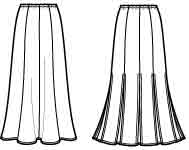
For her second skirt, Nancy chooses another pleated style, this time with box pleats from a lower level. You could adapt Simplicity 4881. Longer skirts are current, but you could make it shorter and leave out the extra seams and pleats.
”s4881”

What would be a slight variant on your favourite skirt style ? Or another skirt style you would love to include ? Or just change fabric type ?

It’s easiest to co-ordinate if all garments of the same type have the same silhouette, see my post. This isn’t essential. But if you choose one straight and one flared skirt, for example, they may not combine equally well with the tops.

Nancy doesn’t describe her second pants style. Use a classic pattern again. Or casual elastic waist pants.

– – –

Your favourite background colours

For easiest co-ordination, Nancy Nix-Rice says it’s best to start with all 4 items of a core, or pairs of (top + bottom) or (under-layer + over-layer), in colours that are closely similar.

Nancy uses a darker and a lighter neutral for these 8 garments. But neutrals may not warm your heart. Imogen Lamport has a good section on colour personality. Perhaps your preferred wardrobe building background colours are ‘basics’ like plum, teal, peach, aqua, rather than neutrals. A ‘basic’ for one person may be an ‘accent’ for another !

(P.S. Imogen Lamport now has a video on choosing neutrals.)

Nancy mentions some problems when you use high contrast colours. Some stylists don’t use high contrast for this reason, see Imogen Lamport’s videos. No need to use high contrast if low contrast looks better on you.

The Second Core items are lighter, but don’t need to be exactly the same colour (though Nancy shows clothes that are). Add interest by varying the colour slightly. Or use another colour for some pieces. Different but compatible shades. Easiest extra colour is one related to your neutrals, such as rust with dark brown and camel. To follow Nancy’s scheme, choose colours close enough to keep your ‘Color Columns’. And background shades. Nancy adds accent colours later !

– – –

Your own core items

Of course we haven’t got to follow Nancy’s suggestions exactly ! but use them for inspiration. So what is your core wardrobe group ?

Judith Rasband in ‘Wardrobe Strategies for Women’ has a smallest ‘cluster’ of 5 items : add another under-layer top.

Or make a slightly different group of 8, also with many combinations. A Nordstrom brochure on how to wear a blazer shows :
dark fabric : jacket, skirt, pants, wrap dress.
light fabric : top, skirt, pants.
evening fabric : tunic.

What are your own core basics ? dresses not pants ? tunic and vest as well as jacket ?

– – –

Your own style

Nancy has chosen the most classic of classics for her examples. Not for everyone.
Do you prefer softer/ more relaxed/ sporty/ striking clothes ?
I’ve already written much about personal style, summarised in recent posts on choices and modern personal styles.

– – –

Co-ordination

So far I’ve mentioned 8 of Nancy’s 12 wardrobe items. Read Nancy’s advice on combining and styling these. She makes 24 different looks from these 8 garments.

Nancy’s core wardrobe has two groups of basics : one group darker and one group lighter. Background colours rather than attention grabbing accents. Plus accessories which link the two colours by including both.

And everything co-ordinates with everything else. Easiest to achieve this with :
– few silhouettes.
– few fabrics.
– few added style elements.
– a small range of colours.

These background basics are very simple.  Not exciting statement clothes. YouLookFab has a piece on using classics as the background for other pieces. I have a post on the power of the boring.

Cheer up 😀 Nancy goes on to add colour and print to the background basics. My next post in this group is planned on that.

– – –

Patterns and links available September 2011

– – –

Other posts in this group :
Accent colour and print
Adding extras
Accessories
More thoughts
And related post :
Two-piece dresses

= = =

So many choices

September 10, 2011

It’s not at all simple to find the clothes that work best for us. There are so many choices. And much of the advice out there isn’t good for everyone. So we have to try things out, and be able to move on when they aren’t right.

– – –

What helps us look good

Body shape :
pear/ triangle, inverted triangle, rectangle, apple/ round, hourglass.
There are also more detailed distinctions, such as inverted triangles with wide shoulders or large cup size. I found Trinny & Susannah’s ‘Body Shape Bible’ very helpful on understanding my short-waisted pear shape, but some people don’t like that book. Many details of our body shape affect what looks good on us. And we only learn by trying and looking. (See my post with comments on pant styles, for two very different detailed accounts of ‘what works’ – fascinating.)

I have a whole lot of body shape features which aren’t dealt with by ‘easy fitting’ aids and aren’t mentioned in most books on fit. I’ve gradually learned about most of my fitting needs, but had some I was stumped on. Happily I’ve recently found the ‘big bible’ book “Fitting and Pattern Alteration” by Liechty, Rasband and Pottberg-Steineckert. It’s a great relief to know what my final fit issues are and what to do about them.

Colouring :
Many people like the seasonal approach to personal colour. But it doesn’t work well for me – I’m a mixture of warm and cool. I use the colours from David Zyla ‘The Color of Style’. (Colours from hair, skin, eyes – my colour check is a lock from my salt ’n pepper hair.) Though I don’t use my colours in the way he suggests. And that too doesn’t work well for everyone. There are many other methods. Some people only manage to find ‘their’ most flattering colours by experimenting.
There’s also good advice on colour and contrast from Nancy Nix-Rice.

Imogen Lamport has much useful guidance about colour and body shape in her blog.

– – –

What helps us feel good

Key items :
Nearly all wardrobe plans are based round : jacket, top, skirt, pants.
Very rarely there’s a mention of : jacket, dress, top, skirt.
But what I wear is never mentioned : blouse, overshirt/ tunic, vest, pants. Jackets only for outerwear. Skirts only for special occasions. Happily the pattern companies are aware of this style, even if most wardrobe plan writers aren’t !

What are the items you like to wear ?
See my post on a personal wardrobe plan.

Personal style :
So many books on finding your style. Many writers use a basic four categories : classic, romantic, casual, dramatic. Yes I can sort of see myself here. But many women need different styles at different times :
work : classic
dressy evening out : romantic or dramatic
at home/ weekend : casual
exercise : sporty.
Some authors (such as David Kibbe and Judith Rasband) put all styles on a line from soft unstructured to angular tailored. I’m not happy with the idea that all human variety is one-dimensional !

And there are many different versions of the main style groupings – what type of ‘dramatic’: edgy, arty, fashionista, red carpet, vintage, hip-hop, goth, boho. . . ? I find it helpful to understand how my ‘minor’ styles affect my ‘major’ style. Okay I definitely wear casual clothes, comfortable and practical, but not sweats and sports gear or tees and jeans. I choose tunic-vest-pants rather than dresses or tailoring. But I like the soft textures and heirloom trims of a romantic, and the quality, basic shapes and neutral colours of a classic.

For me, in most wardrobe advice books there’s too little on ‘casual’ styles. Many writers think ’casual’ means people who don’t care about clothes and need to brush their hair, put on mascara, and generally sharpen up. But that misses the majority of modern styles, which include many ways of feeling relaxed yet looking stylish. See my previous post on styles in the English shops this season. For ideas from a professional stylist see YouLookFab’s posts on individual style. She also has many interesting questions in her Team X or Team Y section. And there’s Imogen Lamport’s personal style section.

Lifestyle :
Thankfully this is a simple option for me. I’m retired and wear informal clothes, which suits my personal style. Little need for businesslike, dressy, or exercise wear. Nowadays lifestyle is an area of clothing decisions where I don’t have to deal with a whole lot of complications 😀 People who love tailored clothes have much more difficulty finding a style they’re happy with when they retire.

Colour personality :
Do you prefer brights or neutrals ? contrast or monochrome ? see Imogen Lamport.

Clothing values :
What is most important to us about clothes – cost, comfort, fashion, effect on others ? see my post.

Wardrobe variety :
Do you like a lot of variety in your styles ? Do you have many different moods to dress for ? Do you like a constant supply of new clothes ? Or do you want a simple wardrobe ? Do you want many different outfits, or is that not important for you ? Do you like your clothes to be co-ordinates ? or to have free choice ? To dress without thinking ? or to enjoy finding new combinations and new accessory styling ? Or both, on alternate days 😀

And do you like to wear simple clothes, or ones with added style elements or embellishment ? No extras, or many accessories such as scarves, belts, jewellery, eye-catching shoes and bags ? A simple outfit or a complex one ?

Sewing style :
Do you prefer sewing that’s easy or advanced, quick or slow, knits or wovens. . .
So which are the clothes it would be better to buy ?

All these points to consider – I can fall in a deep pit of ‘analysis paralysis’. It’s a great relief to make dolls’ clothes – they don’t have to fit or be flattering or even co-ordinate 😀

What is your method for helping yourself to ‘just do it’ when you get stuck ?

– – –

So many choices, no wonder we have difficulty sorting it all out ! I usually don’t fit the simple alternatives. Don’t know whether this is a cause for despair, or whether it just makes it all interesting 😀 At least, after several years of trying things out and exploring, I am beginning to know what is right for me.

Ruthie has recently written about her explorations of this too, in her blog.

I’ve learned a lot from all the times I’ve had to rescue myself from forcing myself to follow advice that is not right for me !

Take it slowly and enjoy each ‘aha’ 😀

– – –

Links available September 2011

= = =

Progress : there are some pictures in next week’s post !

= = =